
Metal does not have to sink.
That is the idea in a new research paper from RMIT University and CNAM in France. The team demonstrated a titanium-polymer lattice that can float in water, keep floating after serious damage, and still behave like a metal structure rather than sink to the bottom.
Floating hardware today usually requires sealed plastic, foam, hollow metal chambers, or some combination of all three. The weakness is pretty obvious: once water gets into the wrong place, you’re sinking.
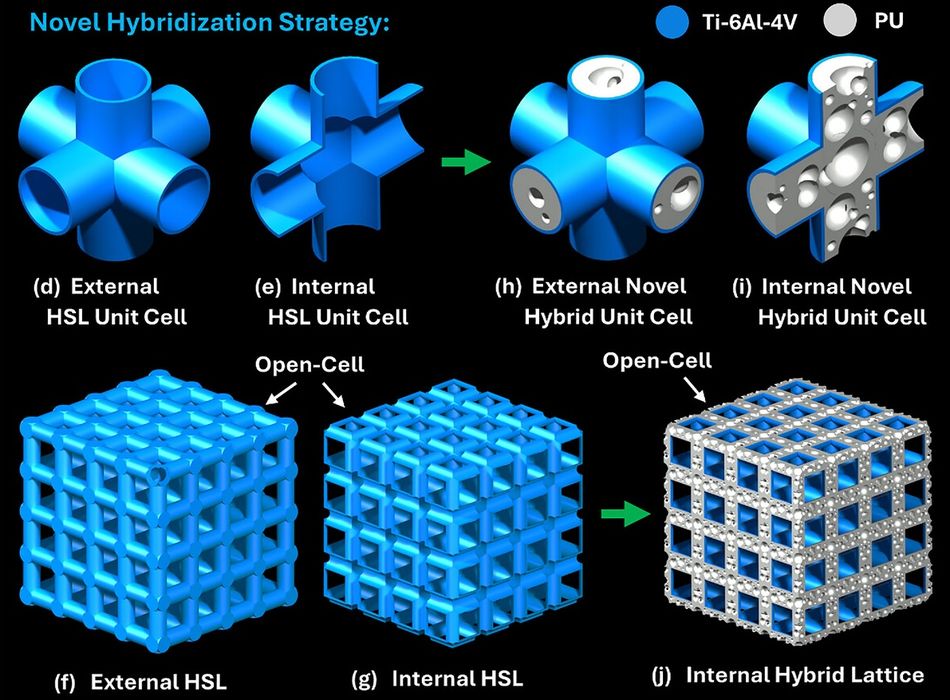
RMIT begins with a titanium alloy lattice made by laser powder bed fusion. They printed hollow struts in Ti-6Al-4V, leaving a network of internal channels inside the metal framework.
An open metal lattice can have a very low apparent density, but water can run through all the open spaces. Once the water is inside, the object behaves like any wet metal object: Down it goes.
Their really clever idea is to fill only the hollow titanium struts with expanding polyurethane foam. The exterior remains an open lattice, so water can still pass through the visible gaps. But the struts become sealed, foam-filled flotation elements distributed through the whole part.
Think of it as a buoy where the flotation is not one big sealed chamber. Instead the flotation power is spread through the structure itself.
The researchers call the design measure “skeletal density.” If the total skeletal density is below the density of the water, the structure can float even while water flows through the open cells.
The team tested lattice designs with internal channel diameters from 2.5 to 4.0 mm. The hybrid lattices below the freshwater threshold floated for more than two months. The unfilled titanium lattices sank.
The most interesting demonstration was a small 3D printed marine buoy, about 100mm tall and 85mm wide. It floated in natural seawater and remained stable even in turbulent testing, including rotation up to about 45 degrees, without any external aids.
The damage test result is even more interesting. The hybrid lattices kept floating after cracking, node fracture, and even a complete layer fracture. They finally sank only after severe compression compacted the structure.
That is a very different failure mode from a a conventional flotation system. Crack into a conventional hollow buoy and water can instantly flood the cavity, causing a sink. Crack this kind of floating lattice and the many tiny foam-filled regions can continue excluding water: it keeps floating!
Could the availability of materials like this change maritime design? Will we see unsinkable ships made with this tech? Possibly, but not by making boats out of printed titanium next year. A more likely concept is tougher floating sensors, buoys, jetties, offshore fixtures, aquaculture hardware, and subsea components where corrosion resistance, strength, and survivable buoyancy are most important.
The paper reports that the lowest-density Ti-6Al-4V plus polyurethane lattice reached a bulk density of about 0.27 g/cm3 and a compressive yield strength of 10.3 MPa, higher than density-scaled comparisons to high-density polyethylene and 316L stainless steel. It also lost only 0.15% of its mass after two weeks in natural seawater, with strength declining by less than 1%.
This is clearly an important advance that will certainly open up a new type of application for 3D printing.
