
Researchers connected blockchain verified IoT monitoring to resin 3D printing safety data.
The paper looks at a very specific but important problem in resin 3D printing: volatile organic compound emissions. This is a class of chemicals that appear during printing, some of which can be toxic. Vat Photopolymerization (VPP), including stereolithography and Digital Light Processing (DLP), is well known for surface finish and accuracy, but the resin workflow is not completely safe.
Many workshops already deal with ventilation, gloves, washing, curing, and waste handling. But is there a trustworthy digital record of what happened in the machine enclosure during a print? That could be critical if the work is regulated, audited, or performed in a shared industrial environment.
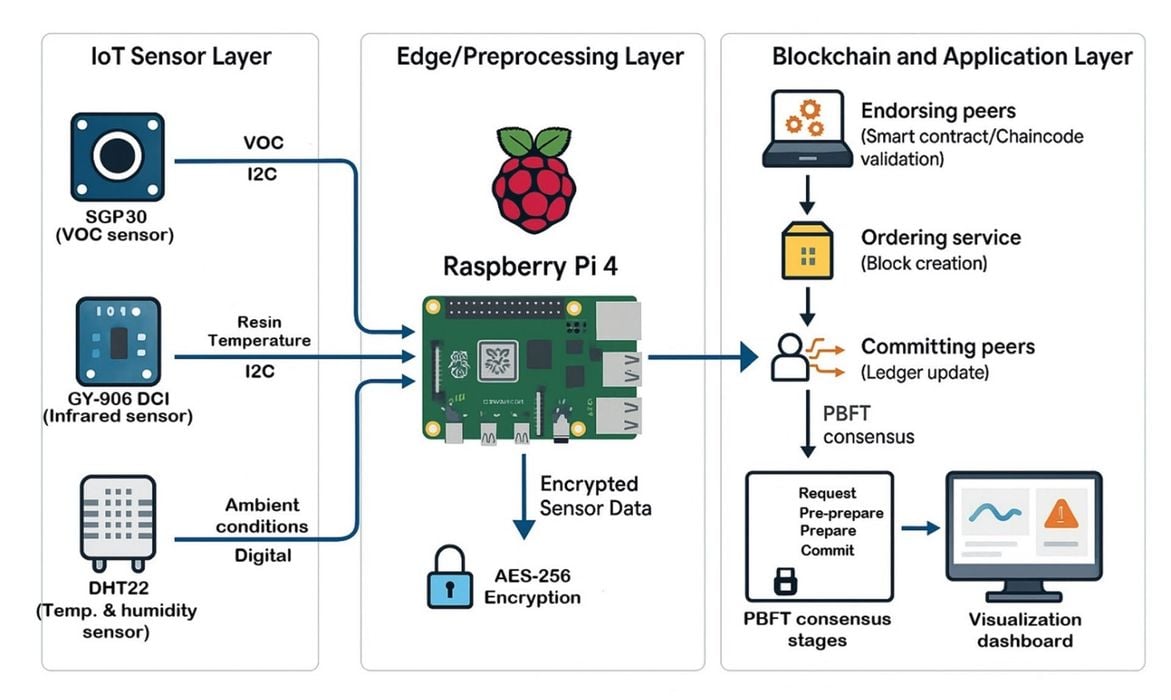
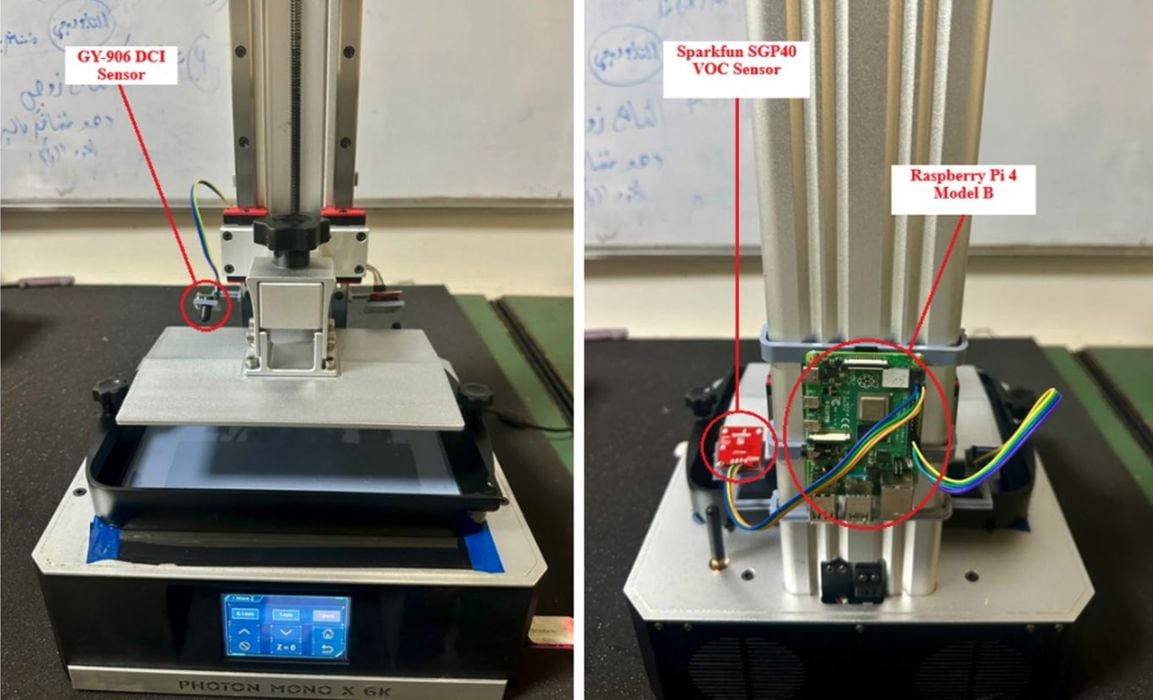
The researchers built a test system around an Anycubic Photon Mono X 6K, a Raspberry Pi 4, and an IoT sensor array. Sensors tracked VOCs, resin temperature, ambient temperature, and humidity, with data flowing into a private Hyperledger Fabric blockchain network.
A Ledger For Air Quality Data
The blockchain angle is not at all about cryptocurrency. It is about making sensor records harder to change after the fact. In this setup, encrypted sensor payloads were validated by smart contracts, hashed, and committed to a private ledger with Practical Byzantine Fault Tolerance consensus.
A fully public blockchain would be hard to justify for a printer enclosure, but a permissioned network between operators, quality staff, and compliance officers is more feasible. In other words, this is a digital audit trail.
The reported performance is fairly strong for this class of monitoring. The network averaged 487.2 transactions per second, with transaction latency of 245.3 ms and total end to end sensor commitment latency of about 441 ms. Data integrity verification was reported at 99.99%.
The researchers also compared the system with a MySQL database under simulated tampering. Hyperledger Fabric detected 100% of 20 tampering attempts, while the centralized database detected 13%. Smart contract alerts responded in 1.8 seconds, versus 258.7 seconds for manual monitoring.
The More Interesting Result Is Not The Blockchain
The emissions findings may be more useful than the ledger itself. The experiments found exposure duration had the strongest relationship with VOC emissions, followed by light intensity. Layer thickness had little or no significant effect.
That is useful because exposure time and light intensity are parameters users can actually adjust, within the limits of print success. If a resin process can be tuned to reduce emissions without wrecking accuracy or mechanical properties, that is something no one knew before.
The system generated 127 alerts with 96.8% alert accuracy and a 3.2% false positive rate. That sounds promising, but a production workshop would want to know how those thresholds were selected, how often sensors drift, and how resin chemistry changes the behavior.
It would be quite interesting to see how this system works in a real factory, because there airflow can be more complex, and of importance, safety-wise.
Can this concept become boring infrastructure? If a blockchain system adds auditability without adding any operator work, it could help service bureaus and regulated operations prove that environmental monitoring actually occurred.
Resin printers need better records of what workers are breathing.
