
It turns out that FFF printed dovetail joints are not always the strongest way to join multi-material parts.
That is the discovery in a recent paper from researchers at the Gheorghe Asachi Technical University of Iasi and collaborators in India and Romania. They printed tensile specimens combining UltraFuse PLA Blue with a PLA/PHA filament, then tested whether the boundary between the two polymers was a weak seam or a load bearing feature.
Multimaterial FFF is often used for parts that need a rigid region beside a tougher, flexible, or functional one. Yet anyone who has attempted a dual material print knows the problem: two filaments can look neatly joined on the build plate but separate quickly under load. Different melt behavior and limited polymer diffusion can leave an interface susceptible to delamination.
The team compared four deliberately mechanical joints: a simple T, a mirrored double T called 2T, a dovetail, and a double dovetail. All specimens used 100% infill and were printed flat on an Ultimaker 3 Extended at 215C, with a 60C build plate and 0.3 mm layers.
Move The Crack Away From The Join
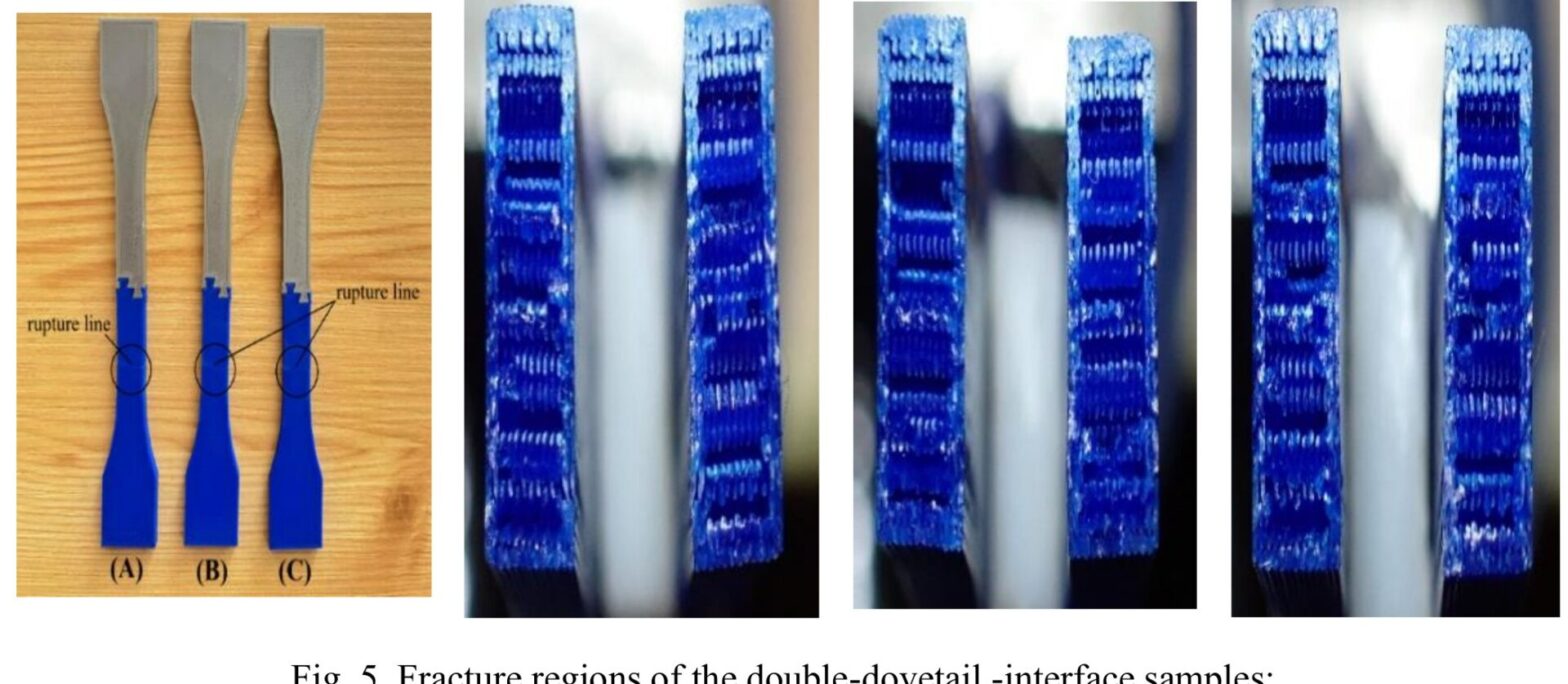
In the 2T and double dovetail samples, cracks propagated through the PLA region instead of following the material contact plane. That suggests the interlocking geometry transferred load effectively enough that the interface was no longer the first failure point.
The double dovetail produced the best balance of strength and elongation: 27.09 MPa tensile strength and 5.12% strain at break. Its wider contact region and repeated interlocks apparently spread the load and allowed progressive fracture instead of a quick peel apart.
Surface profilometry supported that explanation. The better performing 2T and double dovetail joints had smoother, more consistent topography and better filament continuity. The simple T and dovetail shapes showed sharper height changes and depressions, which are plausible voids or poorly fused regions where cracks can begin.
In other words, CAD geometry can partly compensate for imperfect material compatibility. For a packaging component, biodegradable fixture, or lightweight product with locally tailored behavior, that may be more practical than waiting for a perfectly compatible pair of filaments. A slicer or design tool that generates interlocks at material boundaries might eventually be as valuable as a larger dual nozzle machine.
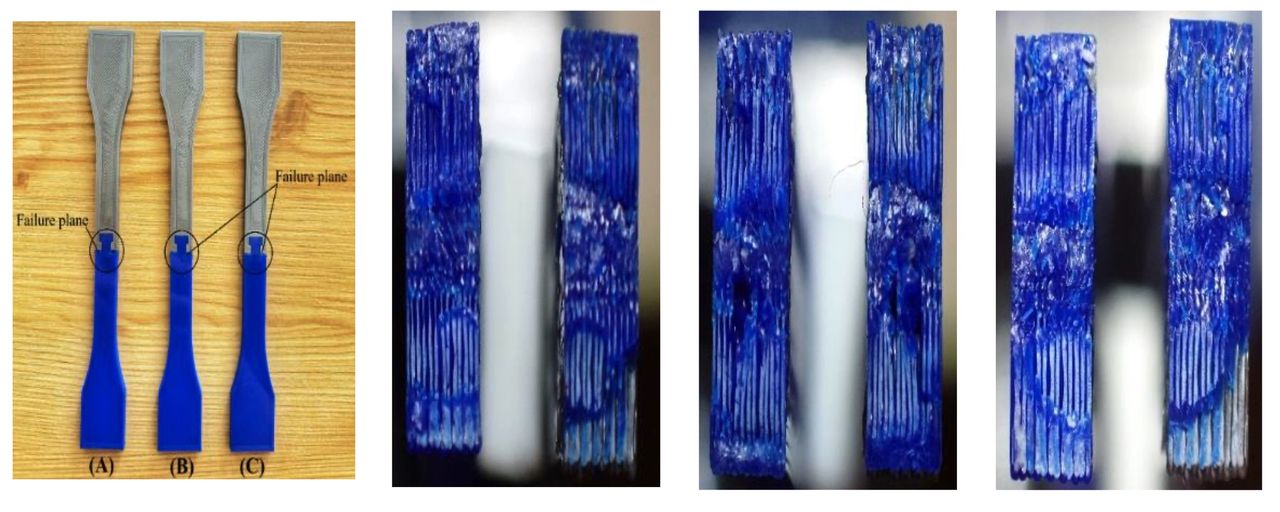
The simple T delivered the highest measured ultimate strength, 30.02 MPa, despite failing largely along the material boundary. The researchers associate that result with its four favorably oriented shells, but it fractured at only 3.39% strain. Meanwhile, the plain dovetail, also with four shells, was the weakest specimen at 15.23 MPa because its narrowed sections concentrated stress.
So a conventional tensile ranking alone would give the wrong design advice. If a part must survive a sudden overload without separating into its two material halves, failure location and ductility need as much attention as the target strength.
This research provides a reminder for multimaterial FFF part designers: a dovetail is not automatically a tough joint.
