

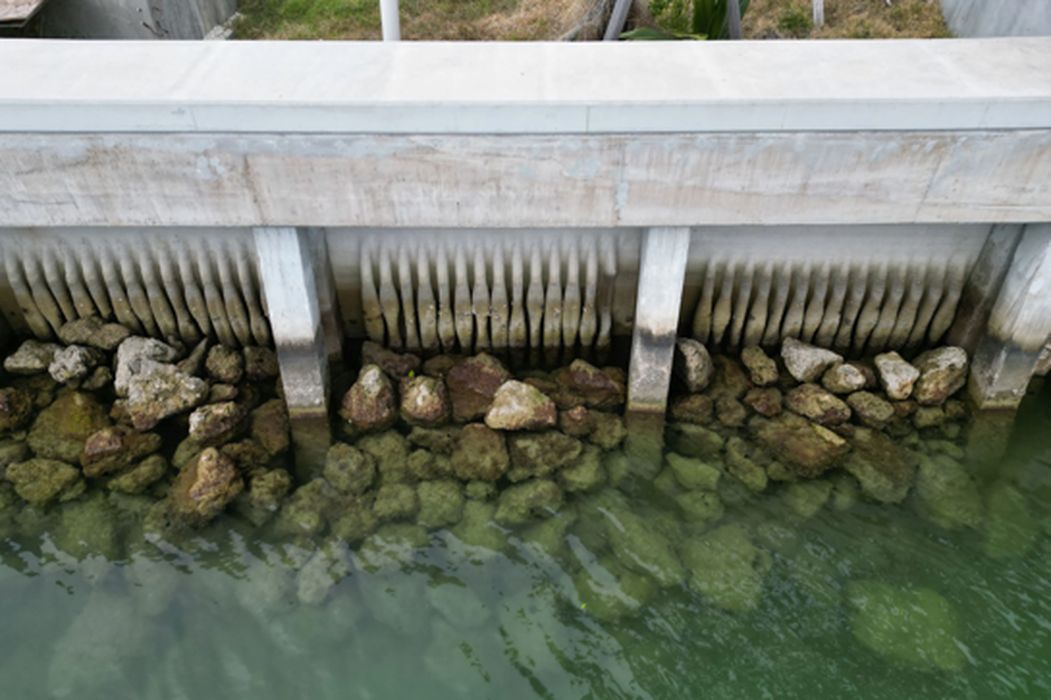
Charles R. Goulding and Andressa Bonafe explore the innovative world of 3D printed living seawalls.
In July 2026, Miami-based Kind Designs announced a new funding round to expand production of its 3D printed living seawalls and enter new coastal markets. The investment marks an important transition for a company that began by rethinking the conventional seawall and is now developing a broader platform for marine infrastructure. By combining robotic concrete printing with biomimetic design, Kind Designs aims to protect shorelines while creating surfaces that can support marine life, an approach that is gaining attention from property owners, municipalities, hospitality groups, and federal agencies.
Expanding the Living Infrastructure Model
A little over a year ago, we examined the work of Kind Designs, a Miami-based company using large-scale additive manufacturing to rethink conventional seawalls. The concept was already compelling: replacing flat concrete surfaces with biomimetic structures designed to protect shorelines while also supporting marine life. Since then, Kind Designs has expanded its customer base, product portfolio, and production ambitions, making the company an even more significant example of how 3D printing can move from an innovative coastal application toward a scalable infrastructure platform.
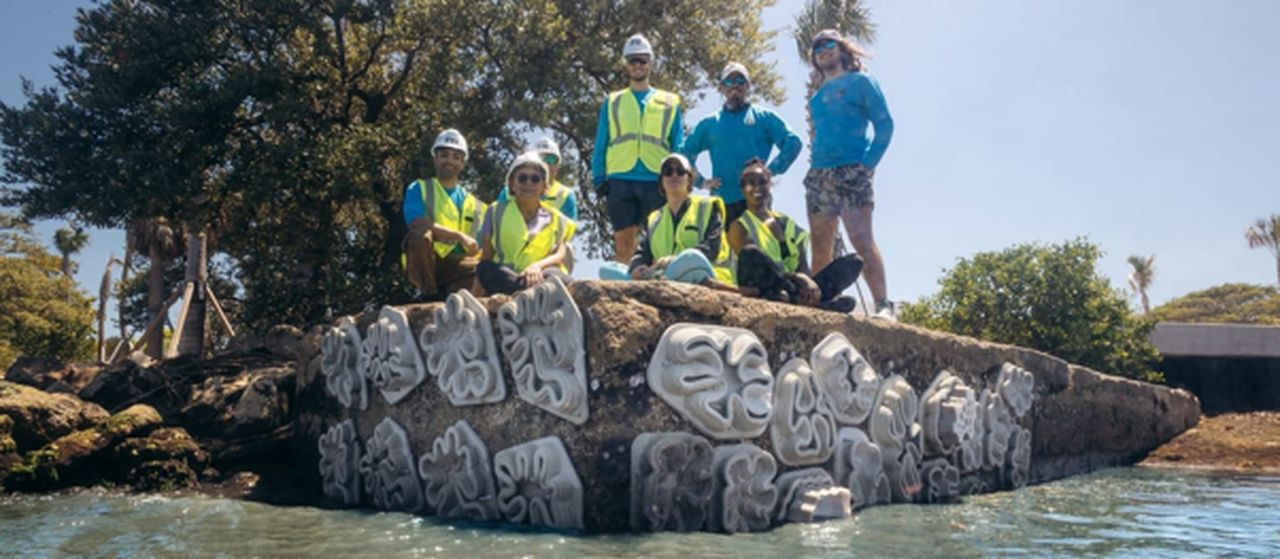
Kind Designs produces 3D printed Living Seawalls with surfaces modeled after natural environments such as mangrove roots, rocky shorelines, and reef habitats. While designed to perform the structural role of conventional precast seawalls, their textured geometries create ledges, crevices, voids and sheltered areas where a variety of marine organisms may find refuge.
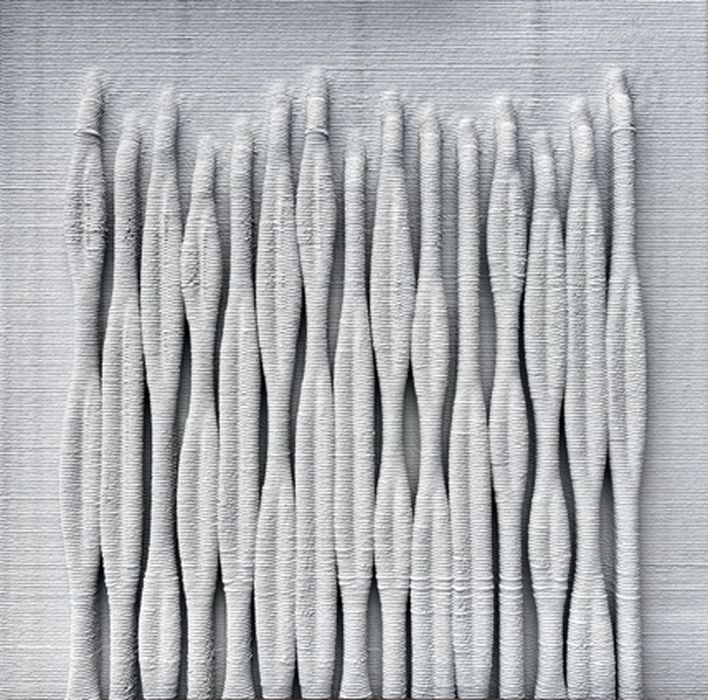
The company describes the structures as direct replacements for standard concrete seawall panels, using a 5,000 psi mortar and customizable reinforcement options including steel, galvanized steel and basalt. Kind has also tested both hydrodynamic and structural performance at the University of Miami. In wave-tank testing at the SUSTAIN Laboratory, a four-inch “Mangrove Root” Living Seawall produced lower wave reflection than a conventional flat wall in 65% of test conditions, with an average reduction of 45%. Separate flexural testing at the Structures and Materials Laboratory found that the reinforced 3D printed panels met or exceeded the target structural requirements for the seawall designs evaluated, while also informing Kind’s continued exploration of reinforcement systems better suited to corrosive marine environments. Kind’s scope now extends beyond full Living Seawall panels. Its growing product portfolio includes modular Living Seawall Tiles designed to retrofit existing seawalls, artificial reefs, and Living Shorelines, with installations serving residential properties, parks, municipal waterfronts and restoration initiatives. One example is a living shoreline project developed with the Billion Oyster Project on Governors Island in New York, where Kind co-designed ten 3D printed oyster reef structures around the organization’s habitat-restoration goals.
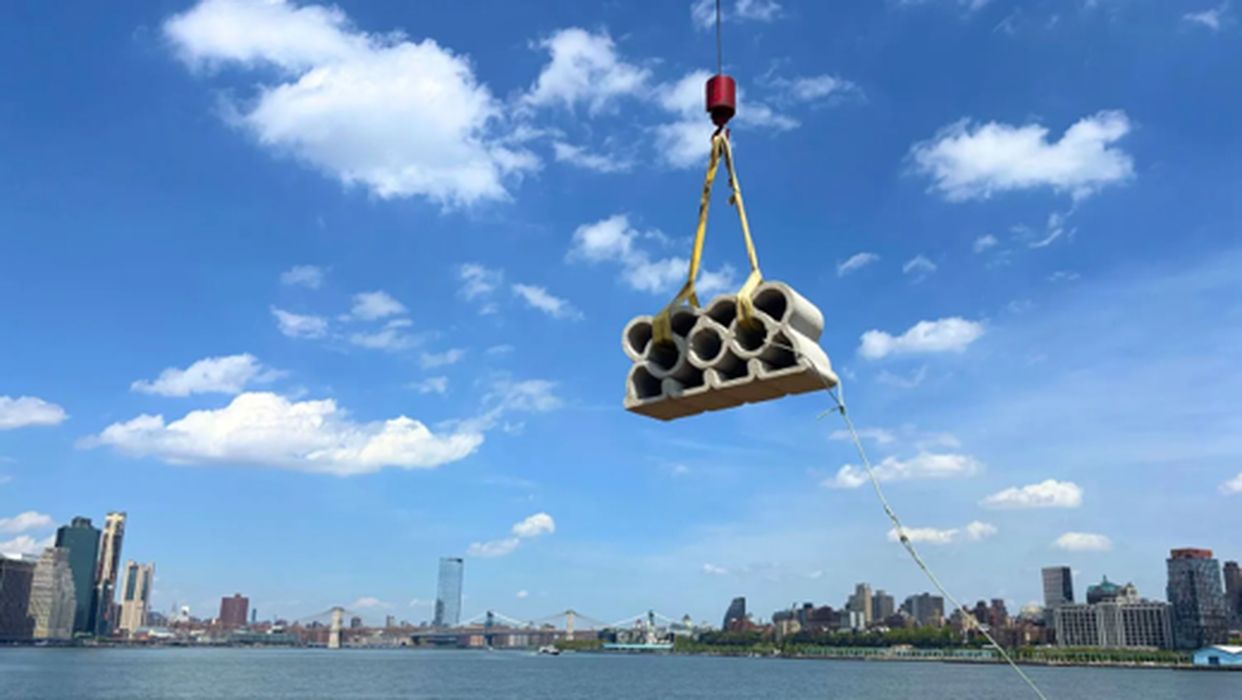
This broader product range reflects the variety of challenges found along different coastlines. A residential property replacing an aging seawall has different requirements from a municipality restoring a public waterfront, a hotel protecting a coastal site or a federal agency evaluating infrastructure in a high-energy marine environment. Additive manufacturing allows Kind Designs to adapt geometries to those conditions without developing an entirely new set of molds for each project.
Why Additive Manufacturing Matters
The value of 3D printing in this application extends beyond manufacturing speed. Marine infrastructure must address structural loads, installation constraints, water chemistry, local species, tides, sedimentation and wave behavior. The ideal surface for oysters in Biscayne Bay may differ from a design intended for corals, mangrove-associated organisms or a shoreline with strong sediment accumulation.
Robotic concrete printing allows engineers to change surface depth, rugosity, openings and internal geometries directly in the digital design. The same manufacturing system can then produce different panels for different environmental or structural conditions. This makes ecological customization more practical and creates opportunities to refine designs as monitoring data become available. The process also supports faster iteration. New panel geometries, mortar formulations, reinforcement systems and printing parameters can be produced and tested without first fabricating expensive dedicated tooling. For an emerging infrastructure category, where performance data and regulatory requirements are still developing, this ability to move quickly between design, production and field testing is particularly valuable.
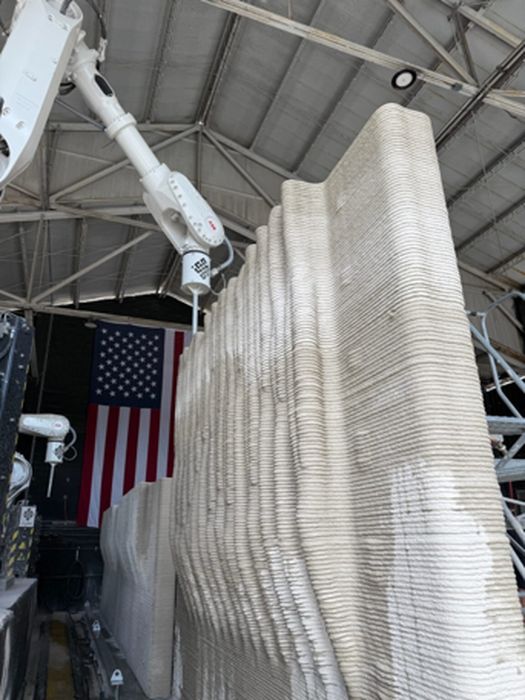
Kind Designs’ expansion plans illustrate the relationship between additive manufacturing and scale. According to the company’s latest funding announcement, it plans to triple production capacity at its seawall factory by increasing its robot inventory and scaling production lines. Because its products are produced through digital fabrication, that expansion can preserve an important advantage of additive manufacturing: the ability to manufacture different geometries without relying on dedicated molds for every design. If demand develops as projected, the company could provide an important demonstration of how large-format additive manufacturing can combine repeatable infrastructure production with project-specific design flexibility.
Miami’s Coastal Additive Manufacturing Ecosystem
Kind Designs is part of a broader concentration of coastal 3D printing activity in South Florida. As discussed in our recent examination of Miami and Austin as emerging additive manufacturing centers, Miami’s exposure to flooding, erosion and storm surge has created an unusually strong environment for testing digitally fabricated infrastructure.
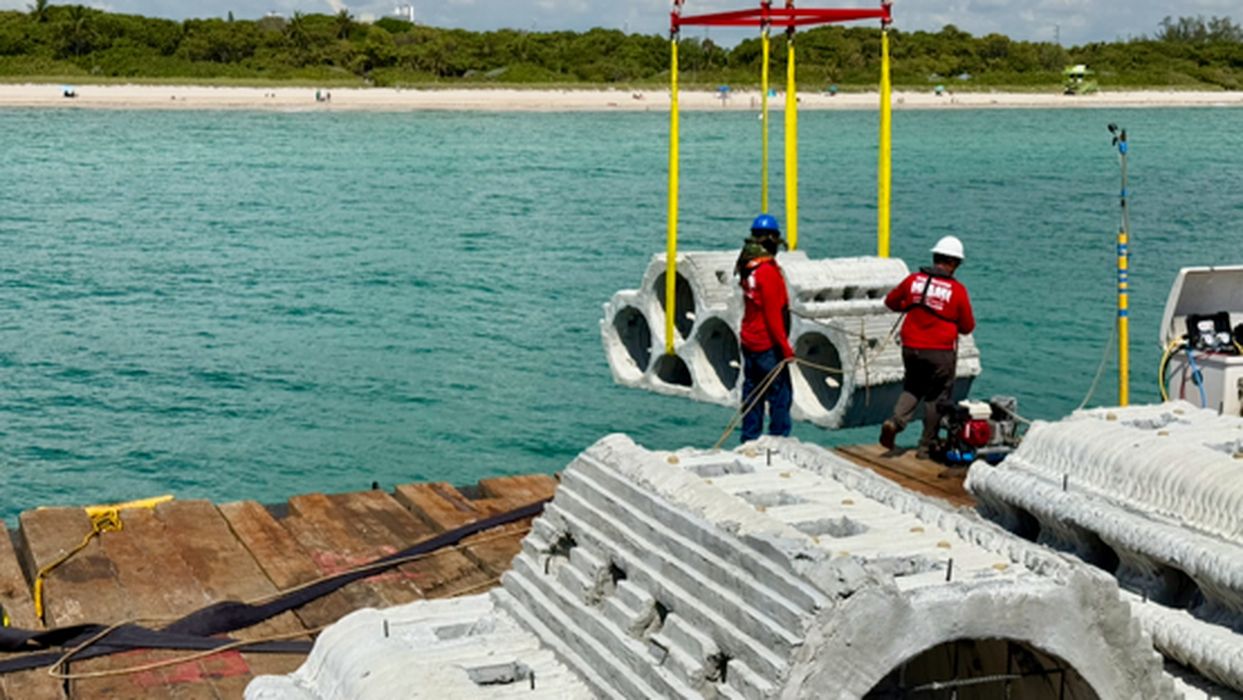
In June 2026, researchers from the University of Miami and their collaborators expanded the ECoREEF project off Miami Beach by deploying three additional 3D printed SEAHIVE structures combined with restored corals. The modules combine perforated structural geometries with corals and other biological components. Researchers are studying their ability to reduce wave energy while supporting reef restoration.
Florida International University is pursuing a related approach through its BioCAP project. In July 2026, FIU researchers installed robotically printed modular tiles on an existing seawall at Miami’s Morningside Park. The tiles incorporate ridges, crevices, grooves and small pools designed for organisms occupying different tidal zones. Researchers will monitor biological colonization, water conditions and the tiles’ interaction with wave energy.
These projects use different designs and commercialization models, but they reinforce the same regional trend. Miami is becoming a working laboratory for the use of additive manufacturing in coastal engineering, with startups, universities, public agencies and marine contractors developing complementary approaches.
A Wider Movement in 3D printed Marine Restoration
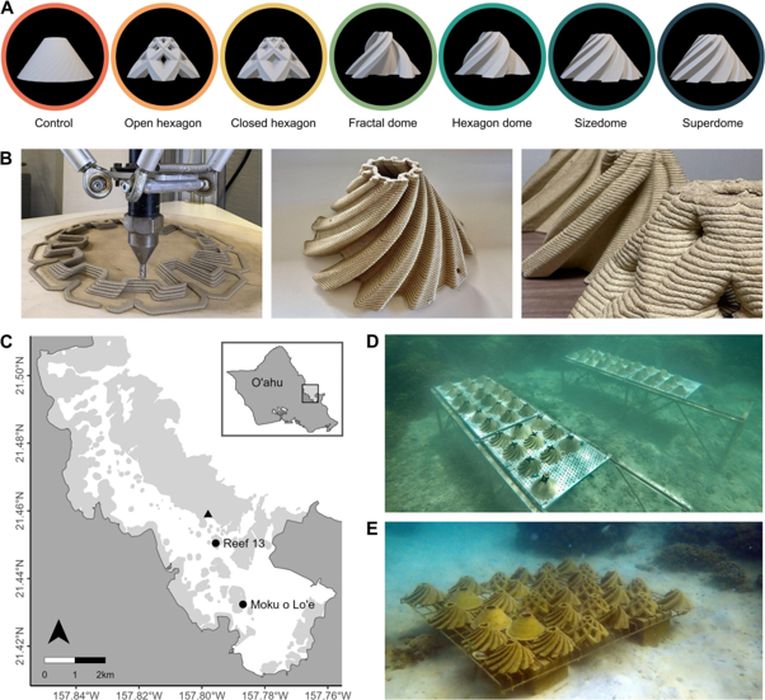
Similar work is taking place outside Florida. At the University of Hawaiʻi at Mānoa, researchers developed ceramic modules containing small spiral-shaped shelters known as helix recesses. In field tests at Kāneʻohe Bay, the helix-recess design attracted roughly 80 times more juvenile coral settlement than flat surfaces, while one-year survival was up to 50 times higher. The modules were created using clay 3D printing and can be incorporated into artificial reefs, seawalls and larger coastal structures. The research forms part of DARPA’s Reefense program, which seeks to develop hybrid reef structures that operate as living breakwaters. The project shows how relatively small geometric features, which would be difficult to reproduce consistently through traditional fabrication, can materially influence coral settlement and survival.
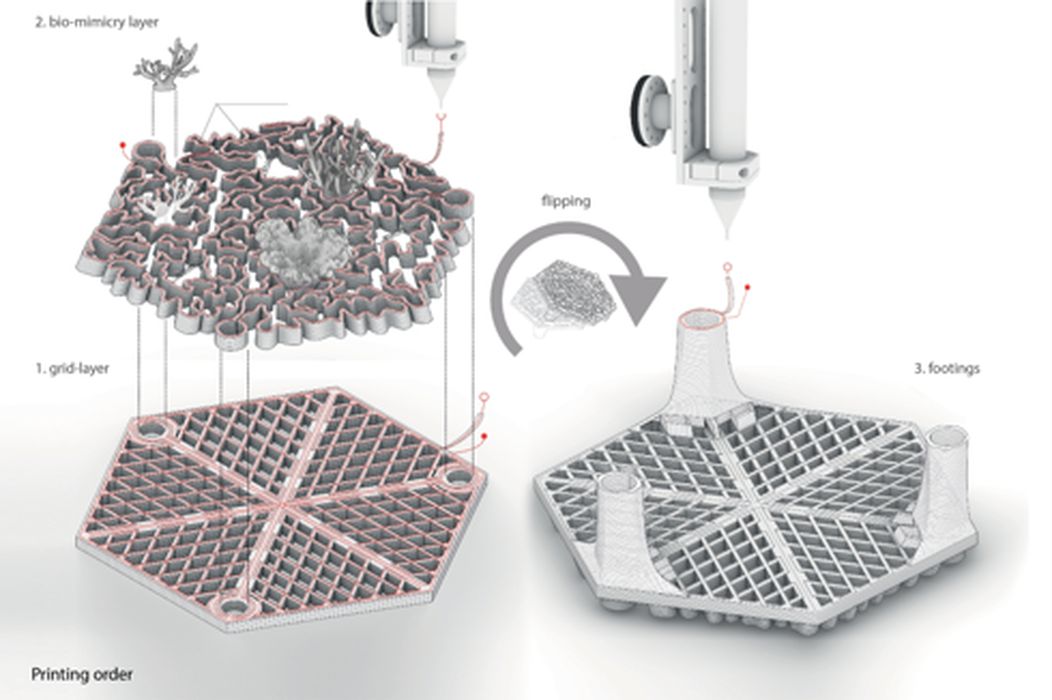
The University of Hong Kong has also demonstrated the value of location-specific additive design. Its researchers produced 128 robotically printed terracotta reef tiles for Hoi Ha Wan Marine Park. The tiles incorporated biomimetic patterns and attachment areas for coral fragments, while their geometry was designed to reduce sediment accumulation, a major local threat to coral health. The research later led to ArchiREEF, an HKU spin-out created to commercialize the 3D printed reef technology.
Other organizations pursuing related approaches include Australia’s Reef Design Lab, whose Modular Artificial Reef Structure system uses ceramic components to create complex habitat, and the Netherlands-based Coastruction, which develops locally adapted, 3D printed reef structures using natural or locally sourced materials.
Taken together, these examples point toward an emerging class of marine infrastructure. Their common advantage is the ability to translate biological and environmental requirements into manufacturable geometry. As field data improves, those designs can be modified, reproduced and adapted to other locations.
A Growing Policy Framework for Coastal Resilience
These innovative efforts take place as coastal policy becomes more receptive to nature-based infrastructure. Florida provides the most direct example. Senate Bill 302, enacted in 2026, directs the state to develop a permitting framework for nature-based coastal resilience and specifically calls for incentives for emerging technologies, including 3D printing. Miami-Dade County has also updated its approach to seawall permitting to accommodate alternatives that provide ecological and wave-attenuation benefits.
The trend extends beyond Florida. At the federal level, the U.S. Army Corps of Engineers’ Nationwide Permit 54 provides a permitting pathway for qualifying living shoreline projects. New York, where Kind has already secured its first projects, directs regulators to encourage nature-based shoreline solutions over traditional hardened structures when feasible. California, another market targeted in Kind’s expansion plans, adopted new Nature-Based Adaptation Strategies guidance in 2026 that addresses permitting pathways for these approaches under the Coastal Act. These policies differ considerably in scope, but together they point to a more favorable environment for the type of hybrid ecological infrastructure Kind Designs is developing.
The Research & Development Tax Credit
Beyond permitting frameworks, public policy can also support this kind of innovation through tax incentives. The now permanent federal Research and Development Tax Credit is available to eligible companies developing or improving products, manufacturing processes and software through qualified technological experimentation.
For companies producing 3D printed coastal infrastructure, potentially qualifying activities may include testing concrete or ceramic formulations, developing printing parameters, evaluating reinforcement systems, creating biomimetic geometries, modeling wave interaction, integrating sensors and adapting robotic production systems for larger-scale manufacturing.
Potential qualified research expenses may include eligible technical wages, supplies consumed during experimentation and certain contracted research costs. The IRS instructions for Form 6765 identify wages, research supplies and eligible contract research as major categories of qualified research expenses, subject to the applicable requirements and exclusions.
The extensive design, testing and process-development work required to move living seawalls and artificial reefs from prototypes to validated, field-deployed infrastructure makes this sector a strong candidate for R&D Tax Credit analysis. R&D Tax Savers has been helping companies navigate the complexity of the R&D tax credit since it was introduced into law in 1981.
Conclusion
Kind Designs’ US$10 million financing round signals that 3D printed coastal infrastructure is beginning to move beyond isolated demonstration projects. The company is expanding from residential seawalls into a wider platform serving hotels, municipalities, federal agencies and restoration programs, while evolving state and federal policy is creating clearer pathways for nature-based and additively manufactured solutions. Alongside work at the University of Miami, FIU, the University of Hawaiʻi and the University of Hong Kong, Kind’s growth shows how 3D printing can connect structural protection with ecological restoration and location-specific design. The next challenge will be scaling production while continuing to generate the engineering and environmental evidence required for broad infrastructure adoption.