
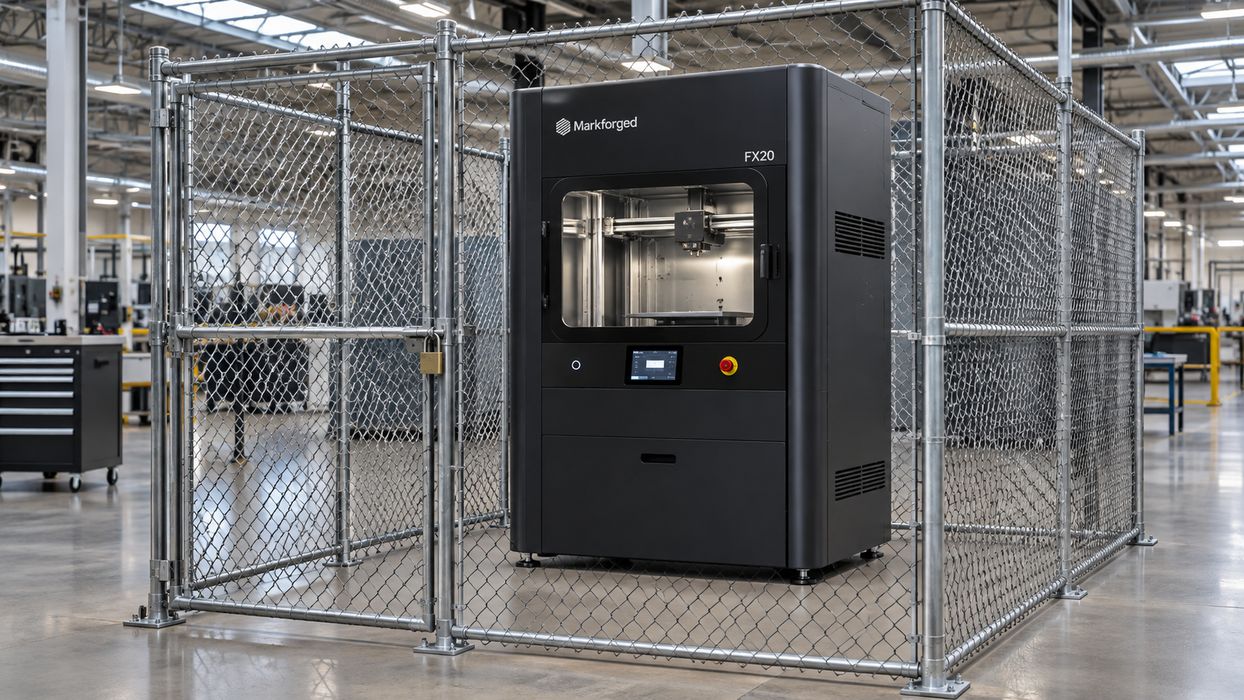
The proposed acquisition of Markforged by Stratasys has fallen apart, and I suspect there’s something quite important going on here.
In May, Stratasys announced it would acquire Markforged from Nano Dimension for US$42.5M. The deal included Markforged’s extrusion technology, including its pioneering continuous fiber reinforcement capability, but excluded the company’s Swedish metal binder jetting operation (the former Digital Metal operation, which Markforged had acquired).
It seemed like a pretty good deal for Stratasys, which would have gained new tech, customers and ongoing material sales. Nano Dimension, meanwhile, would eliminate a big operating expense.
However, on November 11, the two companies mutually agreed to terminate the acquisition agreement. Nano Dimension explained in an SEC filing that obtaining the necessary regulatory approvals would take “materially longer, and be more expensive, than initially anticipated.”
Which regulatory approvals? Neither company has said, but there are some clues.
When Nano Dimension acquired Markforged in April 2025, it entered into an Interim National Security Agreement with the Committee on Foreign Investment in the United States (CFIUS). This government organization examines acquisitions of US businesses by foreign entities to determine whether there are national security concerns.
According to Nano Dimension’s annual reports, the agreement involves requirements related to maintaining manufacturing capabilities for government customers, product integrity, cybersecurity, protection of sensitive information and even restrictions on deploying certain software solutions.
That’s quite a list for a medium-sized 3D printer manufacturer.
You might wonder why there would be a problem transferring Markforged between two Israeli companies. However, US regulations specifically allow for national security reviews when a US business is transferred from one foreign owner to another.
I suspect there may have been difficulties obtaining a new agreement, or modifying the existing one, to accommodate Stratasys’ acquisition. If the government required Markforged to maintain certain independent operations, that could also diminish the cost savings anticipated by Stratasys.
There could also have been competition concerns, given that the two companies sell industrial extrusion equipment to many of the same customers. However, the existing national security agreement makes CFIUS an interesting possibility.
Where does this leave the two companies?
Stratasys seems relatively comfortable with the outcome. CEO Yoav Zeif explained during the company’s recent earnings call that Markforged’s technology was “complementary”, but not “transformative” for Stratasys. There are apparently other ways to obtain similar results for Stratasys.
Nano Dimension has a bigger problem. It acquired Markforged for approximately US$116M last year, and now finds itself unable to dispose of most of the business for a far lower price.
Interestingly, Markforged generated US$18.6M of Nano Dimension’s US$31.9M in revenue during the most recent quarter. Nano Dimension had been attempting to sell the operation that produces more than half of its revenue!
Perhaps another buyer will emerge. I suspect a US buyer might have an easier time obtaining the necessary approvals, particularly one already operating in the defense industry. We could speculate on which company that might be, but suspects could include HP, 3D Systems, GE/Colibrium, or perhaps even Formlabs.
Another possibility could be CORE Industrial partners, who you probably haven’t heard of. They are a private equity firm that already owns 3DXTECH, Triton 3D and Gearbox3D, along with the Fathom Digital Manufacturing service. The Markforged assets would fit into their acquisition pattern.
But there’s something bigger going on here.
We’ve seen countless acquisitions in the 3D printing industry over the past few years, with companies accumulating technologies, materials and sales channels. It was mostly assumed that if two companies could agree on a price, they could complete a deal.
That may no longer be possible.
Industrial 3D printers are increasingly being used to produce military equipment, replacement parts for aircraft and components for critical infrastructure. The ability to manufacture these items domestically is now becoming strategically important to governments.
Governments now have a much higher interest in who owns the manufacturers of that equipment, who controls their software and where their materials are produced.
I wonder whether we’re entering a period in which acquisitions of industrial 3D printer manufacturers become much rarer, particularly when crossing country borders. Companies might instead find themselves looking for domestic buyers, licensing technologies or arranging complicated partnerships when acquisitions get challenging.
The irony here is that the growing success of industrial 3D printing may actually make it far harder for the industry to consolidate, and the Markforged scenario could be one of the first signals of this effect.
Via Nano Dimension SEC Filing, Nano Dimension Annual Report, Stratasys, Nano Dimension Quarterly Results and Stratasys Earnings Call