
Here’s a really common problem in metal 3D printing: LPBF can make shapes that are almost impossible to machine — and then you discover they’re also almost impossible to finish.
New research looks at one possible answer for AlSi10Mg lattice structures: electrochemical polishing.
The paper, “Surface finishing of laser powder bed fusion AlSi10Mg lattice structures by electrochemical polishing,” examines whether electropolishing could smooth the rough surfaces buried inside complex aluminum lattices.
That might be quite useful.
AlSi10Mg is already a popular LPBF material, particularly where low weight, stiffness and thermal performance matter. Lattice structures can push those advantages further by putting material only where it’s needed, while also creating large internal surface areas for applications such as heat transfer.
Unfortunately, all that extra surface area comes with a big downside.
LPBF surfaces can carry partially fused particles, stair-stepping and other print-created roughness. On a simple part, you can often blast, grind or otherwise finish the troublesome surfaces. Inside a dense lattice, good luck getting any tool in there.
And roughness inside a lattice isn’t merely cosmetic. It can affect fluid flow, trap powder, create stress concentrations and make thin struts considerably different from their intended CAD dimensions. If the lattice is supposed to carry loads or move heat efficiently, those differences matter.
Polishing Without Touching the Surface
Electropolishing handles this problem in a completely different way.
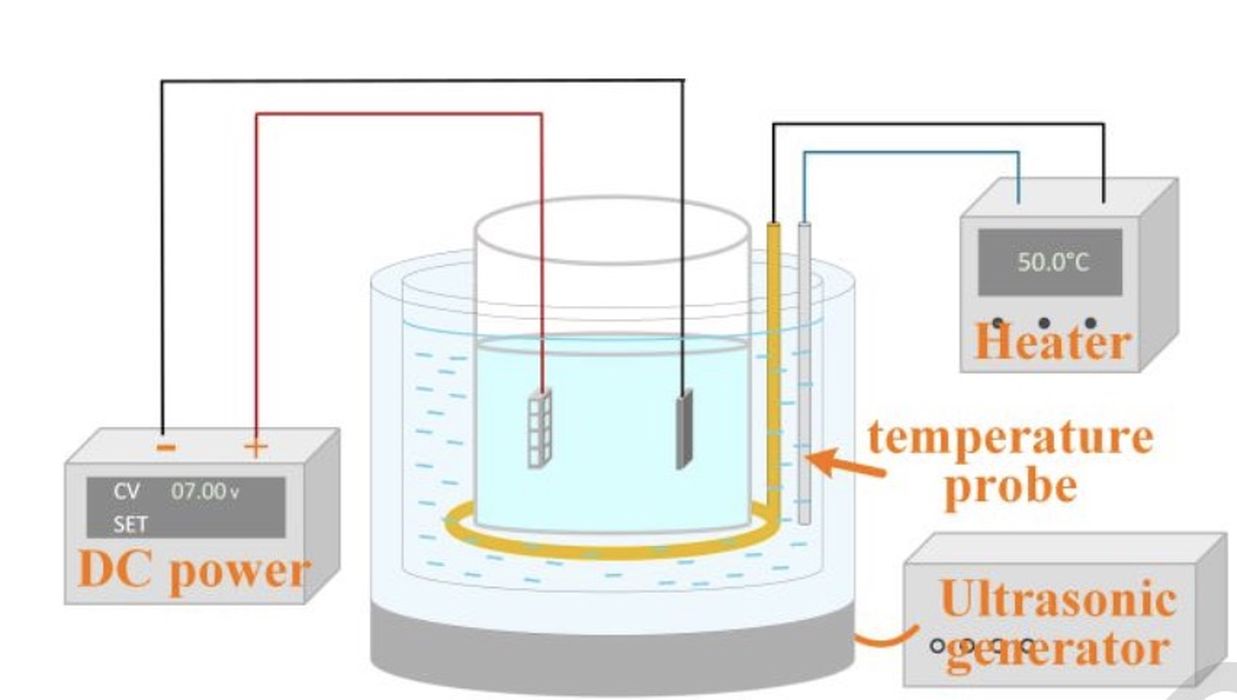
Instead of rubbing, blasting or cutting the surface, the part is placed in an electrolyte and material is removed by controlled anodic dissolution. Under the right conditions, microscopic peaks on the surface are preferentially dissolved, producing a smoother finish.
The interesting bit is that no mechanical tool has to physically reach the surface being polished.
That makes electropolishing particularly attractive for lattices, where much of the geometry may be buried inside interconnected channels and networks of thin struts.
There are other methods that can reach difficult geometry. Chemical polishing, abrasive flow processes and some vibratory techniques can work in places conventional tools cannot. But lattices make all of these methods harder because the geometry keeps changing. Strut diameter, channel size and access can vary from one region to another.
Electropolishing has the same basic difficulty.
Just because electrolyte can enter a lattice doesn’t mean every part of the lattice will be polished equally.
The Real Problem Is Uniformity
This is where things get interesting.
Material removal during electropolishing depends on current density, electrolyte circulation, gas evolution, electrical contact, orientation and the geometry itself. A strut near an electrode may experience quite different conditions from one buried deep inside the structure.
For a chunky component, small differences in material removal might not matter much. For a lightweight lattice made from thin struts, they certainly can.
A polishing process could make the outside beautifully smooth while quietly eating too much material from some internal features. That could alter stiffness, change flow passages or reduce fatigue strength.
AlSi10Mg adds another complication. Its LPBF microstructure, silicon-rich phases and as-built porosity can influence both corrosion behaviour and how the surface responds during electrochemical treatment. It seems unlikely that there would be one magic polishing recipe suitable for every AlSi10Mg lattice geometry.
Making a lattice smoother is only half the job. The process also has to prove it didn’t significantly change the thing it was supposed to improve.
LPBF is increasingly being used to make parts where the complexity is the entire point of printing them. If those internal features then require impossible post-processing, much of that advantage goes away.
A reliable way to electropolish enclosed aluminum lattices could therefore be quite valuable, particularly for heat exchangers and other flow-sensitive structures.
