
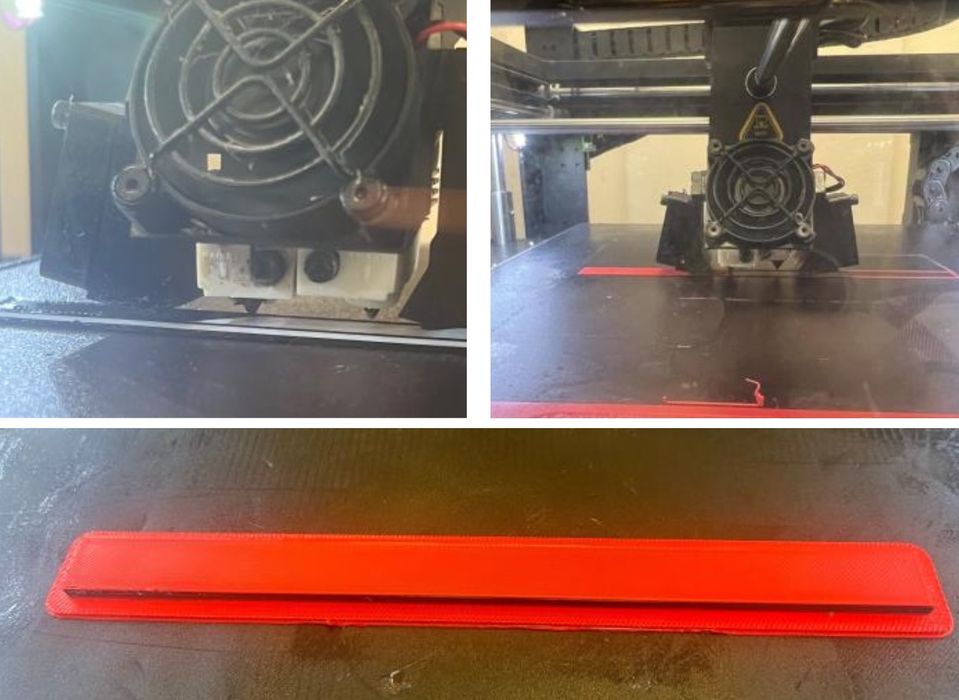
A new study maps how 3D printed layered composite beams behave under vibration and lists ways to tune stiffness and damping.
The paper, titled “Fabrication and experimental modal analysis of layered composite beams using 3D printing,” focuses on experimental modal analysis (EMA) of printed laminates. The team fabricated beams with layered layups and then measured their dynamic response, extracting at least natural frequencies and mode shapes — and possibly damping, though the summary does not say.
Why does this matter for additive manufacturing? Because most polymer AM parts are anisotropic and often used in frames, arms, brackets and housings where vibration and resonance can make or break performance. Designers usually ask whether a printed bracket will sing at a certain speed or behave quietly.
Why Vibration Data On Printed Laminates Matters
Layer sequencing, thickness, and material pairing in a laminate directly control bending stiffness and mass per length. For simple beams, natural frequencies scale with stiffness to mass ratios, so small changes in stacking sequence or material can meaningfully move resonances. In printed parts, this gets more pronounced because layer orientation and interlayer bonding shift effective moduli far more than in isotropic stock.
If this work provides clean EMA data across several layups, it gives engineers something actionable: choose a stacking sequence to raise or lower a target mode, or add a lossy layer to bleed energy at a problem frequency. In other words, it hints at slicer-level control over vibration behavior, not just shape and weight.
There is also a clear industry scenario. The AM market already offers chopped-fiber filaments and continuous-fiber systems from companies like Markforged and Anisoprint. Those platforms promote stiffness gains, but vibration behavior is what many teams ultimately care about for drones, robots, machine guards, and even consumer products. A modal dataset on printed composites would complement tensile charts and bring AM design a step closer to first-time-right outcomes.
Assuming the experiments are sound, the commercial impact is straightforward. Service bureaus could offer vibration-tuned brackets as a premium option. Print farms could standardize a few laminate recipes that push dominant modes out of known operating bands for robot end effectors or drone arms. Educators could use the data to teach modal concepts with low-cost printed specimens rather than machined aluminum coupons.
If you can shift a resonance significantly with nothing but layer sequencing, that is a design tool worth having.
Via OpenAlex
