
A fascinating analyst report from CONTEXT shows a fundamental shift in how 3D printers are used.
There’s been a lot going on in the 3D print world over the past couple of years, with high-power, low-cost equipment arriving, companies merging or disappearing, new application areas, military surges, and of course, tariffs.
CONTEXT chops up the entire market into four categories, which they track separately:
- Industrial
- Midrange
- Professional
- Entry-level
The categorization is essentially done via pricing. For example, lower-priced units are in the Entry-Level category, while the highest-priced options are in the Industrial segment.
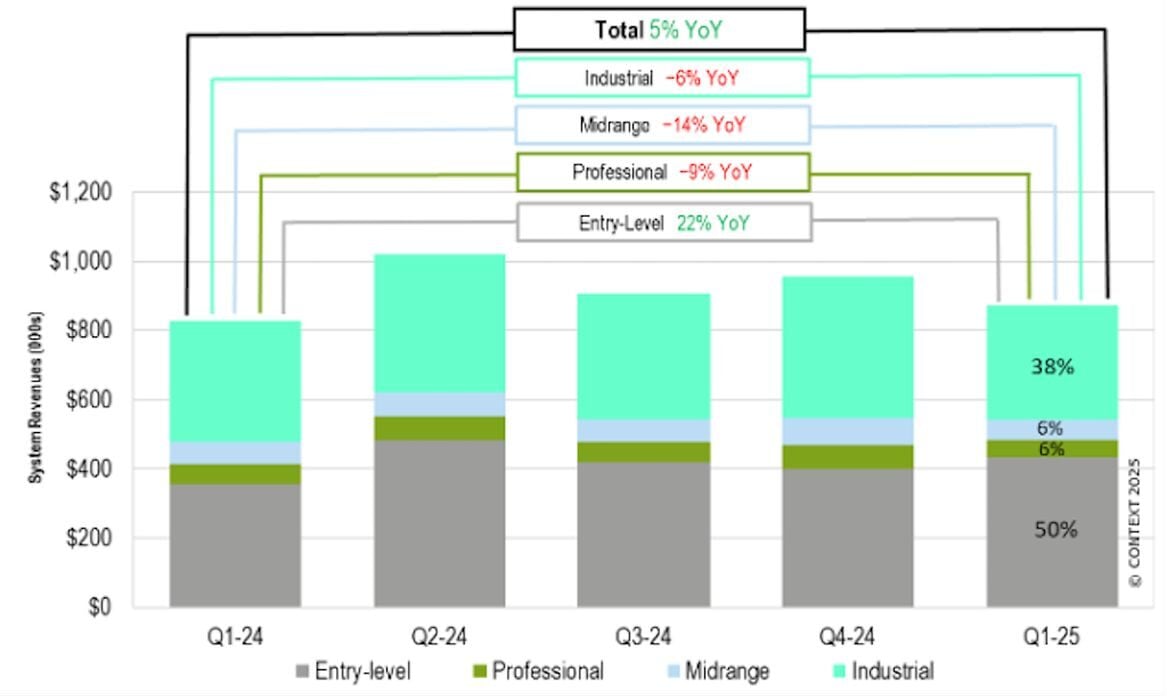
At the top, you can see how the sales revenue for all segments played out over the past five quarters. Below, you can see a breakdown by segment for each category over the past two years:
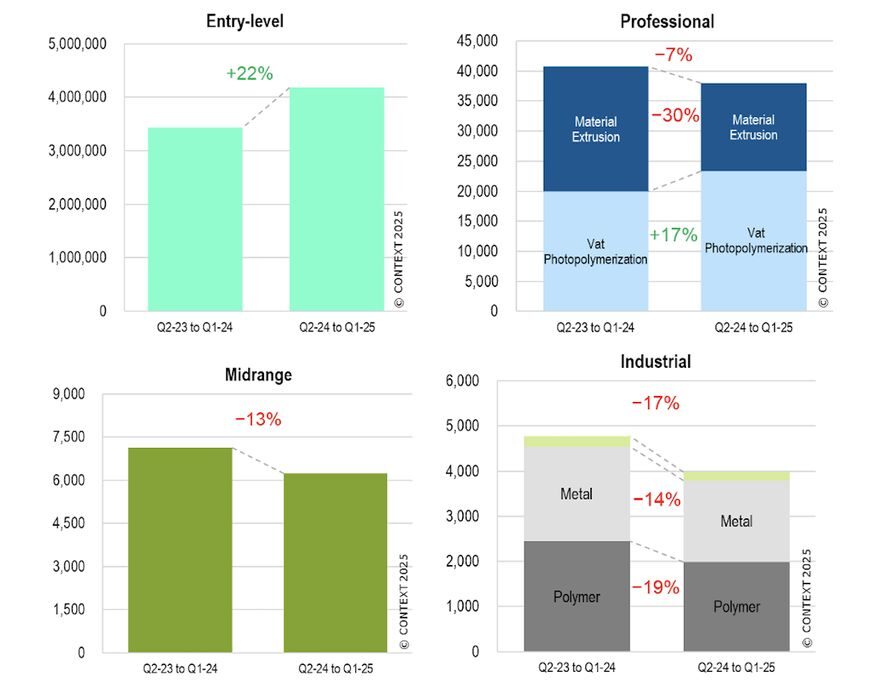
What’s notable is that all segments suffered significant drops in sales, with the exception of the entry-level market.
When I say significant, you might suggest that a mere seven percent drop isn’t significant. You must remember, however, that these 3D printer manufacturers are valued based on an assumption of growth. If there is no growth, or worse, negative growth as we see here, that’s drastically bad.
In the professional segment, we see that resin equipment has actually grown, while FFF technology has dropped. This is very likely because of Formlabs’ introduction of the Form 4 and Form 4L, which offered a significant performance boost over prior machines. This must have led to a huge number of upgrades, as Form 3 operators turned over their machines. There’s another reason here, but I’ll get to that in a moment.
The Midrange and Industrial segments all showed decreases in sales over the past year. That is quite interesting, particularly the metal equipment, which dropped 14%. Metal has been the supposed champion of the industrial segment, with many companies adopting the technology. Apparently, this isn’t really the case when you add up the numbers.
The really interesting part is the Entry-Level segment, which is low-priced equipment. It is during this period that Bambu Lab introduced their powerful X1C machine, which for the first time offered high-speed printing, ease of use, competent reliability, and outstanding quality prints. After their success, other Entry-Level manufacturers began marketing similar equipment.
It’s long been my theory that buyers of more expensive gear (Industrial and Midrange in CONTEXT’s view) might begin switching to Entry-Level machines that basically offer the same quality at a much lower price point.
The symptoms were there: several midrange equipment providers have stalled, been acquired, or even disappeared entirely. Now we see the numbers behind this trend.
The Entry-Level category grew by 22%, whereas all other categories shrunk. Is that not proof of the low-cost machines beginning to take over? This is particularly evident in the Professional Category, where expensive FFF equipment suffered badly against low-cost Entry-Level machines that can essentially do the same thing, except cheaper.
What’s happened is that Bambu Lab and similar companies have definitely taken over a huge chunk of the midrange and professional markets for FFF-style 3D printing.
What’s stopping them from taking over entirely? Plenty. There are many applications that require specific certified materials that aren’t available on low-cost machines. There are purchasing rules against buying Chinese equipment for some organizations. There are specialized machines that print very large objects or in special materials that cannot be used in the FFF process.
Nevertheless, a massive piece of the market has shifted towards a most cost-effective part of the ecosystem. This is very good for 3D printer operators, and not so good for manufacturers of more expensive equipment.
Via CONTEXT
