
There’s a possibly easier path for manufacturers to enter the world of 3D printing.
In the past few years the use of 3D print technology has begun to grow in manufacturing. This is due to a combination of advancements in materials, equipment and software. It’s now possible to produce production parts for a range of applications using today’s AM platforms.
That’s not to say that every part can be additively manufactured; think of this as a spectrum, where each year a few more applications are added. Over time, this has become significant.
Significant enough for some manufacturers to consider using 3D print technology for the first time. And there’s still quite a few manufacturers that have not yet used the technology.
How should they enter this technology space? There are a number of ways, such as buying equipment and experimenting; using a manufacturing service to obtain additively produced parts; acquiring a smaller manufacturer that already uses AM, etc.
One unusual approach is to use a hybrid approach. It is possible to alter existing CNC equipment so that they become a kind of hybrid machine that performs both its normal CNC milling activities and also additive manufacturing.
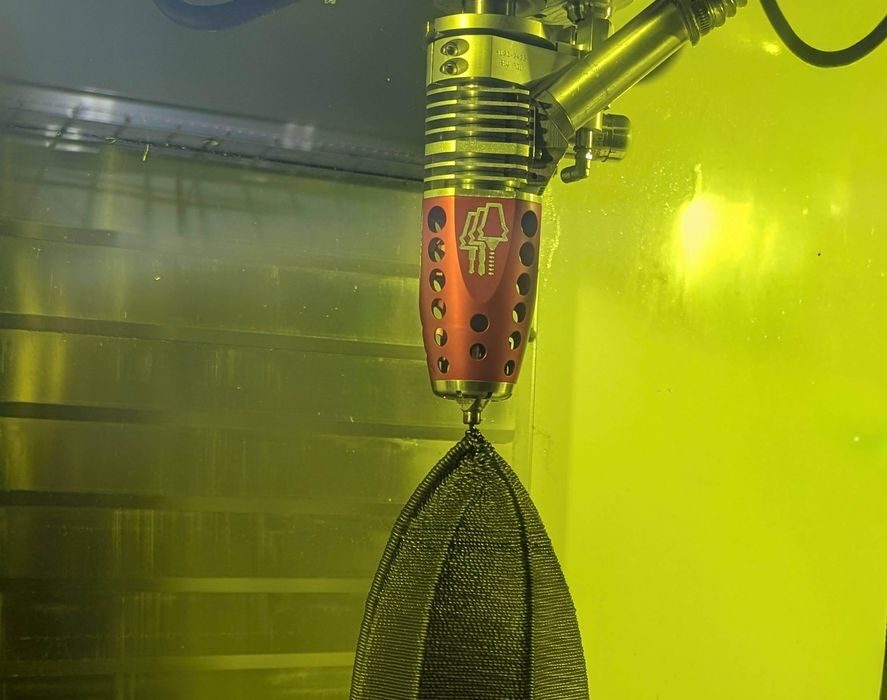
One example of this approach is provided by Hybrid Technologies, which produces specialized toolheads that can be added to most industrial CNC machines for AM. The company produces toolheads for both polymer and metal materials.
Their composite toolhead, the AMBIT XTRUDE, is able to transform polymer pellets into extruded material at an incredibly fast rate, able to deposit up to 9kg per hour. That’s the equivalent of printing a 1kg spool of filament every six and half minutes.
Using that monstrous flow rate, this toolhead, when attached to a sufficiently large CNC machine, can print very large objects in composite materials relatively quickly. The company reports that in a recent test with the US Navy, they were able to print drone hulls in less than an hour.
You can imagine the potential for large-scale manufacturing when print speeds of this magnitude are achieved. Also, the use of pellets instead of filament opens up an enormous range of potential materials for this type of system.
There’s another advantage to a CNC-AM hybrid setup: finishing. CNC equipment can produce very smooth surfaces, but a CNC machine that also has an additive toolhead can do both activities. As the 3D print progresses, it’s possible to activate the CNC toolhead to smooth out the surfaces.
This is especially useful because the extrusions from the large diameter nozzle on the AM toolhead are relatively coarse. Smoothing them can produce a part that might have been CNC’d, yet was mostly 3D printed.
