
Charles R. Goulding and Preeti Sulibhavi highlight how the University of Maryland’s extensive HVAC 3D printing program is moving additive manufacturing from experimental concepts to real-world energy infrastructure.
When we first started writing about HVAC and 3D printing, the list of real-world applications was short. There were prototypes, some airflow experiments, and the occasional custom duct. For an industry responsible for a massive share of global energy use, progress felt slow.
That was frustrating, especially considering how closely HVAC intersects with energy efficiency, thermal management, and large-scale commercial buildings. Between geothermal systems, thermal storage, and high-rise residential and commercial construction, HVAC is where energy performance is won or lost. It seemed like an ideal target for additive manufacturing, yet adoption lagged.
That has now changed in a meaningful way.
The University of Maryland’s Center for Environmental Energy Engineering (CEEE) has quietly built one of the most comprehensive and practical HVAC-focused additive manufacturing programs anywhere. Their work goes far beyond test parts. It addresses real systems, real buildings, and real operating constraints. More importantly, it does so across multiple HVAC technologies, not just one niche application.
CEEE’s work demonstrates that HVAC 3D printing is no longer experimental. It is becoming an enabling technology for energy-critical infrastructure, starting with data centers.
Technology One: Data Centers and Advanced Thermal Management
Data centers are now one of the fastest-growing energy loads in the world. Cooling can account for 30 to 40 percent of total facility energy use, sometimes more. Any improvement in airflow efficiency or heat exchange has an immediate and measurable impact.
CEEE has focused heavily on this problem, using 3D printing to produce advanced heat exchangers, airflow guides, and cooling components that simply cannot be manufactured using conventional methods.
Traditional HVAC components are constrained by tooling, machining limits, and assembly requirements. Additive manufacturing removes many of those constraints. Complex internal channels, variable geometry, and topology-optimized structures become possible. That translates directly into better heat transfer and lower pressure drops.
A key aspect of this work is the use of composite materials. As we have previously covered extensively in past articles, composites are increasingly important in additive manufacturing because they combine strength, thermal performance, and durability. In data center environments, where components must withstand continuous operation and elevated temperatures, composites make practical sense.
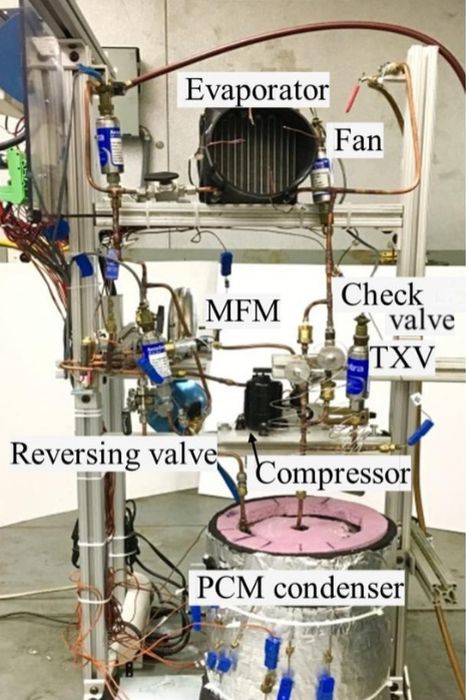
CEEE’s printed components are not just lighter or more complex. They are designed to perform better thermally while reducing material usage. That combination matters when scaled across thousands of cooling units in hyperscale facilities.
Technology Two: “Dark” Data Centers and Reliability-Driven Design
The push toward “dark” data centers, facilities designed to operate with minimal or no on-site staff, raises the bar even further. In these environments, reliability is non-negotiable. Components must perform consistently for long periods without maintenance intervention.
CEEE’s additive manufacturing approach supports this model in several ways.
First, printed HVAC components can be customized for specific facility layouts and airflow patterns. Rather than forcing standardized parts into suboptimal configurations, designers can match components to actual thermal loads. That reduces hot spots and stress on equipment.
Second, additive manufacturing enables rapid iteration. If a design change is needed, parts can be updated and produced without retooling delays. This is especially relevant for data centers, where cooling strategies evolve alongside server densities and processor architectures.
Anthony Palumbo has recently explored these data center trends in multiple Fabbaloo articles, particularly the growing infrastructure demands driven by AI and high-density computing. The work coming out of CEEE fits squarely into that narrative. As compute density increases, cooling systems must evolve just as quickly. Additive manufacturing provides that flexibility.
In dark data centers, fewer failures are not just desirable, they are essential. HVAC components optimized through 3D printing play a quiet but critical role in keeping these facilities running without human intervention.
Technology Three: Desiccant and Advanced Heat Exchange Systems
Another major area of CEEE’s work involves desiccant-based HVAC systems and advanced heat exchangers. These systems are often used in high-efficiency buildings where humidity control and energy recovery are critical.
Desiccant wheels and heat exchangers traditionally involve complex geometries that are expensive to manufacture and difficult to optimize. Additive manufacturing changes that equation.
CEEE researchers have demonstrated that 3D printing allows for precise control of internal structures that influence airflow, moisture absorption, and heat transfer. Instead of relying on flat or uniform designs, they can tailor internal pathways to maximize performance.
This has direct implications for commercial buildings and multi-story residential construction. Energy codes are becoming stricter, and HVAC systems must do more with less energy. Incremental improvements are no longer enough.
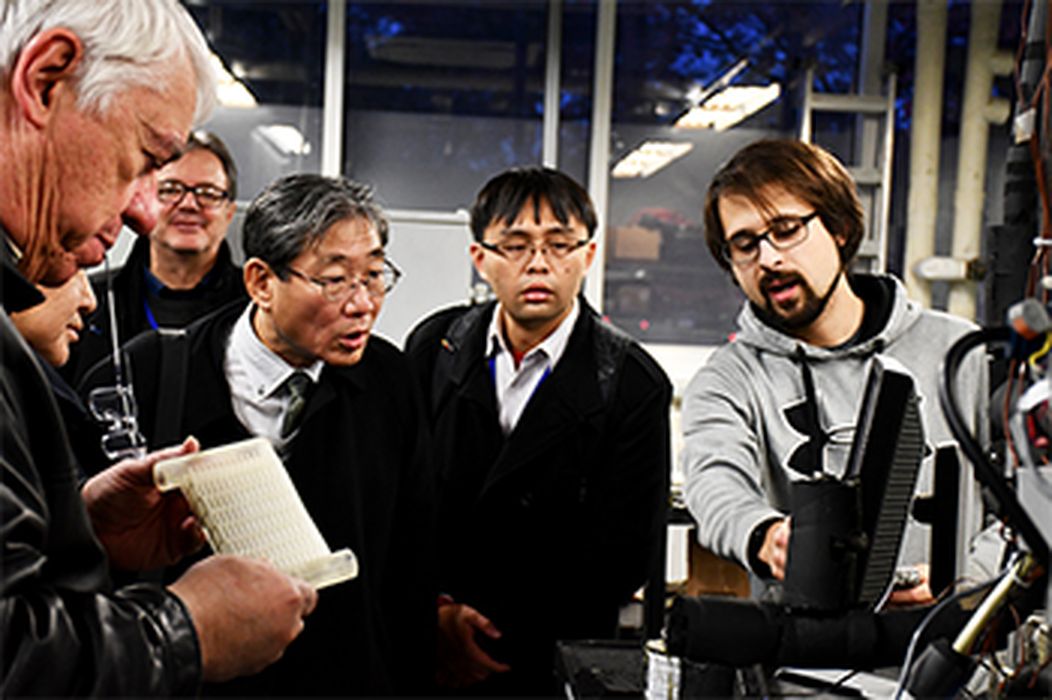
By enabling entirely new design approaches, 3D printing allows HVAC engineers to rethink how these systems function. The result is not just better components, but better systems overall.
Technology Four: Industry Collaboration and the Daikin Lab
Perhaps one of the most important aspects of CEEE’s program is its collaboration with industry, particularly through its work with Daikin.
Daikin is one of the world’s largest HVAC manufacturers, and their involvement signals that additive manufacturing is being taken seriously at the highest levels of the industry. The Daikin lab at the University of Maryland serves as a bridge between academic research and commercial deployment.
Within this lab, 3D printed HVAC components are not theoretical. They are tested, validated, and evaluated against real performance metrics. This includes durability, thermal efficiency, and manufacturability at scale.
We have previously covered Daikin’s interest in advanced manufacturing, including additive processes. What makes the CEEE partnership notable is its focus on practical integration. The goal is not to replace all traditional manufacturing, but to use 3D printing where it makes the most sense.
That often means low-volume, high-complexity parts. It also means rapid prototyping and testing cycles that would be impractical using conventional methods. Over time, these capabilities feed directly into commercial product development.
Why This Matters for the HVAC Industry
The work at the University of Maryland represents a shift in how HVAC systems are designed and built. Instead of adapting designs to manufacturing constraints, engineers can now design for performance first.
This matters for energy efficiency, but it also matters for cost control, sustainability, and resilience. Buildings are becoming more complex, and their energy systems must keep up.
Additive manufacturing is not a silver bullet. It will not replace sheet metal ducts or mass-produced components overnight. But as CEEE has shown, it excels in areas where complexity, customization, and performance intersect.
For data centers, that intersection is already here. For commercial and high-rise residential buildings, it is rapidly approaching.
The Research & Development Tax Credit
The now permanent Research & Development Tax Credit (R&D) Tax Credit is available for companies developing new or improved products, processes and/or software.
3D printing can help boost a company’s R&D Tax Credits. Wages for technical employees creating, testing and revising 3D printed prototypes can be included as a percentage of eligible time spent for the R&D Tax Credit. Similarly, when used as a method of improving a process, time spent integrating 3D printing hardware and software counts as an eligible activity. Lastly, when used for modeling and preproduction, the costs of filaments consumed during the development process may also be recovered.
Whether it is used for creating and testing prototypes or for final production, 3D printing is a strong indicator that R&D-eligible activities are taking place. Companies implementing this technology at any point should consider taking advantage of R&D Tax Credits.
A Long-Term View
What makes CEEE’s work especially compelling is its scope. They are not focused on a single component or application. They are building a body of knowledge that spans multiple HVAC technologies and use cases.
That approach is exactly what the industry needs. HVAC systems are interconnected, and improvements in one area often affect others. By addressing data centers, advanced heat exchangers, desiccant systems, and industry collaboration together, CEEE is laying the groundwork for broader adoption.
For those watching the intersection of additive manufacturing and energy systems, this is a program worth paying attention to. HVAC 3D printing has moved beyond curiosity. Thanks to efforts like these, it is becoming part of the real infrastructure that powers modern buildings.
And that is a development long overdue.