
Texas A&M researchers unveiled a picojoule, maskless method for 3D printing pure metal nanostructures with sub-250 nm resolution.
Nanoscale metal AM has long been a trade-off between purity, resolution, and practicality. Focused electron/ion beam deposition can hit sub-100 nm, but it is slow and requires a vacuum. Two-photon polymerization (2PP) processes either entrap organics or demand a metallization step that adds complexity and often limits feature size around the half-micron range. Electrohydrodynamic and pulsed electrodeposition approaches show promise for multi-metal work but struggle with truly arbitrary 3D geometry and maskless flexibility.
This new study claims a process for maskless, additive-free 3D metal printing with depth and lateral resolution under 250 nm, no vacuum, and very low pulse energy. If it holds up, that is a notable shift for labs pursuing metamaterials, microdevices, and next-gen sensors.
Hot Electrons, Not Polymers
The team exploits femtosecond laser excitation of metal nanocrystals (NCs) to generate spatiotemporally confined hot electrons that drive a nonlinear, multi-electron process. The authors name their mechanism nanoprinting induced by multiple-electron transition (nPIMET).
Mechanically, it looks like 2PP, but without photoinitiators or polymer networks. The voxel is sharpened by the nonlinear absorption, which they show is far more localized at 515 nm than at 343 nm. The pulse energy to trigger fusion is reported as quite low, which opens the door to multi-beam scaling.
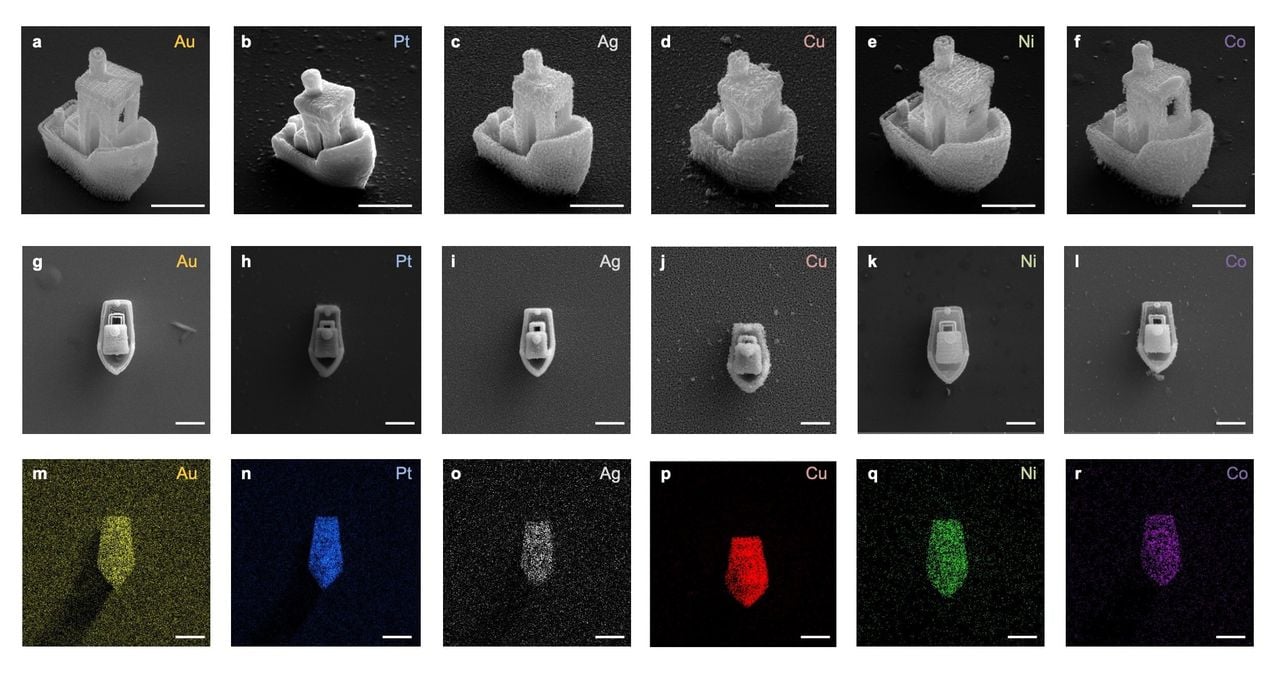
It is also material-agnostic: Au, Ag, Pt, Cu, Ni, and Co are possible. The researchers printed free-standing nanopillars near 288 nm diameter, spiral arrays, and complex volumetric shapes — including an Eiffel Tower-like piece and a miniature #3DBenchy about 15 × 7.7 × 21 μm — using both layer-by-layer and free-space toolpaths (see image at top). No vacuum chamber; just a sealed liquid-ink cell, then solvent rinse, and, for fragile geometries, critical point drying.
Performance, Constraints, And Comparisons
On properties, there is pretty encouraging data. The researchers show dense cross sections with negligible voids, no detectable carbon, and low oxygen. Conductivity of printed Au hits about 32% of bulk after a short 350 C anneal. Single-metal nanopillars show yield strengths from 232 MPa up to 2.64 GPa depending on alloy and size, within the envelope. A body-centered cubic mechanical metamaterial deforms and recovers without catastrophic failure, suggesting consistent fusion.
Commercially, this could carve out a market niche where maskless, pure-metal features below 300 nm enable optical, mechanical, and sensing functions that are currently awkward — especially if multi-metal switching becomes routine.
