
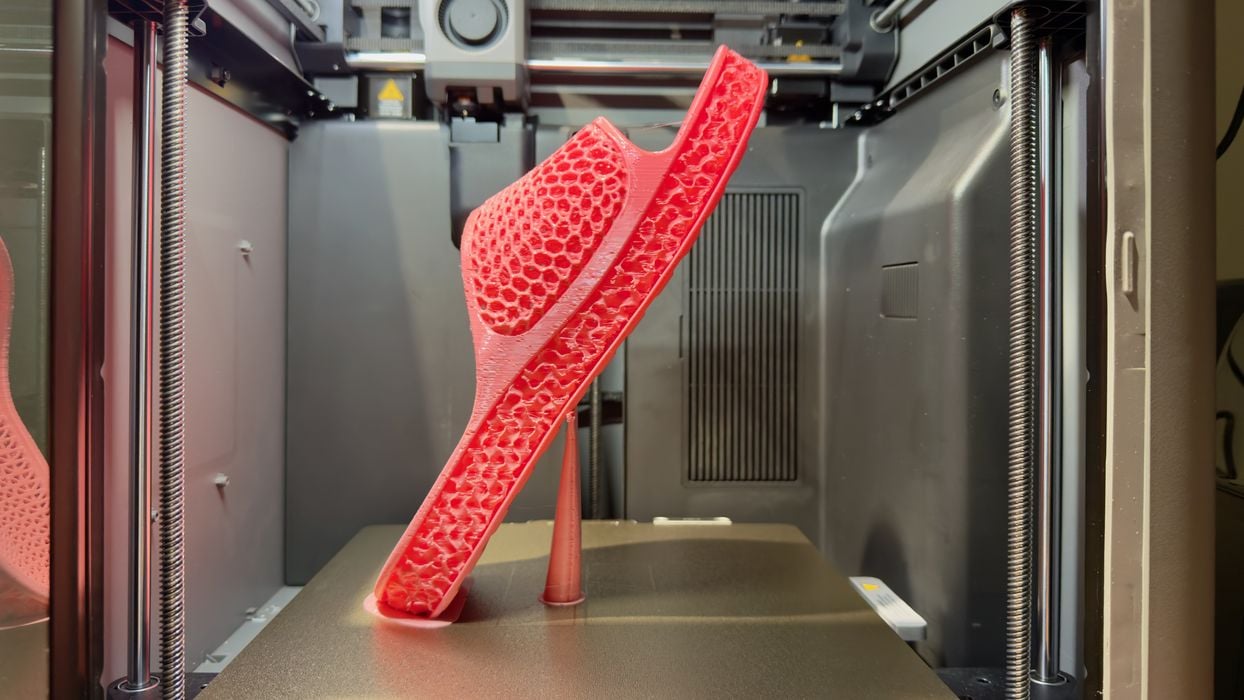
The 3D print industry may be missing out on a major distributed application: footwear.
I’m sure you’ve heard of the several startup companies that have developed specialized 3D print farms to produce 3D-printed footwear. The most prominent is Zellerfeld, but there are others now operating, and very likely many more still cooking.
At these sites, you’ll see a cascade of amazing shoe designs, some of which are pretty radical. Buying them is as easy as taking a measurement and pressing a button. Because of the measurements, you’re almost guaranteed to receive a pair of shoes that fit perfectly.
My question: why can’t we all do this at home?
It would seem to be an obvious application: download any number of unusual designs from popular 3D model sites, scale them, and print.
If you look at the major 3D model repositories today, you will see a rapidly increasing number of shoe models. It’s hard to say exactly how many, given the infinite scrolling of most sites, but it would be fair to say there are tens of thousands of shoe designs available for download today.
Well, if we have the printers and the 3D models, why aren’t we all printing shoes?
There are two major issues.
The first is scaling. Shoes must be sized to fit the wearer. Unfortunately, in my look at a number of shoe models online, I’ve found very few that properly explain how to scale the model. A few designs include a sizing chart where you can get a reasonable guess at a near-correct size.
What’s needed is some kind of measurement standard where a wearer can take two or three easy measurements and apply them to any shoe 3D model. Unfortunately, today’s slicing tools don’t make this very simple to do.
The second problem is the material, TPU. It turns out there are many softness grades of TPU, and you have to choose the correct one for the design. There are no standards for this, and in most cases, you have to burrow through the comments to find someone testifying that “TPU95A worked really well”, and hope they were correct.
TPU also has major issues simply being printed on most devices. It is so soft that it cannot be used in a filament swapping system, usually requiring some kind of ad-hoc spool mounting system to relieve the strain on the stretchy filament. That requirement alone will scare off most of today’s general 3D printer operators.
It seems to me that if we did two things, this situation would be entirely different:
Adjust slicing software to easily resize shoe models.
Design desktop FFF systems that can much more easily use TPU material.
If those were in force, it would be significantly simpler to 3D print your own shoe models, and I am sure many people would do so. This could have enormous potential, because, as you know, most people need two shoes.
