
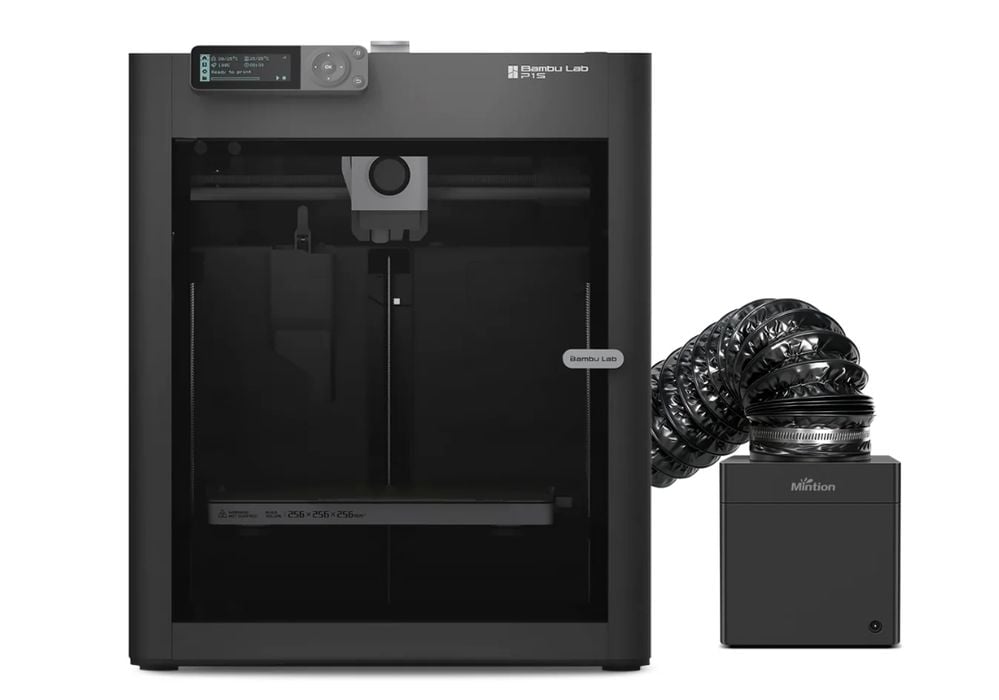
Mintion has released an inexpensive filtration system for desktop 3D printers.
The company produces a variety of accessories for desktop 3D printers, including webcams, cleaners, toolkits, heat inserts, and filtration. They even offer an air quality meter that can be used to test 3D printer setups.
Their latest filtration system is the V1, which is designed to capture and eliminate emissions from a desktop 3D printer.
Hold on, what emissions? It turns out that FFF systems do emit pollutants when the plastic is heated up. There are two kinds of emissions: nanoparticles, which are tiny pieces of the material, small enough to get airborne; and volatile organic compounds (VOCs), which are a family of chemical agents, some of which can be toxic.
Different plastics have different emission behavior — and can emit different types of VOCs. The worst is likely ABS/ASA, and that’s something you can even notice with your nose if printing either of those materials.
You definitely don’t want to be breathing in much of these emissions. That’s why it’s often suggested to properly ventilate your 3D print area. Unfortunately, this isn’t always possible. If you’re located where you can’t cut a hole in the wall for a vent, you’re out of luck.
For those folks, the answer is an in-place filtration system. A proper filter can capture most of the emissions, so the issue is this: how do you push that polluted air through that filter?
Part of the solution is an enclosure: the enclosure walls prevent emissions from immediately spreading around the room, and then a filtration system can clean them.
Many modern desktop 3D printers are enclosed, and they usually offer a vent port on the back of the machine for this purpose. The idea here is to connect the V1 to that port to process the polluted air.
The V1 includes a three-stage filtration stack, comprised of:
- A coarse filter to capture large dust particles, fibres, etc.
- A HEPA H13 filter to capture nanoparticles
- A deep activated carbon bed to absorb VOCs
The V1 also includes a centrifugal fan to move air out of the enclosure, but through the filter for cleaning. In theory, cleaner air is exhausted by the system, and your work area is safer.
The filter is separate from the enclosed machine, and it’s connected by a large 100mm flexible air hose. The polluted air remains in the hose until it’s cleaned by the external filter. The V1 is available with a number of adapters for already enclosed 3D printers from Bambu Lab, Prusa Research, etc.
Does this setup work? According to this analysis by Mintion, you can see that PM2.5 (a measure of small particles) does drop notably during the course of a print job. Notice also that the majority of the particles are produced during the initial stages of the job when things are heating up. Mintion provides a number of test results using different materials that react differently when heated.
The best part of this solution is the price: US$105. That is quite low compared to some other dedicated 3D printer filtration systems. It may not have all the bells and whistles, but it’s really the filtration that counts.
At that price, it should be a no-brainer for anyone operating an enclosed desktop FFF 3D printer.
Via Mintion
