
A new simulation study investigates how large spatter forms and damages surface quality in metal additive manufacturing.
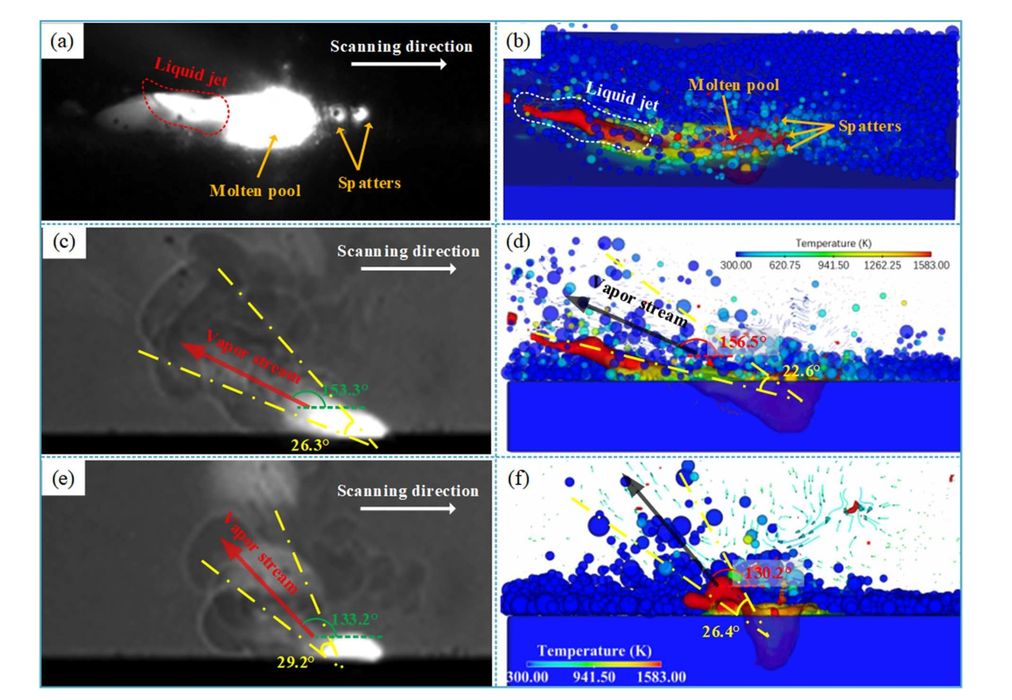
The paper, titled Large spatter formation mechanism and its influence on surface quality in additive manufacturing process using in situ monitoring informed solid liquid gas coupling simulation, looks at a common problem in laser based metal additive manufacturing: Ejected particles can mess up the print job.
Spatter is always present in Laser Powder Bed Fusion (LPBF), where the laser creates a small and highly energetic melt pool within a powder bed. Metal vapor, shielding gas flow, recoil pressure, molten droplets, and loose powder all interact in a very short time period. That makes it difficult to figure out why a particular particle becomes unusually large, where it travels, and whether it lands on the build in progress.
Small particles may be removed by gas flow or settle harmlessly away from the active region. Larger ejected droplets and agglomerates are a more serious concern. If they land on a subsequent layer, they can interfere with powder recoating, alter local energy absorption, or become surface attached defects.
Connecting What The Camera Sees To The Physics
Rather than treating the melt pool, vapor plume, and surrounding atmosphere as separate events, the approach attempts to model their interaction while grounding the model in observed process behavior.
In other words, the researchers are trying to bridge the usual gap between a monitoring image that shows a bright, chaotic plume and a simulation that predicts what may be occurring inside it. Machine cameras and photodiodes generate plenty of data, but a production team still needs a credible explanation before it can turn an image anomaly into a parameter change or a quality decision.
Surface quality is an especially practical outcome to examine. Internal porosity often receives the greatest attention in metal AM research because it can affect mechanical properties and qualification. However, poor surface finish can drive machining, blasting, polishing, inspection, and support removal costs. For complex internal passages or lattice structures, those post processing options can be limited or unavailable.
If large-spatter events can be associated with predictable laser conditions, scan strategies, powder states, or gas flow behavior, 3D printer operators could potentially avoid at least some surface defects before they occur. A more advanced version of this approach could also support closed loop process controls, build interruption rules, or better placement of monitoring sensors.
Useful Model, Difficult Production Problem
Powder lots vary, optics become contaminated, gas flow changes across a large build plate, and complex part geometry produces different thermal conditions from one scan vector to the next. A model calibrated on selected monitoring data must demonstrate that it is useful across many machines, materials, and builds.
There is also a commercial question. OEMs increasingly sell monitoring, analytics, and process control as part of their AM platforms. A validated mechanism for large-spatter formation could make those tools more actionable, but only if it reduces false alarms and produces recommendations operators can actually use.
Via Taylor & Francis
