
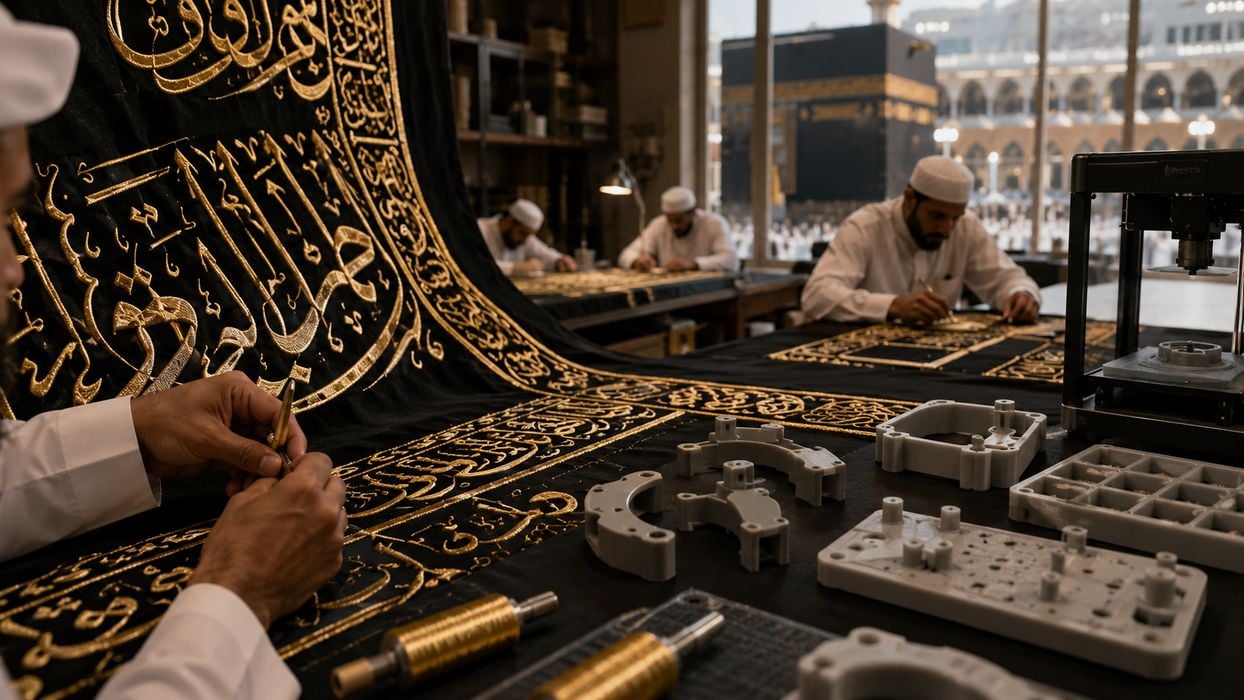
A new research paper proposes a practical framework for using additive manufacturing in the sacred gold thread embroidery of the Kaaba’s Kiswah.
The Kiswah is not a typical textiles project. It is meticulously produced each year with silk fabric and gold thread embroidery, and any change to that process must respect centuries of craft and religious significance. That is why the researchers’ decision to talk about digital transformation and AM is notable — it describes careful modernization.
The work appears in the academic literature and focuses specifically on integrating AM with gold thread embroidery workflows for the Kiswah. It is not a machine launch, but instead a framework proposal.
AM has already made its way into fashion and heritage spaces, from 3D printed couture elements to jigs and fixtures that stabilize delicate restoration work. The difference here is this particular application’s sanctity and the precision demanded by Arabic calligraphy, raised motifs, and the strict dimensional fidelity on heavy silk panels.
The paper’s core idea is to formalize a digital pipeline that preserves traditional aesthetics while introducing selective AM where it helps most. That likely includes digital capture of motifs, parametric pattern management, and physical aids produced by polymer AM to improve repeatability and ergonomics during embroidery. The aim is not to “print the Kiswah,” but instead to support the people who make it.
This could lead to simple, high-impact parts: alignment fixtures for fabric handling, curved clamps that match panel geometries, tactile templates that define letterforms, and organizational trays that reduce touch time and error. These are the type of parts that service bureaus and internal labs deliver all the time using FFF for robust jigs and SLA/DLP for fine-detail guides.
There is also a tantalizing but complex extension: precious-metal AM. Laser Powder Bed Fusion (LPBF) and binder jetting can work with gold alloys, which opens the door to 3D printed embellishment carriers or dies for embossing raised guides under the embroidery. This sounds great, but cost, certification, and material behavior on silk would make such steps non-trivial.
The value proposition is pretty clear: better repeatability, less physical strain on artisans, faster setup, and cleaner handoffs between design, preparation, and stitching. A digital library of motifs with corresponding 3D printable fixtures could also help training, where apprentice embroiderers practice on standardized panels before graduating to production.
This is a tooling story. It requires polymer systems with reliable tolerances, stable resins or nylons. It also matches the existing business of printing low-volume, high-precision aids — the kind of parts that eventually justify an in-house SLA unit or a dependable FFF work cell alongside traditional craft benches.
For the Kiswah, approvals will involve religious authorities, workshop leadership, and likely conservation experts. Even a benign fixture has to pass tests for cleanliness, off-gassing, and long-term storage. A likely path is going to be incremental: start with non-contact design aids and training rigs, then move to light-touch guides on non-sacred practice pieces, and only then approach production panels.
This is a very interesting move because it reframes 3D printing not as a replacement for traditional craft, but instead as stewardship technology that protects precision and people.
Via OpenAlex
