
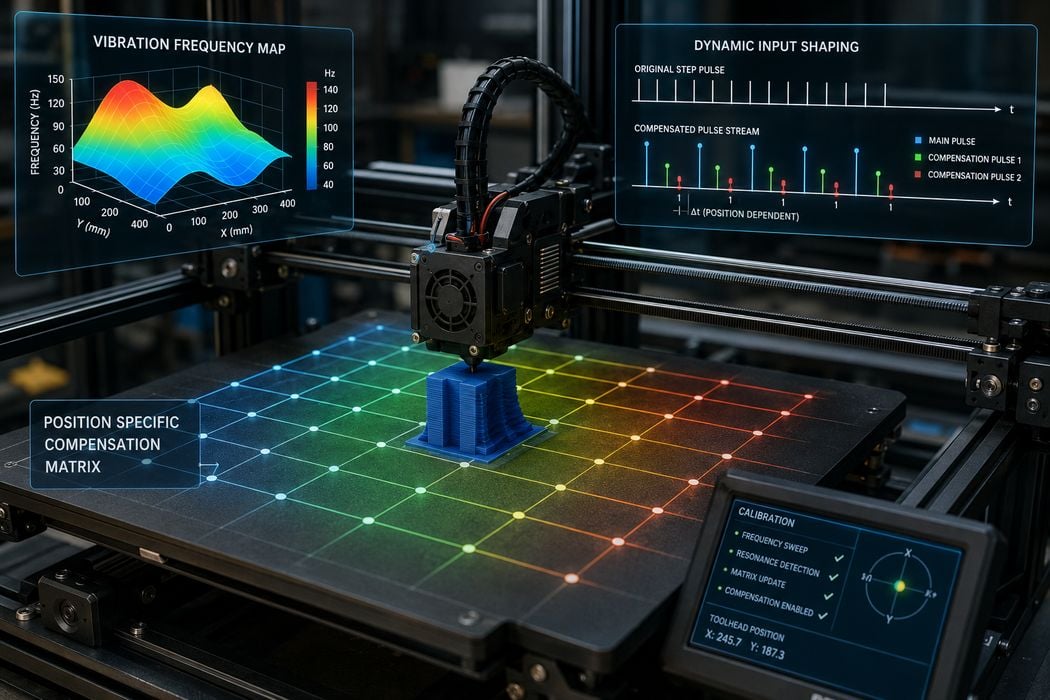
A new Chinese patent application suggests a more sophisticated way to stop ringing on high speed CoreXY 3D printers.
The application, CN122299938A, is assigned to Atom Reshape Technology (Shenzhen) Co., Ltd. Their invention is titled, in translation, “Full Field Dynamic Vibration Pattern Suppression Method, System and Printer for 3D Printers.”
It’s all about ghosting, ringing, vibration marks and accuracy loss when a CoreXY FFF machine runs too quickly.
Most modern high speed desktop FFF systems now use some form of input shaping. The machine buzzes the toolhead, measures vibration with an accelerometer, identifies a resonant frequency, and then modifies motion commands so the machine does not excite that resonance as badly.
That approach has been a major reason today’s desktop machines can move way faster than older designs while still producing great surface quality.
However, there’s a problem.
A CoreXY machine does not have one perfect vibration frequency everywhere on the bed. The toolhead position changes belt spans, belt loading, effective stiffness and dynamic behavior. A frequency measured at the center of the build area may not be the correct frequency near a corner or along an edge.
The patent directly is all about solving that problem.
Instead of using one compensation value for the entire XY plane, the proposed system builds a discretized compensation parameter matrix across the print area. The printer calculates the toolhead’s current physical position from the stepper motor command sequence, looks up nearby compensation values, interpolates between them, and generates a location specific compensation frequency in real time.
In other words, the input shaping would follow the toolhead around the build area.
The patent describes reshaping the original drive command into a modified pulse stream. For each original step pulse, the system emits a main pulse and at least one subordinate compensation pulse. The delay time between these pulses changes dynamically with the current toolhead position so the compensation frequency better matches the local mechanical resonance.
This is a fairly interesting idea because it treats vibration as a spatial problem, not just a single calibration problem.
The Calibration Problem
There is a pretty obvious issue with all this: calibration time.
The patent describes an initial calibration step where the toolhead moves to sampling points defined in the compensation matrix, performs frequency sweep excitation, and uses a toolhead mounted accelerometer to identify resonance peaks. Those values update the matrix.
If the matrix has only a small number of XY positions, calibration might be tolerable. But the whole point of the invention is to handle position dependent changes across the build area. That implies many sampling points, especially near the edges where the patent says belt span changes can be more sensitive.
This could turn a quick input shaping routine into something way longer.
It is not entirely clear whether a commercial version would require a full calibration at many positions in three dimensional chamber space. The patent mainly discusses the XY print region, which makes sense for a CoreXY motion system. However, it also mentions temperature drift, dynamic load calibration and long running behavior. Those variables could expand the calibration problem considerably if the system tried to map different Z heights, chamber temperatures, toolhead loads or belt conditions. You can imagine the length of a comprehensive calibration routine that handles all that stuff.
A practical commercial product would likely need some shortcuts. It might use a coarse factory map, then refine selected points during setup. It might concentrate sampling near mechanically sensitive areas. It might also use interpolation, instead of measuring every possible location.
The patent also proposes dynamic load calibration during non contact travel moves, using vibration decay data to estimate damping and adjust compensation pulse weighting. There is belt tension assessment using motor feedback current ripple and accelerometer phase offset. There is temperature drift compensation, which would adjust timing based on chamber temperature because belts and structures can change behavior as they heat.
This is quite a laundry list of patent claims, suggesting a future product based on this concept could be pretty complicated.
This could be especially useful on larger CoreXY machines, where the difference between center and corner dynamics can become more obvious. It could also help 3D printer operators who print large parts, multiple parts spread across the bed, or long jobs where heat and belt behavior change over time.
The catch is the implementation. This requires calibration time, storage, interpolation, accurate timing, reliable sensor data and firmware integration tight enough to insert compensation pulses without causing new artifacts. The patent claims subordinate pulse insertion precision of one microsecond or better, which is not trivial in a low cost controller environment.
If this concept works, then it could enable even more print speed from CoreXY systems.
Via Espacenet
