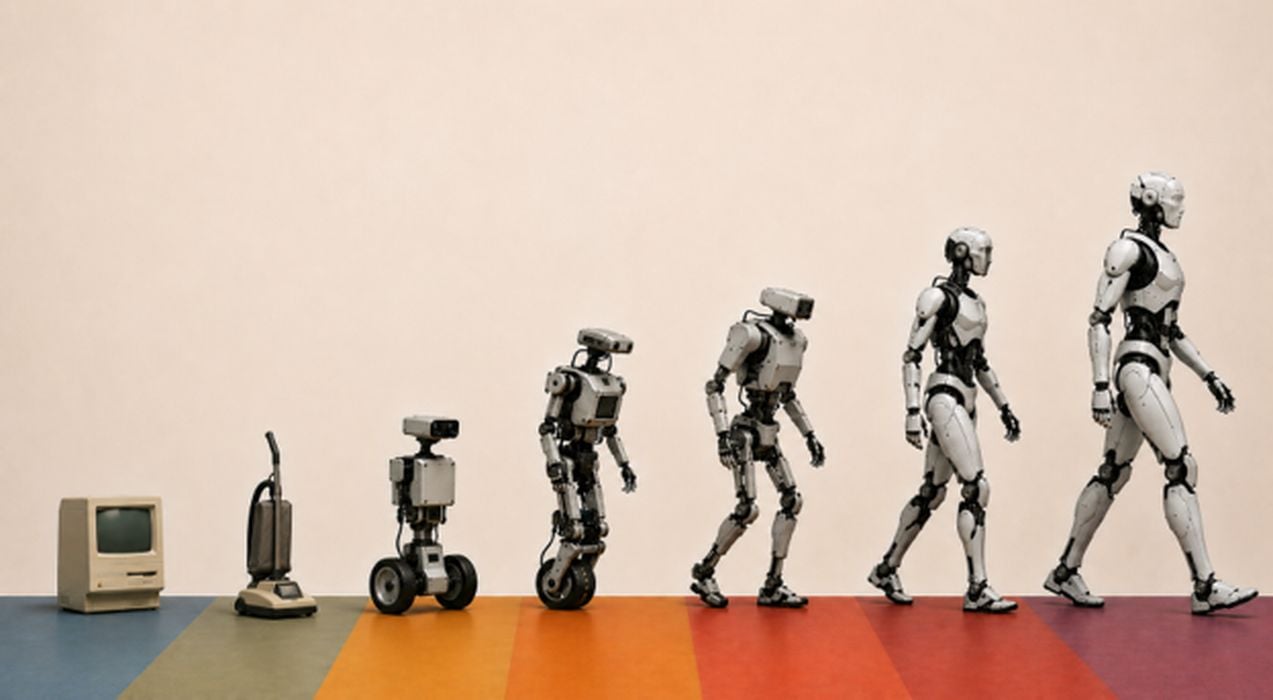
Charles G. Goulding raises the key question: How effectively can humanoid robots perform work traditionally done by humans?
Robots Enter the Human Sphere
Industrial robots already dominate large sections of manufacturing. They weld frames and inspect parts with extraordinary consistency. But their success depends on controlled environments built around repetition and fixed movements.
The next generation looks very different. A humanoid robot is generally envisioned as a machine roughly the size of an adult human. Most designs stand between five and six feet tall. They usually have two arms and two legs along with shoulders and elbows and knees that roughly mirror human joints. They are designed to walk through ordinary buildings and manipulate ordinary tools precisely because those buildings and tools were originally built for people.
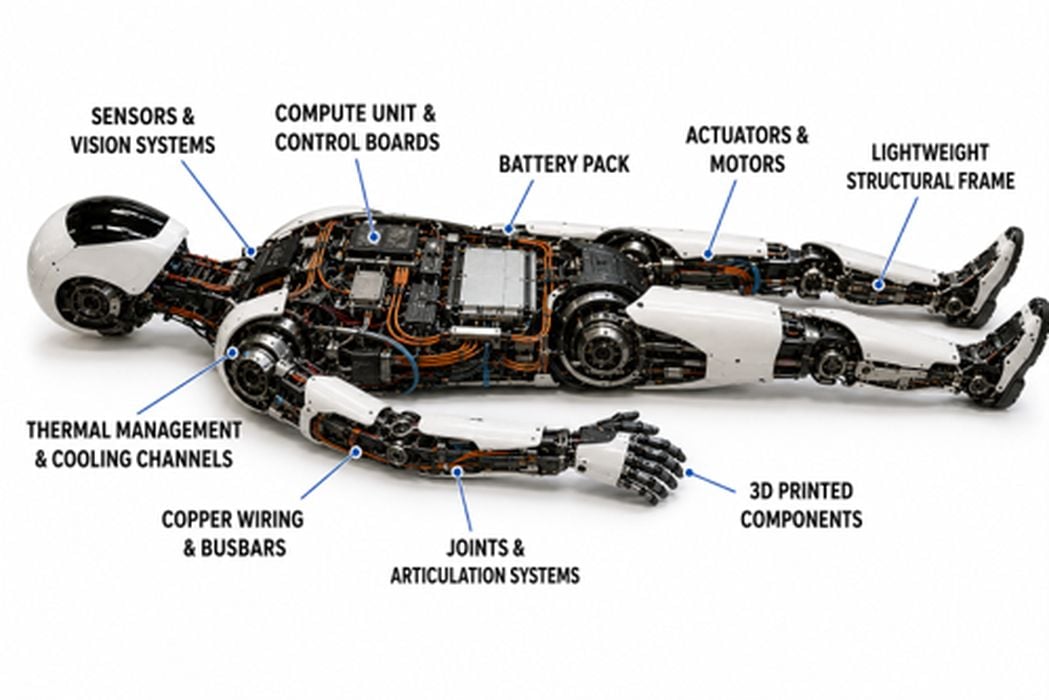
The current generation combines motors and batteries with machine vision and onboard computing. Cameras interpret surroundings while AI systems guide balance and movement. Humanoid machines act like mobile workers capable of navigating ordinary human-centered infrastructure.
Warehouses And Factories Are A Starting Point
Inside warehouses and factories, many industrial tasks are too variable for rigid automation. Workers retrieve parts and reposition materials throughout the day. They respond to interruptions. They navigate crowded facilities filled with temporary obstacles. Traditional industrial robots struggle once conditions become less controlled.
At the same time, many employers struggle to fill physically exhausting jobs consistently. Warehousing and logistics operations often face high turnover rates. Aging industrial economies place additional pressure on the labor pool, while younger workers show less interest in repetitive physical work.
This combination creates the opening for humanoid robotics. Companies are not only searching for lower labor costs. Many are searching for labor stability in environments where staffing has become increasingly difficult.
Major Constraints: Copper And Other Materials
Humanoid robots present huge engineering challenges. Weight is a constant problem. A heavier robot requires more energy to move. Larger batteries increase operating time but also increase mass. Additional mass places more stress on joints and motors while reducing agility and balance.
The cycle turns materials into a central engineering constraint. Designers pursue lighter structures and lower power consumption at the same time. Aluminum and titanium help reduce weight. Advanced polymers improve durability while controlling heat and stress.
Copper is particularly important because humanoid robots are electrically dense systems. Motors require copper windings while wiring systems depend heavily on copper conductivity. Charging systems and power electronics lean on the same material base. The more dexterous the machine becomes, the more electrical complexity required.
Humanoid robotics are also emerging during a broader industrial buildout already consuming large amounts of copper. Electric vehicles and renewable energy infrastructure depend on conductive material across grids and transmission networks. AI data centers add another layer of electrical demand. Humanoids therefore are part of much industrial competition for the same material base.
Mining supply cannot expand quickly enough. New projects require years of financing and permitting before production begins. Refining capacity also remains concentrated in a relatively small number of regions. Though robots look futuristic, these material constraints are nothing new.
Batteries May Decide What Robots Can And Can’t Do
Battery performance may become another defining constraint on humanoid robotics. A machine capable of moving dynamically through real environments consumes large amounts of energy while trying to stay balanced and to carry weight.
Current battery technology creates difficult tradeoffs. Larger batteries increase operating time but also increase weight and mechanical stress. Smaller batteries improve agility but reduce useful deployment windows. Engineers try to balance endurance and mobility at the same time.
Fast charging also creates challenges. A warehouse fleet cannot sit idle for extended charging periods. Companies may eventually rely on battery swapping systems or hybrid operating models where robots rotate through charging cycles continuously.
3D Printing Accelerates Production
Additive manufacturing already plays a major role in robotics. Engineers redesign housings and structural parts constantly while prototypes evolve.
Humanoid robots, given their crowded internal geometries, can also benefit from 3D printing. Cooling channels and wiring paths compete for space around joints and motors inside a compact frame. Engineers often need multiple redesign cycles before arriving at workable configurations.
3D printing allows engineers to reduce weight while preserving structural strength. It also allows redesign without forcing companies into expensive tooling commitments during an industry that still changes rapidly from one generation to the next.
Speed matters in particular because of the aggressive deployment timelines being discussed by key companies. Elon Musk expects Tesla to eventually produce humanoid robots in very large numbers. He has even suggested the long-term scale could exceed automobile production itself.
This level of deployment would place major pressure on manufacturing systems. Additive manufacturing will not replace conventional industrial production, but it will help companies iterate and repair systems quickly enough to keep pace with the timelines they are publicly discussing.
Supply Chains Will Also Matter Enormously
A humanoid robot concentrates several vulnerable supply chains inside one product. Chips and batteries create one layer of dependency, precision manufacturing another. Electrical infrastructure creates yet one more.
Governments increasingly treat advanced manufacturing as strategic infrastructure. Export controls and tariffs now shape industrial decisions that once belonged mostly to global markets. Supply chains become geopolitical very quickly under those conditions.
That reality changes how companies think about maintenance and repair. A warehouse operator, for instance, cannot tolerate long delays every time a housing cracks or a structural bracket fails.
Additive manufacturing can meaningfully help. A warehouse or factory may eventually print replacement housings or custom grippers near the point of use instead of waiting for centralized production and shipping. Certain robotic joints and lightweight structural brackets already lend themselves naturally to 3D printing because they require unusual geometries and rapid iteration.

The Research & Development Tax Credit
Enacted in 1981, the now permanent Federal Research and Development (R&D) Tax Credit allows a credit that typically ranges from 4%-7% of eligible spending for new and improved products and processes.
Qualified research must meet the following four criteria:
- Must be technological in nature
- Must be a component of the taxpayer’s business
- Must represent R&D in the experimental sense and generally includes all such costs related to the development or improvement of a product or process
- Must eliminate uncertainty through a process of experimentation that considers one or more alternatives
Eligible costs include U.S. employee wages, cost of supplies consumed in the R&D process, cost of pre-production testing, U.S. contract research expenses, and certain costs associated with developing a patent.
On December 18, 2015, President Obama signed the PATH Act, making the R&D Tax Credit permanent. Beginning in 2016, the R&D credit can be used to offset Alternative Minimum Tax for companies with revenue below US$50 million. For the first time, pre-profitable and pre-revenue startup businesses can also obtain up to US$500,000 per year in payroll tax offsets and cash rebates.
Public Opinion Matters Enormously
Humanoid robots raise strong concerns about human labor rights. Economic fairness is another concern. If deployment benefits only investors, public hostility toward humanoid robotics will grow quickly.
The social response will depend heavily on how the technology is introduced. Robots that reduce injuries and absorb dangerous work will be easier to accept than robots used mainly to cut payroll. Public perception will also depend on whether workers share in the productivity gains through better wages, shorter hours, or safer working conditions.
A machine assisting workers during exhausting or hazardous tasks likely will be providing welcomed support. By contrast, a humanoid visibly replacing large groups of workers during periods of economic instability will be viewed very differently.
The key question is whether societies integrate humanoid robots without creating an overwhelming sense of human redundancy and social disposability. People tolerate technological change more easily when the gains remain broadly shared. They become hostile, and understandably so, when efficiency appears detached from human well-being. Humanoid robots may eventually force a larger political and cultural argument about what modern economies owe the people whose labor built so much infrastructural advancement in the first place.
Charles G. Goulding is a practicing attorney.