
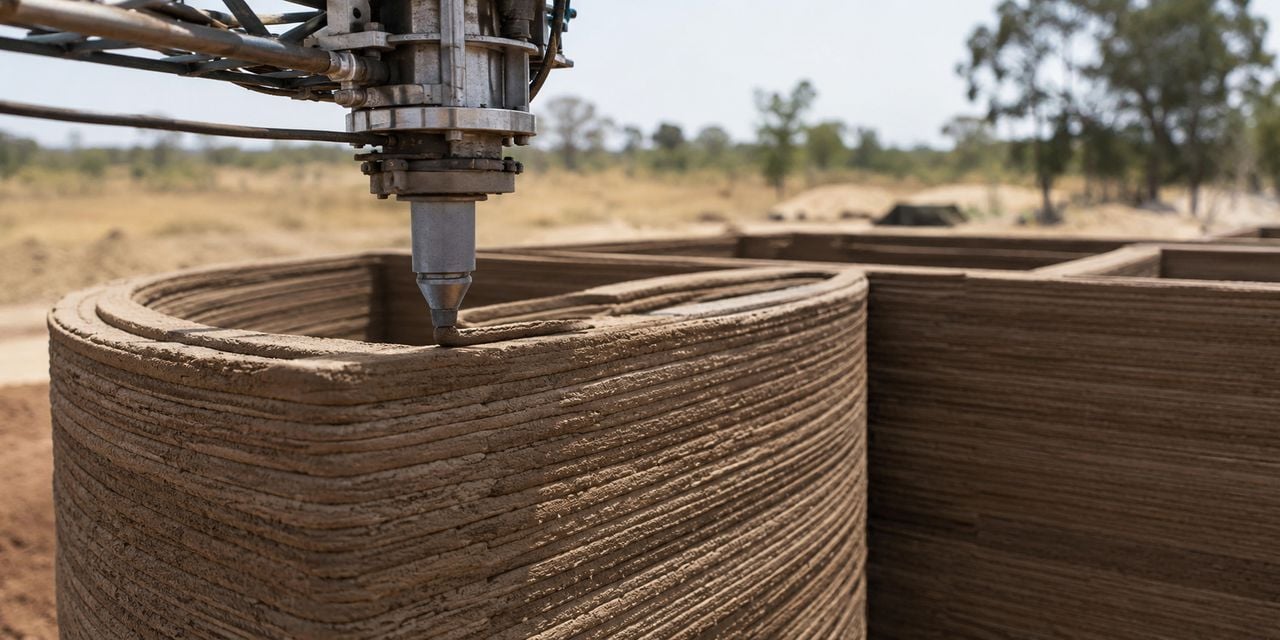
A French lab has posted a raw-earth 3D printing dataset that could push construction 3D printing closer to robust automation.
The release, titled “Raw-Earth 3D Printing Dataset,” is now available publicly, which provides a public, citable resource for anyone to use. For teams using clay and soil extrusion, this could be quite important. Repeatable, shared data is how the best results can be obtained with given local materials.
Raw-earth extrusion is different from the normal concrete printing. Unlike portland cement mixes or polymer FFF, earth-based materials are highly inconsistent, having wide variability of moisture, particle size, chemistry and local geology. Extrusions can slump between layers, drying can induce shrinkage and cracks, and the window for deposition rates is narrow.
Why An Earth Dataset Matters For Construction 3D Printing
Open datasets let labs compare apples to apples. With common images, sensor traces, and labeled outcomes, teams can iterate on layer height estimation, bead width prediction, and defect detection without rebuilding the same ad hoc rigs. This should greatly aid anyone printing in these materials..
Polymer FFF has already benefited from low-cost flow sensors, lidar height maps, and camera-based quality checks, while mortar and concrete printing groups have begun to share testbeds for rheology and buildability. Raw earth has lagged behind on open, standardized data. This data drop from LS2N helps close that gap and gives smaller labs a way to contribute without custom hardware starting from zero.
Potential Impact And Open Questions
Who benefits first? University robotics and civil engineering groups will likely jump on it to benchmark their workflows. OEMs building gantry or robotic-arm earth printers might be able to use the data to pretrain models before factory-floor tuning. Material developers working on stabilizers and fiber blends can correlate rheology to printability with fewer blind trials.
This is a very interesting development for an under-documented corner of construction 3D printing. Dirt is cheap and everywhere, but turning it into a reliable structure at scale is really a data problem.
Via Zenodo
