Charles R. Goulding and Andressa Bonafe spotlight how 3D printing has transformed fashion’s most iconic stage, from Met Gala showpieces to custom-built mannequins designed to reflect the diversity of the human body.
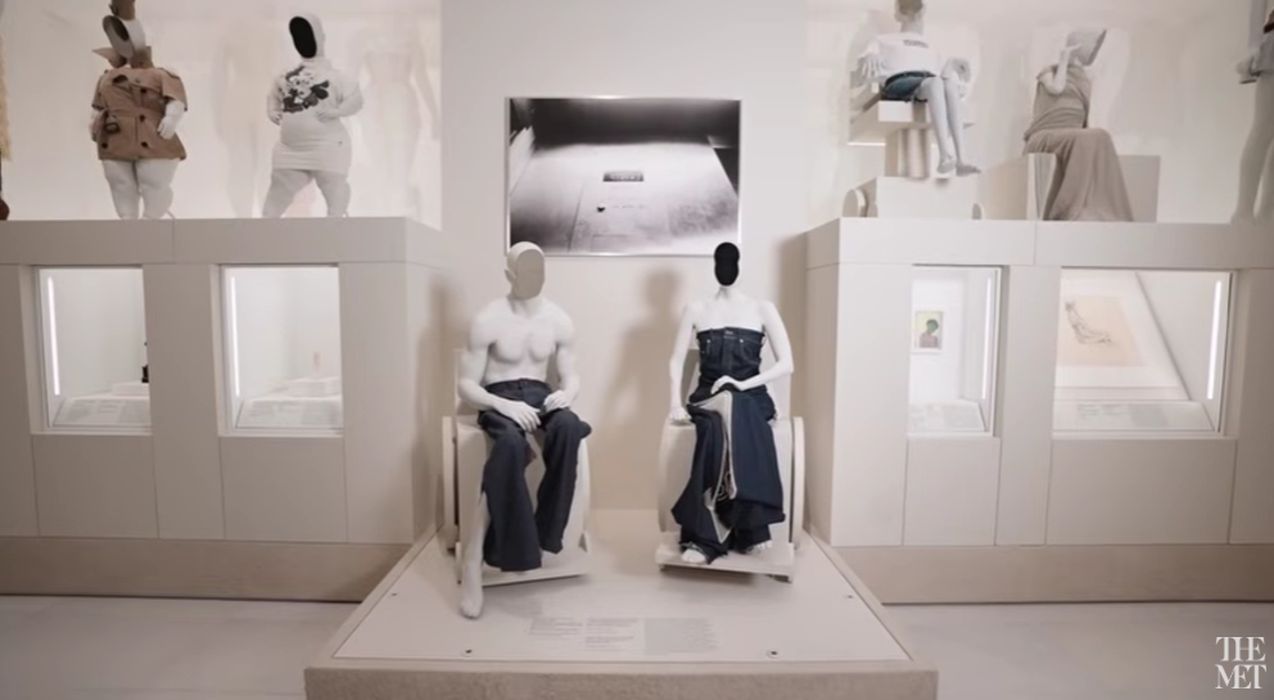
When the Metropolitan Museum of Art unveiled its new “Costume Art” exhibition on May 10, 2026, it introduced something the institution had never displayed before: a collection of mannequins reflecting diverse body types, including larger bodies, pregnant bodies, trans bodies, and bodies with disabilities. According to Smithsonian Magazine, each figure was modeled after a real person, with subjects posing before 175 cameras simultaneously. The body scan data was then translated into digitally designed, 3D printed, and hand-finished forms, making it feasible to produce custom proportions that standardized mannequin molds would not easily accommodate. It was a striking use of additive manufacturing: not to create spectacle, but to make fashion display more anatomically specific, more inclusive, and less dependent on standardized bodies. It is not the first time additive manufacturing has shaped what visitors encounter at the Met. On the Met Gala red carpet, it has been doing so for over a decade.
Beyond the Standard Mannequin
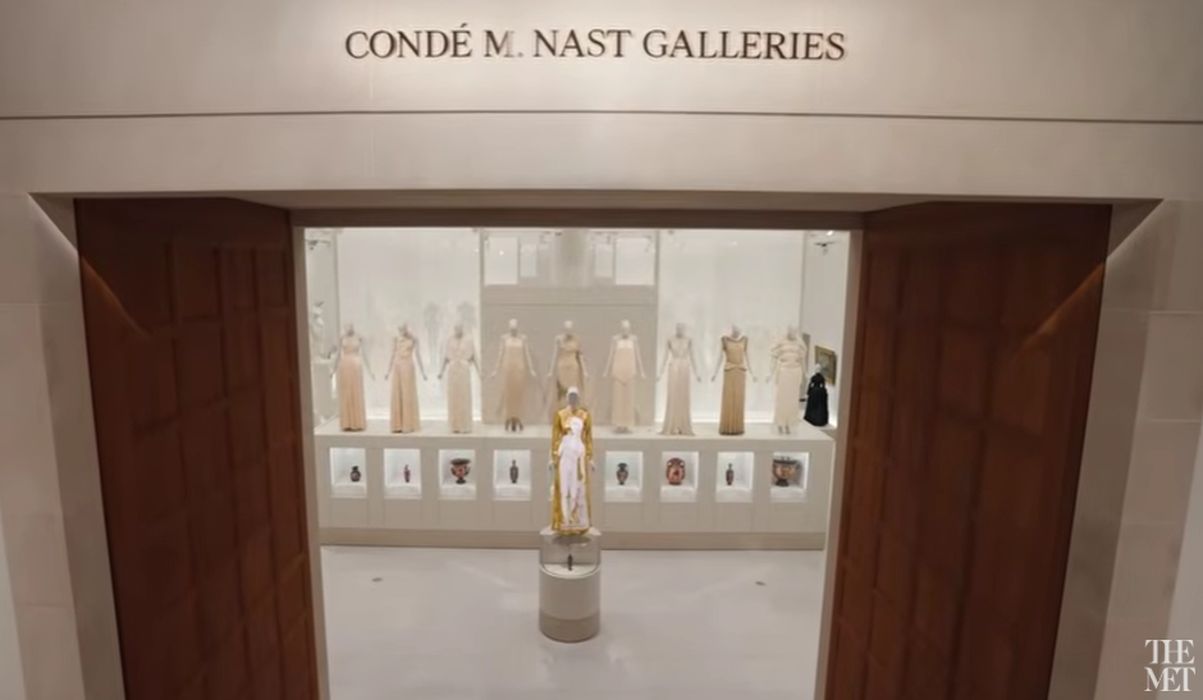
The “Costume Art” exhibition inaugurates the Met’s new Condé M. Nast Galleries, a nearly 12,000-square-foot space adjacent to the Great Hall. The show explores the centrality of the dressed body across art history, pairing garments from the Costume Institute with artworks from the museum’s broader collection. The Met describes the exhibition as a way to reveal the relationship between clothing and the body, with pairings that range from formal and aesthetic connections to political, symbolic, and conceptual ones.
According to the Met, the exhibition includes nearly 400 objects from its collection. Rather than treating fashion as secondary to painting or sculpture, the show places garments and artworks in direct conversation. Andrew Bolton, curator in charge of the Costume Institute, explained to Vogue that the exhibition is structured around a typology of bodies, with “the dressed body” serving as the connecting thread across the museum.
That curatorial idea depends heavily on the mannequins themselves. Smithsonian Magazine reports that nine real people served as the basis for 18 mannequins, while seven additional forms were created to reflect experiences less commonly represented in fashion display, including pregnancy. All of the mannequins have mirrored faces, allowing visitors to see themselves reflected in the exhibition. After the show closes in January 2027, the mannequins will enter the Met’s permanent collection.
For artist Michaela Stark, one of the models, the exhibition “institutionalizes the idea that bodies are different,” as quoted by Smithsonian Magazine. That statement also captures why 3D printing matters here. The technology allowed the museum to move away from standardized display forms and toward bodies derived from real human variation. In doing so, additive manufacturing became part of the exhibition’s argument: fashion is not only about garments, but about the bodies that carry them.
How Does 3D Printing Tech Move from Concept to the Runway?
Advanced design teams leverage industrial 3D printing and post-processing methodologies to bridge the gap between digital modeling and structural performance:
- Kinetic and Kinetic-Hybrid Integration: Designers utilize custom software toolpaths to construct body-mapped pieces, electroformed metallic bodices, and motorized kinetic elements (such as moving micro-motifs) engineered directly into custom apparel bases.
- Material and Blend Experimentation: Engineering teams continuously test alternative technical filaments, polymers, resin-curing cycles, and electroforming coatings to achieve exact mechanical tolerances, flexible movement, and precise aesthetic finishes.
- Mannequin Infrastructure Replication: Museums and commercial brands leverage 3D printed components and hand-finished forms to establish durable, permanent collection infrastructures that mirror precise real-world human proportions.
The Met Gala’s 3D Printing Record
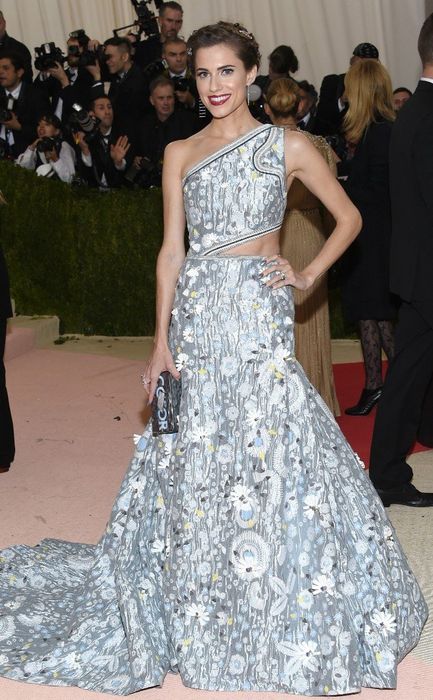
“Costume Art” makes 3D printing part of the museum’s curatorial language, but the technology’s relationship with the Met began much earlier on the red carpet. The Met Gala has been a recurring stage for wearable additive manufacturing, especially since the 2016 “Manus x Machina” theme brought fashion and technology into direct conversation. That year, Allison Williams wore a Peter Pilotto gown developed with Cinter using 3D printing for delicate appliqué work, while Kate Hudson’s Atelier Versace look also pointed to the growing role of additive manufacturing in red-carpet design. These early examples were less about replacing couture craft than extending it, using digital fabrication to create sculptural details that could then be integrated into traditional garments.
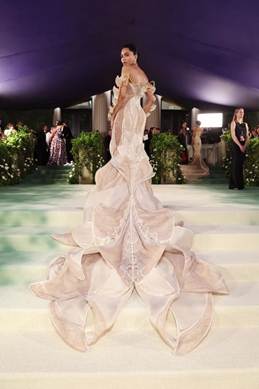
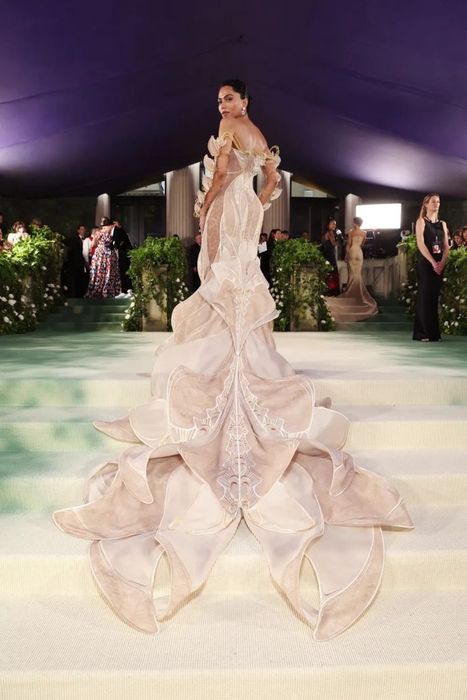
The clearest turning point came in 2019, when Zac Posen collaborated with GE Additive and Protolabs on a group of 3D printed Met Gala looks and accessories worn by Jourdan Dunn, Nina Dobrev, Katie Holmes, Julia Garner, Deepika Padukone, and others. The project showed the range of additive manufacturing in fashion: full sculptural garments, body-specific bustiers, headpieces, embroidery elements, brooches, and cufflinks. In 2022, Iris van Herpen extended that trajectory with technology-forward Met Gala looks worn by Dove Cameron, Teyana Taylor, Winnie Harlow, and Fredrik Robertsson. Long recognized as one of fashion’s leading references in 3D printing, van Herpen helped move the technology from experimental runway objects, such as her 2010 “Crystallization” top, into the language of contemporary couture. At the Met Gala, her work showed how digital fabrication could support garments that behave less like clothing alone and more like wearable sculpture.
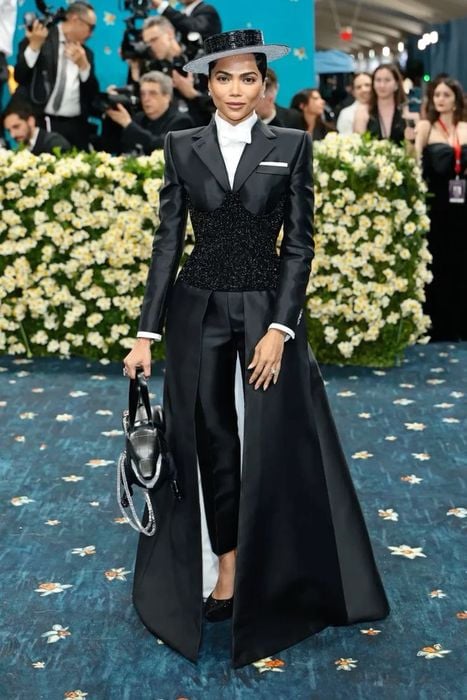
More recent Met Galas have pushed the technology beyond the garment itself into kinetic, body-mapped, and sculptural extensions of the wearer. In 2024, Mona Patel’s Iris van Herpen look used 3D printed structures and moving butterfly motifs, while Paloma Elsesser wore a custom H&M two-piece featuring a made-to-measure metallic bodice that was 3D printed and electroformed in an oxidized green finish, with 3D-printed calla lilies across the chest. Patel returned in 2025 with a Thom Browne look completed by a 3D-printed hat, while André 3000’s piano-backpack relied on 3D-printed elements to turn an otherwise unwieldy sculptural object into something wearable on the carpet. In 2026, the same logic appeared in Kendall Jenner’s Zac Posen/GapStudio look, which used 3D printing to create a body-specific mannequin and corset base, as well as in Robert Wun’s sculptural looks for Lisa and Jordan Roth, where 3D scanning and 3D-printed body forms became part of the visual language of the garment.
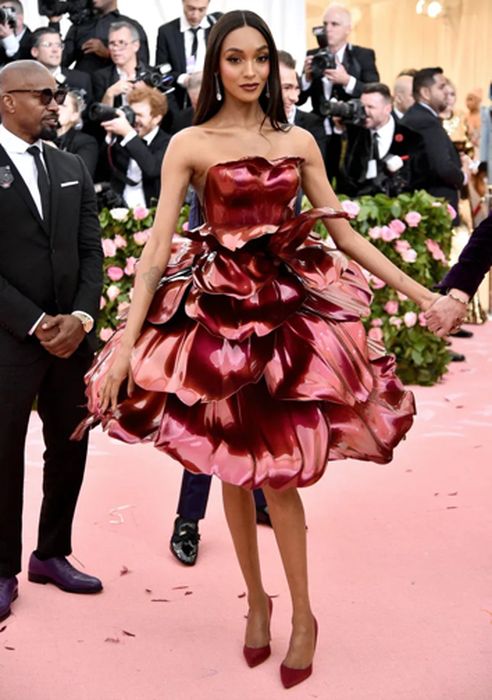
Taken together, these examples show why 3D printing keeps returning to fashion’s most scrutinized red carpet. It allows designers to work from body scans, produce rigid or semi-rigid forms with precise fit, create lightweight sculptural structures, and fabricate geometries that would be difficult to sew, cast, mold, or embroider by hand. The technology does not replace couture craft; it expands it through digital modeling, material testing, and iterative engineering, the same kinds of activities that can carry important R&D tax credit implications.
How Do Fashion Engineering Activities Align with Research and Development Criteria?
Developing non-standard mannequins and wearable architectural garments requires overcoming severe material science, software scaling, and mechanical limits, aligning directly with Section 41 criteria.
| Core R&D Technical Activity | IRS Four-Part Test Alignment | Financial Recovery Impact |
| Photogrammetry & Mesh Processing | Resolves technological uncertainty regarding translating raw 3D scan coordinates into printable, structurally sound watertight solid geometries. | Captures qualified engineering and software developer hours spent optimizing 3D digital layouts and file parameters. |
| Filament & Resin Stress Testing | Conducts a systematic process of experimentation to test custom polymers and flexible resins for tensile strength, heat resistance, and durability. | Recovers the direct costs of raw filaments, photopolymer resins, and chemical reagents consumed during iterative printing cycles. |
| Hardware & Post-Processing Integration | Overcomes mechanical engineering hurdles linked to multi-axis print deposition, electroforming finishes, and structural consolidation. | Offsets internal labor costs of technicians, system engineers, and master modelers troubleshooting hardware settings. |
Strategic Insight for CFOs and Creative Directors: While landmark cultural displays—such as Zac Posen’s collaborations with GE Additive, or Iris van Herpen’s body-mapped metallic bodices—generate massive public brand equity, they fundamentally represent intensive technical experimentation. For tax purposes, 3D printing acts as an immediate indicator that eligible R&D activities are occurring on the production floor. Partnering with R&D Tax Savers allows apparel tech firms and display innovators to cleanly document technical employee wages and prototype material costs, turning artistic spectacle into a structured source of capital recovery.
Fashion Gets a Digital Makeover
The Met’s 3D printed mannequins for “Costume Art” bring the fashion story full circle. What began in experimental runway pieces and later appeared on the Met Gala red carpet as sculptural gowns, body-mapped accessories, and digitally fabricated forms is now part of the museum’s own exhibition infrastructure. Additive manufacturing has become a tool not only for spectacle, but for precision, representation, and new ways of thinking about the dressed body. For fashion companies, designers, and technology suppliers working in this space, that evolution also has a practical business dimension: the modeling, testing, material experimentation, and iterative engineering behind these applications may support valuable R&D tax credit opportunities.