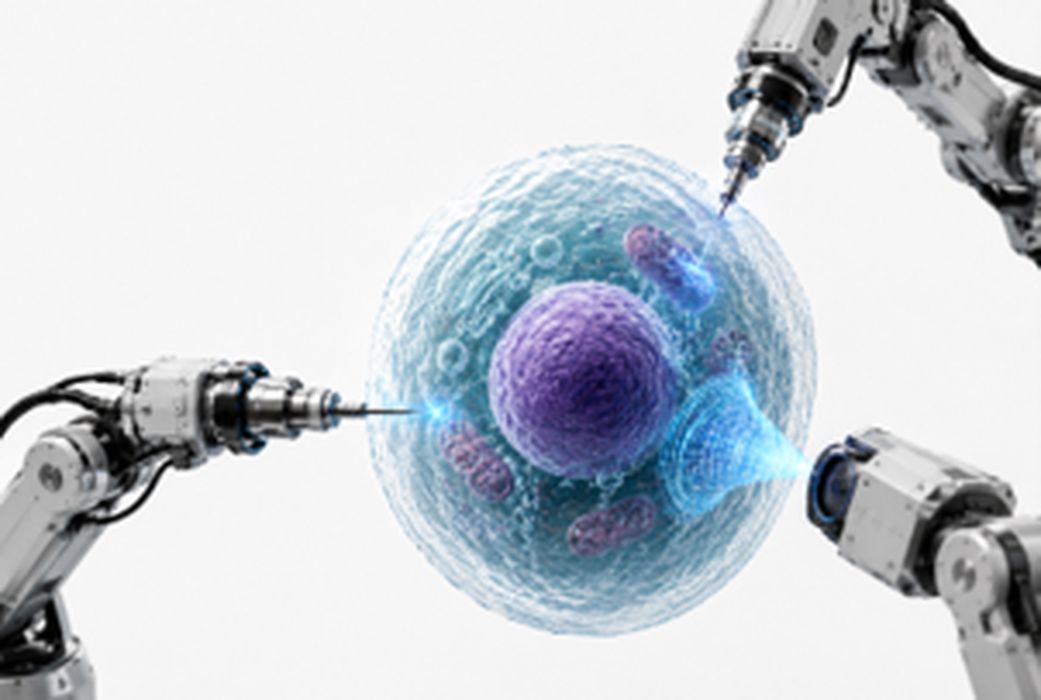
“Where do I think the next amazing revolution is going to come? … There’s no question that digital biology is going to be it.” — Jensen Huang, CEO, NVIDIA, Forbes.
Charles G. Goulding examines the convergence of AI-driven digital biology and additive manufacturing, revealing how next-generation research is accelerating scientific breakthroughs and reshaping the future of biotechnology.
For more than a century, biology has largely been a science of discovery. Scientists spent countless hours in laboratories trying to understand how living things work. Every experiment answered a small question, and over time those answers accumulated into modern biology.
That process continues today, but something important has changed. Scientists are no longer limited to discovering how life works. Increasingly, they can redesign small parts at the outset. They can alter DNA, create proteins that have never existed before, teach microbes to manufacture medicines and industrial chemicals, and use artificial intelligence to help decide which ideas are worth testing – all before a laboratory experiment even begins.
Digital Biology 101
Take a single cell to begin. Every living thing is built from cells. Each cell contains DNA, a long molecule that stores the instructions needed to keep that cell alive. Those instructions tell the cell which proteins to make, which in turn are the building blocks for how the organism will respond to changes in the environment.
For most of history, scientists could observe those instructions but had very little ability to change them. Today, DNA has become something scientists can work with digitally. Researchers can store DNA in databases and compare it with millions of other DNA sequences to search for patterns. They can even edit DNA sections and send digital DNA designs to companies that manufacture those sequences as physical molecules. Biology still takes place inside living cells, but much of the planning now happens digitally.
| Traditional Biology | Digital Biology |
| Observe living systems | Design and improve living systems |
| Read DNA | Read, write, and edit DNA |
| Begin with laboratory experiments | Begin with computer models |
| Discover | Design, test, improve, and redesign |
A good way to think about digital biology is to compare it with modern architecture. The building is designed on a computer, tested, revised, and optimized before construction begins. Digital biology follows a similar pattern. Scientists increasingly design first and experiment second.
Medicinal Example
Suppose researchers want bacteria to manufacture a new medicine. The first step is deciding what they want the bacteria to do. Should the cells produce insulin? A vaccine ingredient? An enzyme that breaks down plastic waste? A protein that could become a new cancer treatment?
Once that goal is clear, scientists begin designing the DNA instructions that might persuade the bacteria to perform that new job. Specialized software helps organize those designs, compare them with existing genetic sequences, and predict which versions appear most promising.
When the design is ready, it is sent electronically to a company such as Twist Bioscience or Integrated DNA Technologies. Instead of shipping metal parts or electronic components, these companies manufacture DNA itself. A digital file becomes a physical strand of DNA.
Researchers insert that DNA into living bacteria and allow the cells to grow. Sometimes the new instructions work immediately. More often they require adjustment. Scientists measure the results, revise the design, manufacture a new DNA sequence, and repeat the process.
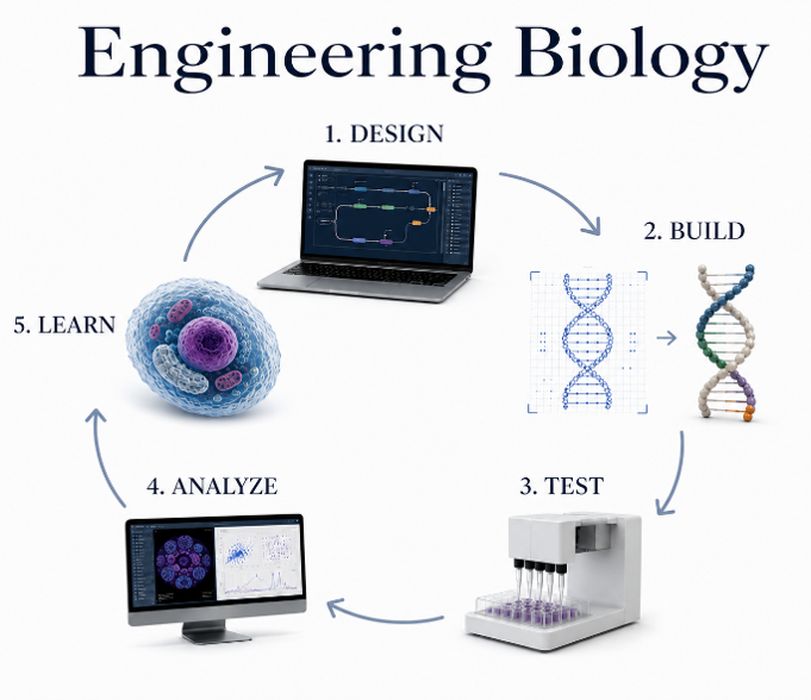
Much of modern digital biology follows this cycle. Researchers at institutions such as Cold Spring Harbor Laboratory (CSHL) use variations of this iterative workflow every day. A DNA construct may be designed in software, synthesized by a commercial provider, inserted into cells, analyzed using automated instruments, and then redesigned based on the results.
Digital Biology Taking Off
Digital biology did not appear because of a single breakthrough. Several important technologies matured at roughly the same time. The first was the dramatic decline in the cost of reading DNA. Thirty years ago, sequencing DNA was slow and expensive. Today, companies such as Illumina have made DNA sequencing a routine part of biological research.
Scientists also learned how to manufacture DNA from digital designs. Twist Bioscience and Integrated DNA Technologies now produce custom DNA for researchers around the world, allowing laboratories to test ideas that exist first as computer files.
The next breakthrough was gene editing. Technologies such as CRISPR allow researchers to make precise changes to DNA. Rather than waiting for random mutations or broad chemical treatments, scientists can alter specific genetic instructions much like correcting a typo in a document.
Artificial intelligence has accelerated the process even further. AI systems can analyze enormous biological datasets, predict how proteins will fold into their working shapes, and help researchers identify promising designs before they begin laboratory experiments. Instead of testing every possibility, scientists can spend more time evaluating the ideas most likely to succeed.
This convergence has attracted companies that, until recently, had little connection to biology. NVIDIA, best known for building the processors behind the artificial intelligence boom, now sees biology as one of computing’s next great frontiers. CEO Jensen Huang recently told students at the University of California, Berkeley, “Where do I think the next amazing revolution is going to come? … There’s no question that digital biology is going to be it.” He explained his reasoning with a second observation: *“For the very first time in human history, biology has the opportunity to be engineering, not science.” [Forbes]
The Manufacturing Layer, with 3D Printing
The better scientists become at designing biology, the greater the demand becomes for laboratories that can rapidly build and modify the tools needed to test those ideas. These laboratories are filled with incubators, microscopes, pumps, robotic liquid handlers, imaging systems, and analytical instruments. Every new experiment requires physical hardware, and unlike an automobile factory, research laboratories rarely repeat the same process for years. New biological questions often require new fixtures, new fluid pathways, new sample holders, new reaction vessels, or entirely new experimental setups.
At institutions such as Cold Spring Harbor Laboratory, many of the tools supporting cutting-edge biological research are surprisingly ordinary: custom microscope brackets, microfluidic fixtures, sample holders, alignment jigs, tube racks, and adapters that exist only because a particular experiment demanded them. Few are manufactured commercially because they may only be needed by one laboratory or one research team. Additive manufacturing fills that gap by allowing researchers to fabricate specialized hardware as quickly as their experiments evolve.
3D printing technology has become particularly valuable in five areas:
1. Building Better Models of Human Organs
One of the biggest challenges in drug development is predicting how a medicine will behave inside the human body. Cells growing on a flat plastic dish often respond very differently than cells inside an organ.
To solve that problem, researchers have developed organ-on-a-chip systems—small transparent devices containing tiny channels through which nutrients, medicines, and living human cells flow. Companies such as Emulate, a spinout of Harvard University’s Wyss Institute, have developed chips that mimic the behavior of organs including the lung, liver, intestine, and brain. Pharmaceutical companies use these systems to study diseases and evaluate potential medicines before moving to animal or human testing.
Each new organ model requires different channel layouts, fluid connections, and supporting hardware. High-resolution stereolithography printers from companies such as Formlabs allow researchers to rapidly prototype many of those components, dramatically shortening the time between a new biological idea and a working experiment.
2. Helping Laboratory Robots Adapt
Automation has become one of the defining features of modern biology. Companies such as Opentrons manufacture relatively inexpensive robotic liquid handlers that can transfer samples, prepare experiments, and perform repetitive laboratory tasks with remarkable precision. These robots allow scientists to run hundreds of experiments while reducing human error.
The robots themselves, however, rarely stay exactly as they left the factory. One published project described a mass-balance integration with the Opentrons OT-2 robot, allowing automated gravimetric experiments and liquid-mass measurements as part of a larger workflow. Instead of redesigning the robot, researchers added the hardware and software needed for that specific task.
Different laboratories use different tubes, bottles, sensors, cameras, and experimental containers. Researchers routinely design and print custom tube holders, pipette adapters, microscope mounts, cable guides, and robotic fixtures that allow the same robot to perform entirely new experiments. Much of this customization is accomplished with 3D printing. The required parts are highly specialized and often unique to a single laboratory. A researcher may need an adapter that holds a particular brand of test tube, positions a sensor at a precise angle, or secures an experimental device that did not exist when the robot was originally designed.
3. Giving Cells a Better Place to Grow
Cells respond to their surroundings. The stiffness of a material, the size of tiny pores, and the way nutrients flow through a structure all influence how living tissue develops. Growing cells on a flat plastic dish is convenient, but it often fails to reproduce the conditions found inside the human body.
Companies such as CELLINK, part of BICO, develop bioprinters and specialized bioinks that allow researchers to build three-dimensional scaffolds where living cells can organize into structures that more closely resemble real tissue. These printed scaffolds are being used to study cancer, evaluate new medicines, investigate wound healing, and explore tissue regeneration.
Most of these printed structures help scientists perform more realistic laboratory experiments, giving them models that behave much more like living organs than traditional cell cultures. Cold Spring Harbor Laboratory provides a useful example. Its Organoid Shared Resource gives Cancer Center researchers access to the reagents, equipment, protocols, and expertise needed to culture and experiment with three-dimensional organoid models. CSHL researchers have also used organoids to study pancreatic cancer, breast cancer, and patient-derived tumor models.
4. Sharing Laboratory Hardware
Digital biology depends on sharing information and tools. The NIH 3D Print Exchange, created by the National Institutes of Health, allows scientists, educators, and clinicians to download printable files for laboratory equipment, molecular models, anatomical structures, and educational tools. Instead of designing every laboratory accessory from scratch, researchers can begin with existing digital models, modify them for their own experiments, and print them locally.
The concept mirrors digital biology itself. DNA sequences can be transmitted electronically, and many of the tools used to study those sequences can now travel the same way.
5. Speeding Up Discovery
The greatest contribution of additive manufacturing may be that it keeps laboratory hardware moving at the same pace as digital biology itself. Imagine a research team studying a newly discovered virus. Early experiments suggest that a slight change in the shape of a microfluidic chip could improve how infected cells are exposed to potential antiviral drugs. The existing chip is not quite right. One channel needs to be wider, another reservoir slightly deeper, and the tubing connections must be moved to accommodate a different imaging system.
With conventional manufacturing, those seemingly minor changes could require ordering custom parts and waiting days or even weeks before testing could resume. During that time, researchers have ideas they cannot evaluate. With additive manufacturing, an engineer updates the CAD model, prints a revised prototype, confirms that it fits the existing equipment, and the biology team begins running experiments the same day.
The Research & Development Tax Credit
The developments in the digital biology science may strengthen R&D tax credit opportunities because many of the activities look like the kind of technology-driven, iterative problem-solving that IRC § 41 is designed to evaluate. Companies using AI to predict protein structures, design synthetic DNA, engineer microbes, build organ-on-a-chip platforms, develop bioprinted tissue models, or customize lab automation often are not merely following a fixed recipe. They may be trying to resolve technical uncertainty about whether a biological design will work, which design will perform best, or how to improve function, performance, reliability, or quality. Examples of designing DNA digitally, sending designs for physical DNA synthesis, inserting DNA into cells, measuring results, revising the design, and repeating the cycle are especially relevant because they reflect an organized process of experimentation rather than one-time testing.
The same concept may apply to additive manufacturing and lab automation activities where companies design, print, test, and refine custom fixtures, microfluidic components, robotic adapters, sample holders, or bioprinting scaffolds to make experiments possible or improve experimental performance. Potentially creditable costs may include wages for scientists, engineers, software developers, and technicians; supplies consumed in testing; eligible cloud or computer-use costs; and certain third-party research payments, if the statutory requirements are met. Qualification is not automatic. Routine quality checks, market research, simple vendor selection, ordinary data gathering, work performed after the product or process is ready for commercial production, foreign research, or research funded by a customer or grant may not qualify.
Conclusion
Digital biology is changing how scientists work. Instead of asking only how nature functions, researchers increasingly design biological systems on computers, manufacture new DNA, use artificial intelligence to guide experiments, and rely on automation to evaluate the results.
Those advances begin with digital information, but they end in the physical world. The growing demand for customized laboratory hardware is creating new opportunities for additive manufacturing. As digital biology continues to mature, the connection between computers, living cells, and rapidly manufactured laboratory hardware is likely to become even stronger.