
A Greek led research team has found a practical way to improve 3D printed PVDF parts.
The work comes from researchers at Hellenic Mediterranean University, International Hellenic University, FORTH, and collaborators, and appears in The International Journal of Advanced Manufacturing Technology. It focuses on Polyvinylidene fluoride (PVDF), a high performance fluoropolymer with chemical resistance, thermal resistance, flexibility, and piezoelectric behavior. That’s a material that I have not heard of anyone 3D printing.
PVDF could be interesting for printing sensors, biomedical devices, energy harvesting, and chemically exposed parts due to its engineering properties. These properties also make PVDF challenging for Material Extrusion (MEX) processes.
PVDF Is Useful But Fussy
The study is a fairly detailed process optimization exercise for PVDF printing, which is often exactly what high performance polymer printing needs before it can be properly used.
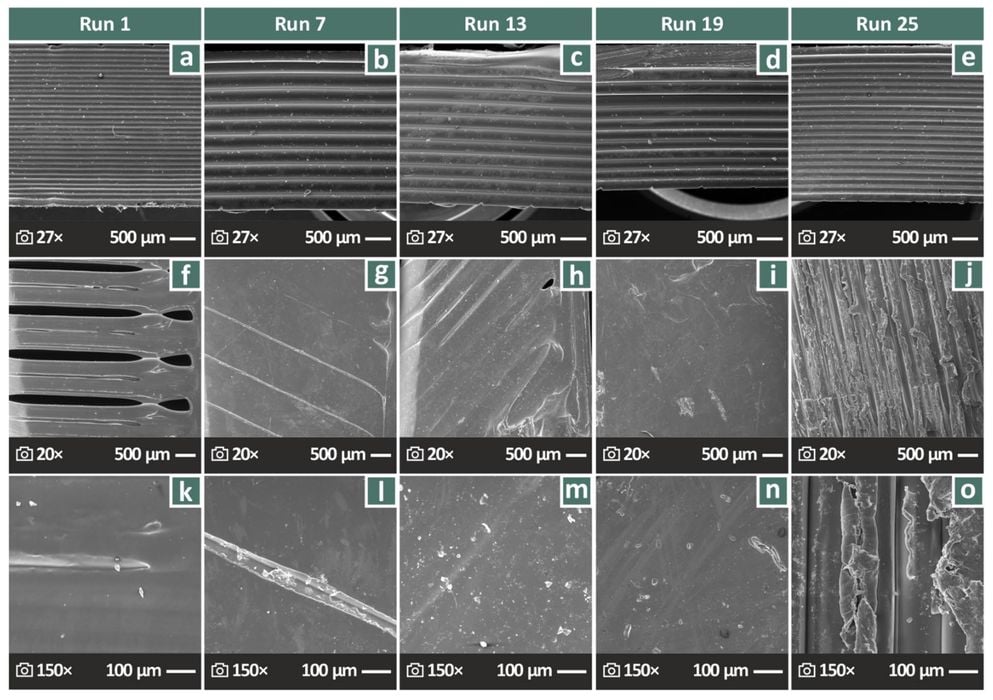
The team produced custom 1.75mm PVDF filament from granules using a 3devo desktop extruder, dried the material, and printed test specimens on an Intamsys Funmat HT. They then measured surface roughness, dimensional deviation, and porosity using methods including optical microscopy, scanning electron microscopy, and CT scanning.
Six print parameters were varied: raster deposition angle, infill density, nozzle temperature, bed temperature, print speed, and layer height. The researchers used a Taguchi L25 design, meaning 25 experimental runs with five levels for each parameter, plus repetitions and confirmation runs. A reduced quadratic regression model was then used to predict outcomes.
The thermal work is also important. The PVDF showed an initial decomposition temperature around 451.5C, while the tested nozzle temperatures were 290C to 310C. In other words, the study stayed below the obvious thermal danger zone, although that does not remove all crystallization and shrinkage issues. Note that PVDF would be considered a high temperature material for 3D printer purposes.
Optimization, Not Magic
The reported improvements are interesting. Average roughness fell from 19.33 µm to 13.56 µm in the best comparison, while root mean square roughness fell from 24.57 µm to 17.90 µm. Dimensional deviation improved from 471.15 µm to 378.90 µm.
The porosity result is the most interesting result. CT measured porosity dropped from 1.95% to 0.27%. The researchers describe this as a reduction of more than 700%, which is mathematically awkward if read as a normal percentage reduction, but the point is this: the best parameter set produced far fewer internal voids.
Print speed was the most important parameter for surface roughness. Layer height dominated porosity. Bed temperature had the strongest effect on dimensional accuracy. That makes physical sense: extrusion formation affects surface texture, layer geometry affects void formation, and thermal management affects shrinkage and residual stress.
This is useful because it shows there is no single magic setting for PVDF. A profile optimized for a smooth surface may not be the same one that minimizes porosity or holds dimensions. That is the case for most materials in FFF 3D printing, but it becomes more a lot more expensive when the material is a specialty fluoropolymer rather than plain old PLA.
This is the kind of research that can, over time, benefit commercial additive manufacturing: how else would you know how to print PVDF?
3D printed PVDF parts used as sensors or biomedical components do not merely need to print; they need standard surfaces, controlled voids, and repeatable dimensions. This research will help get us there.
Via The International Journal of Advanced Manufacturing Technology
