Charles R. Goulding and Aaron Rofe reveal how the same 3D printing breakthroughs reshaping pickleball and tennis are poised to revolutionize padel equipment as the sport rapidly expands across the U.S.
For much of the 20th century, the Delaware Power Station in Philadelphia provided electricity to the city’s residents and businesses. Completed in 1923, the plant closed in 2008, and its abandoned turbine hall sat dormant until last year, when it reopened as Ballers, a 55,000-square-foot sports club with three glass-and-mesh padel courts, golf simulators, and courts for squash and pickleball. Its founder, David Gutstadt, a former Equinox executive, calls padel and pickleball “the real anchors” of the club, which now counts roughly 700 members paying between US$100 and US$457 a month. Gutstadt has since opened a second Ballers in Boston and is developing a third in Los Angeles.
He is far from alone. Entrepreneurs from very different corners of the business world are converging on padel: Gary Sheinbaum, a former Tommy Hilfiger executive, has backed a racket-sport venture in West Palm Beach; Jon Krieger, co-founder of the Bluestone Lane coffee chain, built a padel club in Cresskill, New Jersey; and Ronnie Fieg, founder of streetwear label Kith, made three padel courts a centerpiece of Kith Ivy, his members-only Manhattan club, where individual membership runs US$45,000 up front plus US$10,000 a year.
The participation numbers explain the enthusiasm. Padel drew roughly one million American players last year, according to the U.S. Tennis Association, which only began tracking the sport in 2025. USA Padel, the sport’s domestic governing body, reported club and individual memberships grew about 50 percent year-over-year in 2025. Publicly accessible courts have grown from around 227 three years ago to roughly 1,000 today, showing up everywhere from rooftop clubs at Westfield malls in Los Angeles to a repurposed fulfillment center in Westfield, Indiana, and a former fur-storage courtyard in Harlem. A professional circuit, the Pro Padel League, has raised US$15 million and begun airing matches on CNBC.
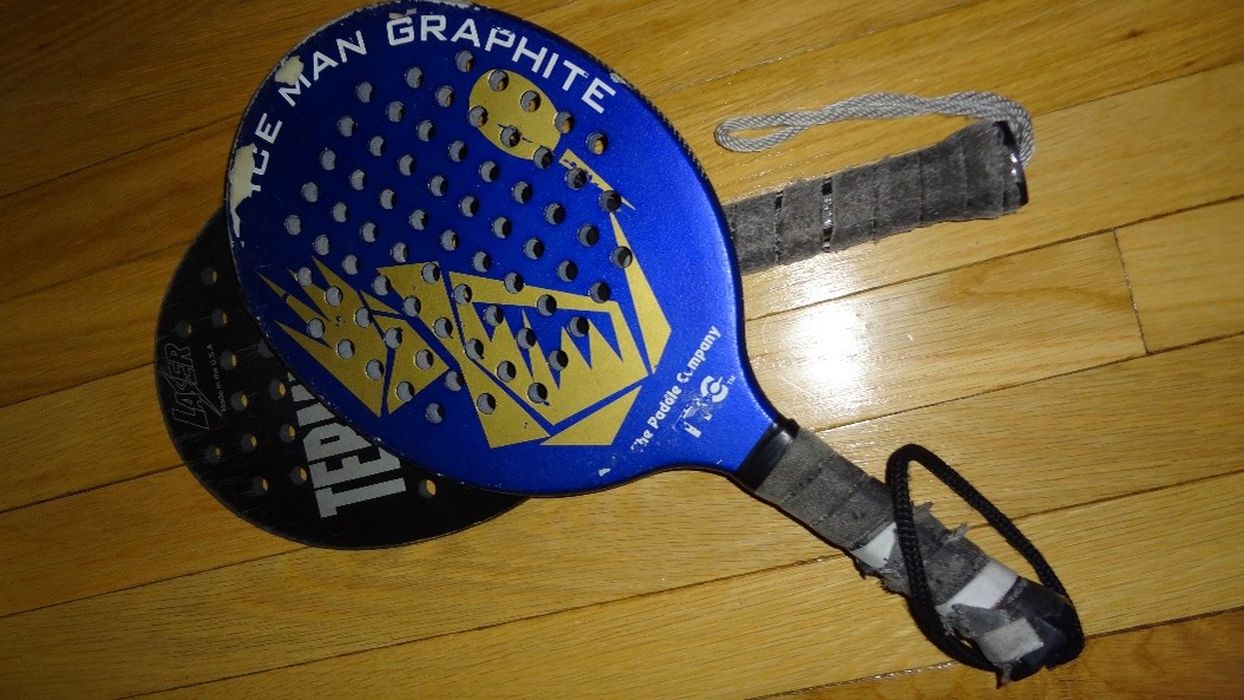
Club owners are candid about the comparison driving all of this. As Alma Padel founder Abigail McCulloch put it, many US operators are betting that padel will mirror pickleball’s rise, having watched pickleball participation climb from about four million Americans in 2020 to more than 24 million last year. But padel is a costlier build than Pickleball. McCulloch estimates it costs around US$50,000 to install a single padel court, largely due to the glass and mesh enclosure walls. As Krieger, the Bluestone Lane co-founder, put it, “The barrier to entry of pickleball is nothing compared to padel”. Padel’s equipment is also fundamentally different from pickleball’s or tennis’s: instead of strings, padel rackets have solid, dense heads perforated with holes, and the balls, while sharing tennis-ball coloring, are less bouncy. That distinct hardware profile is exactly the kind of design space where 3D printing has already proven itself in adjacent racket sports.
What Pickleball has Already Shown is Possible
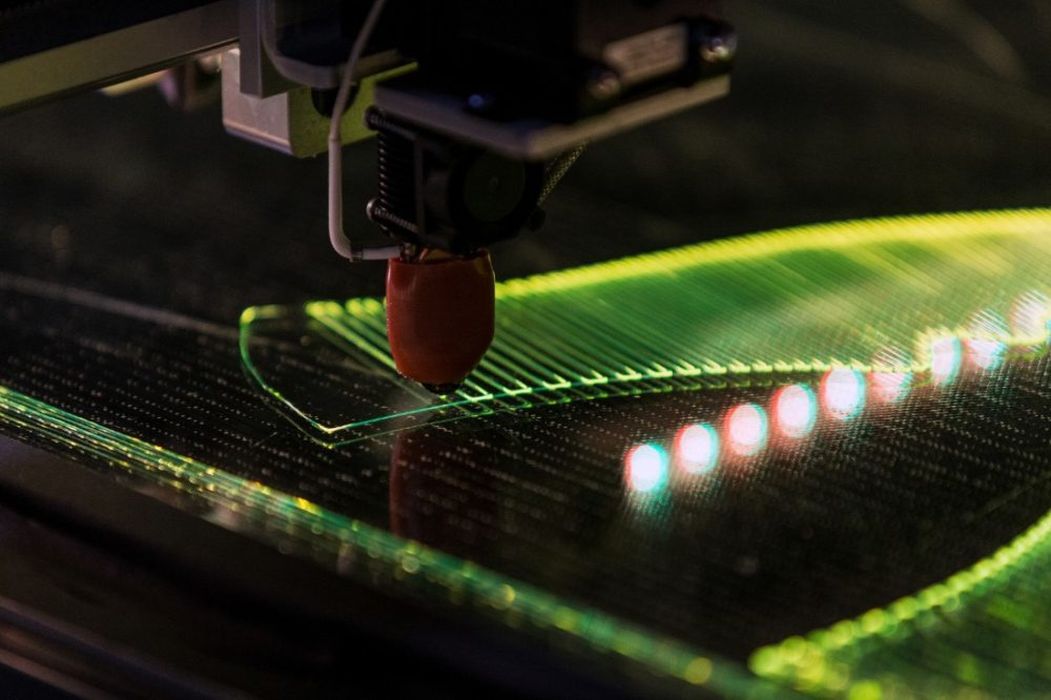
Pickleball’s boom gave equipment makers a real-world proving ground for additive manufacturing in racket sports, and Wilson Sporting Goods has led the way. Wilson partnered with Azul 3D to apply the technology to paddle design and function, organizing the effort around five familiar 3D printing strengths: part consolidation, novel geometries, customization, digital inventory, and localized manufacturing. That partnership produced two notable paddle designs. The Custom Core Paddle is built around a 3D printed lattice structure tailored to an individual player’s style, offering a more robust core and reduced shock on ball contact, a meaningful benefit for players managing long-term hand and wrist strain. The Quiet Paddle uses similar lattice principles specifically to cut down on the sharp noise pickleball paddles are known for, an issue that has become a genuine friction point as courts multiply in residential and mixed-use developments.
Wilson has applied the same thinking to racket handles more broadly, using 3D printing to produce customizable, weight-balanced handles in as little as 72 hours, compared with a typical two-week turnaround through conventional manufacturing. The resulting handles are tuned for aerodynamics and improved internal structures that give players better durability and weight balance.
What Tennis has Already Shown is Possible
Tennis offers an even broader set of precedents, spanning rackets, footwear, and small accessory components. Wilson has used 3D printing since 2021 to prototype racket frames, allowing designers to rapidly iterate on weight and string tension while giving individual players more customization than traditional manufacturing allows. In Italy, CRP Technology’s Windform materials have been used to reengineer racket grips, addressing the way cloth and smooth grips degrade with perspiration during a match, and Prince Sports has worked with CRP’s 3D printing technology since 2007. A separated Italian startup, AMBelievable, has applied additive manufacturing to tennis dampeners, the small clips inserted into racket string to control vibration and noise. Using materials like ABS, PLA, nylon, and TPU, and manufacturing methods including SLS, SLA, and FDM, AMBelievable designs dampeners with internal honeycomb or lattice patterns that improve vibration absorption while staying lightweight, with dimensions, stiffness, and damping tuned to each specification.

Footwear has moved just as fast. Nike’s Flyprint technology uses 3D printing to produce a lightweight, breathable upper that supports natural movement and ventilation, with the kind of stability and quick-direction responsiveness that matters in any fast-paced court spot. Adidas has taken a parallel path with its 4D printed shoes, built using Carbon’s Digital Light Synthesis technology to create complex internal structures that improve energy return, stability, and comfort while reducing weight.
Bringing the Playbook to Padel
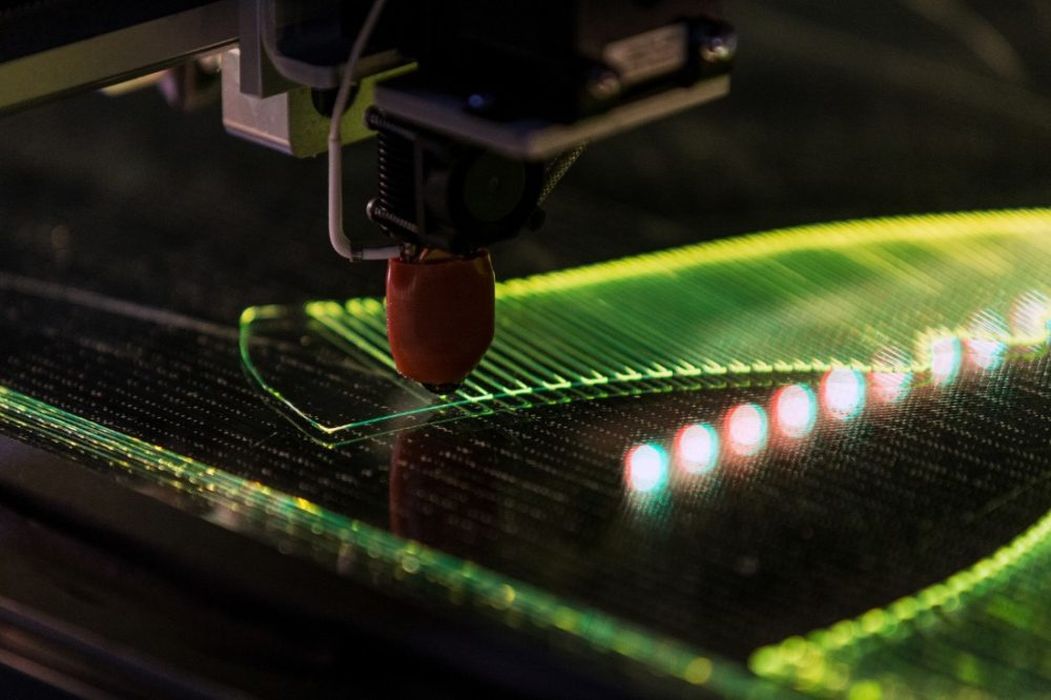
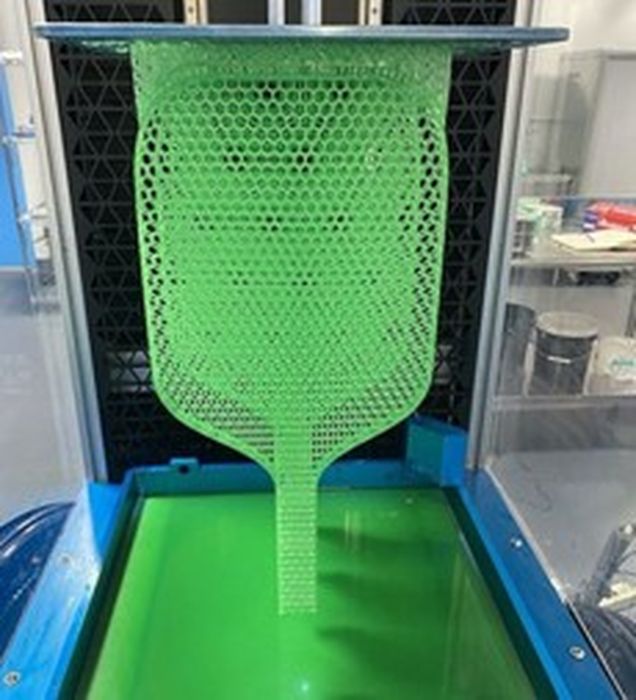
Padel’s equipment gaps maps neatly onto everything pickleball and tennis have already solves. Padel Rackets, with their solid, perforated heads, are a strong candidate for the same lattice-core approach Wilson and Azul 3D used in the Custom Core Paddle: a 3D printed internal structure could be tuned per player for shock absorption and feel, while a “quiet” variant could address noise concerns as padel courts, like pickleball courts, increasingly show up inside shared buildings, malls, and mixed-use developments such as the retrofitted power plant, warehouse, and mall-rooftop locations described above. Wilson’s rapid, weight-balanced handle production could apply just as directly to padel racket handles, and CRP’s grip work addressing perspiration-related grip degradation is a direct fit for a sport played in intense, all-court rallies. Padel could also adopt 3D printed vibration dampeners along the lines of AMBelievable’s tennis products, and given the sport’s emphasis on quick lateral movement in a smaller court footprint, 3D printed footwear built on Nike Flyprint or Adidas 4D principles could offer padel players the same stability and energy-return benefits tennis players are already seeing.
Given how expensive court construction already is, at roughly US$50,000 per court by McCulloch’s estimate, equipment manufacturers have areal incentive to differentiate on the racket and footwear side rather than compete purely on real estate. The 3D printing manufacturers that already have working relation ships with Wilson, Azul 3D, CRP, Prince, and Nike are well positioned to extend those platforms into padel rather than starting from scratch.
The Research & Development Tax Credit
IRC § 41 generally requires qualified research to satisfy a four-part framework: the research must involve qualifying domestic research expenditures, be technological in nature, be intended to develop or improve a business component, and include activities that substantially constitute a process of experimentation for a qualified purpose. Research may qualify even if the development effort does not ultimately succeed, provided the work is directed at resolving uncertainty regarding capability, method, or design. A qualifying process of experimentation generally involves identifying technical uncertainty, evaluating alternatives, and testing those alternatives through modeling, simulation, systematic trial and error, or similar engineering methods.
For companies in the sports and padel ball industry, the developments discussed above may help frame eligible IRC § 41 activities where the work involves domestic, technology-based experimentation to improve the function, performance, reliability, or quality of a product or production process—not merely cosmetic changes, marketing preferences, or routine quality-control testing. For example, projects involving 3D printed or lattice-core rackets, rapid weight-balanced handle development, grip improvements, vibration dampeners, 3D printed footwear, materials testing, prototyping, and iterative engineering may each support a qualifying business component when engineers are evaluating alternative materials, structures, designs, or manufacturing methods to resolve technical uncertainty. In practice, a padel equipment or ball manufacturer should document the specific uncertainty being addressed, the alternatives tested, the prototype or test results reviewed, and the U.S.-based wages, supplies, and contract research costs tied to that experimentation, because those facts can distinguish credit-eligible R&D from routine production or ordinary product refreshes.
The R&D tax credit is available for for-profit companies designing or developing new or improved products or processes, including companies applying advanced manufacturing methods and materials science to padel and adjacent sports-equipment innovation.
R&D Tax Savers has helped hundreds of companies claim these credits since the credit’s inception in 1981.
Conclusion
Padel follows a familiar script: rapid participation growth, an influx of entrepreneurial capital, and a scramble to build courts before the window closes, much as pickleball did before it. But padel’s equipment is a different animal from pickleball’s paddle or tennis’s strung racket, and that difference is exactly where 3D printing has already demonstrated its value in adjacent sports. The lattice cores, customized handles, engineered grips, vibration dampeners, and 3D printed footwear that Wilson, Azul 3D, AMBelievable, Nike, and Adidas have already brought to pickleball and tennis represent a ready-made roadmap for padel’s next phase of equipment innovation.