
Charles R. Goulding and Preeti Sulibhavi discuss how Lockheed Martin’s bold production strategy could foreshadow the next era of defense manufacturing, where additive manufacturing plays an increasingly strategic role.
A recent report highlighted an unusual strategic shift at Lockheed Martin. According to the report, the aerospace and defense giant is increasingly willing to manufacture critical military equipment before receiving formal Pentagon purchase orders, effectively betting that demand will materialize rather than waiting for contracts to be finalized. At first glance, that sounds like a remarkably risky move. Building inventory without confirmed customers is generally considered one of the cardinal sins of manufacturing.
For most manufacturers, it would be.
For Lockheed Martin, however, the calculus is very different.
The distinction is important, particularly for those following the evolution of additive manufacturing. While the headlines naturally focus on defense spending, the story underneath is really about production strategy. It signals that one of the world’s largest industrial manufacturers believes the geopolitical environment has changed enough to justify abandoning traditional just-in-time thinking in favor of strategic manufacturing readiness.
That has significant implications for suppliers throughout the defense supply chain, including companies specializing in industrial 3D printing.
Why most manufacturers would never do this
Modern manufacturing has spent decades optimizing around lean production and just-in-time inventory.
The logic is simple. Inventory sitting on warehouse shelves ties up working capital, consumes storage space, increases insurance costs and creates the risk that products become obsolete before they’re sold.
Smaller businesses simply cannot afford these risks.
Consider a typical machine shop or contract manufacturer. Producing components without a purchase order means paying for raw materials, labor, machine time and overhead entirely from company cash reserves. If the expected customer changes specifications, delays procurement or cancels the project altogether, that inventory may never generate revenue.
For many small and medium-sized manufacturers operating on relatively thin margins, this can quickly become an existential financial problem.
The rise of just-in-time manufacturing during the past four decades was largely intended to eliminate precisely these kinds of risks.
Lockheed Martin operates under entirely different economics
Lockheed Martin does not operate like a conventional manufacturer.
The company finished 2025 with approximately US$75.0 billion in annual sales and employs roughly 123,000 people worldwide. It is headquartered in Bethesda, Maryland, and remains the largest defense contractor in the United States by revenue.
More importantly, Lockheed possesses something few companies can match: extraordinary visibility into long-term demand.
Defense procurement doesn’t behave like consumer markets.
Governments don’t suddenly decide they no longer require missile defense systems, advanced fighter aircraft or precision-guided munitions because economic conditions soften for a quarter. Procurement cycles span years, often decades, with programs extending across multiple administrations.
Recent geopolitical events have only strengthened that predictability.
The ongoing war in Ukraine, heightened tensions in the Indo-Pacific, increased NATO defense spending and instability throughout the Middle East have collectively driven sustained demand for advanced defense systems. Rather than shrinking, Western governments are actively rebuilding stockpiles that were significantly depleted over recent years.
Against that backdrop, manufacturing products ahead of formal purchase orders becomes less of a speculative gamble and more of a calculated capacity decision.
Manufacturing readiness has become a competitive advantage
Defense manufacturing increasingly faces a new challenge.
Winning contracts is no longer sufficient. Contractors must also demonstrate they can deliver products quickly.
Governments have learned painful lessons from recent conflicts regarding production bottlenecks. Many advanced weapons require complex global supply chains, specialized materials and highly qualified suppliers. Waiting until contracts are signed before beginning production introduces delays that modern military planners increasingly consider unacceptable.
If Lockheed can deliver missiles, interceptors or aircraft months sooner because production has already begun, that capability itself becomes a competitive advantage.
In other words, inventory becomes strategic infrastructure rather than idle stock.
Additive manufacturing makes this strategy more practical
The interesting connection for the 3D printing industry is that additive manufacturing directly supports this kind of production philosophy.
Lockheed Martin has steadily expanded its use of additive manufacturing across multiple business units over the past several years.
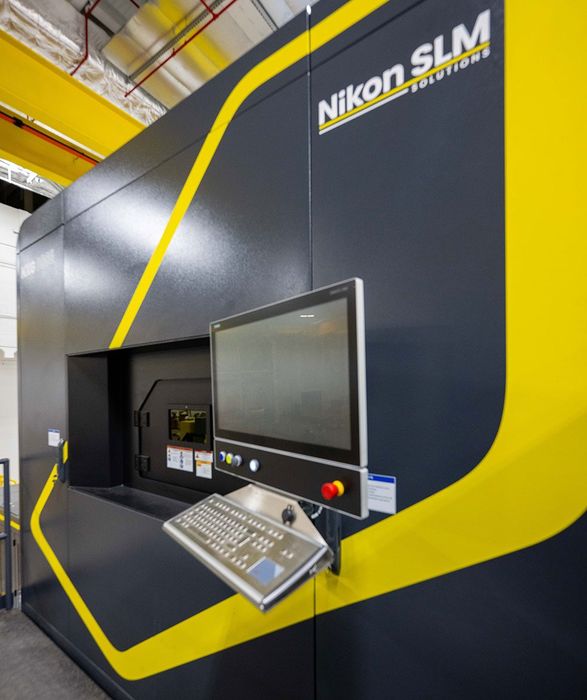
One notable example is the company’s use of large-format metal additive manufacturing to produce components for spacecraft and missile programs. Lockheed has worked with companies including Nikon SLM Solutions to qualify large metal laser powder bed systems capable of producing complex aerospace hardware while reducing lead times and minimizing part counts.
The company has also collaborated with Sintavia on the development and qualification of metal additively manufactured aerospace components for defense applications, helping accelerate production while simplifying supply chains. These efforts demonstrate how additive manufacturing is moving beyond prototyping into certified production hardware for demanding military environments.
In another example, Lockheed Martin Space has increasingly incorporated additive manufacturing into satellite and spacecraft production, using printed metal components to reduce weight, consolidate assemblies and shorten manufacturing schedules. Such applications have become particularly valuable for national security space programs where production speed and supply chain resilience are increasingly important.
Specifically, in developing the multi-mission Mako™ hypersonic missile, engineers used AM to make guidance housing and tail fin parts. They demonstrated that these critical assemblies met requirements at a fraction of the cost – a staggering 1/10th – and reduced production time, making it 10 times faster and cheaper compared to conventional subtractive methods. In a customer space where agility, speed and affordability reign, AM is helping to move the needle. Now, with Lockheed manufacturing products without prior purchase orders, this helps it become king.
These examples illustrate a broader trend.
Additive manufacturing is no longer simply about producing lighter components or enabling complex geometries. Increasingly, it serves as a strategic manufacturing capability that enables faster production, localized manufacturing and reduced dependence on lengthy conventional supply chains.
Those advantages become especially valuable when companies intentionally choose to manufacture ahead of confirmed orders.
Financial strength changes the risk equation
Perhaps the most overlooked factor is Lockheed Martin’s balance sheet.
Large defense contractors possess access to capital that smaller manufacturers simply cannot match.
Holding additional inventory certainly incurs carrying costs, but those costs represent a relatively modest burden for an organization generating tens of billions of dollars in annual revenue and managing a multi-year backlog of government business.
Furthermore, many of the products involved are not speculative consumer goods.
Missiles, interceptors, avionics and defense electronics supporting existing military platforms have relatively predictable long-term demand. While procurement timing may fluctuate, complete demand destruction remains highly unlikely.
That dramatically reduces inventory risk compared with commercial industries where consumer preferences change rapidly.
For a small manufacturer, inventory sitting unsold for twelve months could trigger bankruptcy.
For Lockheed Martin, the same inventory may simply represent future deliveries waiting for administrative approvals.
Those are fundamentally different financial realities.
A changing philosophy throughout defense manufacturing
The larger takeaway is that this development reflects a changing mindset across the defense sector.
For decades, efficiency was the dominant objective. Lean manufacturing, optimized inventory and just-in-time logistics became universal best practices.
Today’s geopolitical environment rewards resilience instead.
Governments increasingly value surge capacity, redundant suppliers, domestic manufacturing capability and production flexibility. Speed has become almost as valuable as cost efficiency.
Additive manufacturing fits naturally within this new framework.
Digital inventories, distributed manufacturing networks and on-demand production all reduce dependence on fragile international supply chains while allowing manufacturers to respond more quickly to changing military requirements.
Rather than replacing conventional manufacturing, industrial 3D printing increasingly complements it by filling production gaps, accelerating qualification programs and enabling rapid scaling when demand suddenly increases.

The Research & Development Tax Credit
Enacted in 1981, the now permanent Federal Research and Development (R&D) Tax Credit allows a credit that typically ranges from 4%-7% of eligible spending for new and improved products and processes.
Qualified research must meet the following four criteria:
- Must be technological in nature
- Must be a component of the taxpayer’s business
- Must represent R&D in the experimental sense and generally includes all such costs related to the development or improvement of a product or process
- Must eliminate uncertainty through a process of experimentation that considers one or more alternatives
Eligible costs include U.S. employee wages, cost of supplies consumed in the R&D process, cost of pre-production testing, U.S. contract research expenses, and certain costs associated with developing a patent.
On December 18, 2015, President Obama signed the PATH Act, making the R&D Tax Credit permanent. Since 2016, the R&D credit has been used to offset Alternative Minimum Tax (AMT) for companies with revenue below US$50 million. And, now, pre-profitable and pre-revenue startup businesses can also obtain up to US$500,000 per year in payroll tax offsets and cash rebates for up to five years.
Below is a table that presents Lockheed’s recent research and development expenditures and human capital.
| Fiscal Year Ended | Research and Development Expenses | Employee Count | R&D Per Capita |
| 2025 | $2.0 billion | ~123,000 employees | $16,260 |
| 2024 | $1.6 billion | ~121,000 employees | $13,223 |
| 2023 | $1.5 billion | ~122,000 employees | $12,295 |
| 2022 | $1.7 billion | ~116,000 employees | $14,655 |
Note: Between 2022 and 2025 R&D per capita was slightly lower than due to sunset provisions in the Tax Cuts and Jobs Act (TCJA). The OBBBA, passed at the end of 2025, restored full R&D – expensing, which may provide some insight into the trend illustrated above.
One company worth watching
Whether Lockheed Martin’s decision ultimately becomes standard practice across the defense industry remains to be seen.
What seems increasingly clear, however, is that the company is positioning itself for an era in which defense demand is expected to remain elevated for years rather than months.
The willingness to manufacture ahead of formal Pentagon orders reflects considerable confidence, not only in future contracts but also in the broader geopolitical trajectory.
For the additive manufacturing industry, that should not be overlooked.
As defense manufacturers place greater emphasis on production readiness, supply chain resilience and manufacturing agility, industrial 3D printing becomes more strategically important than ever. The technology enables precisely the flexibility required when companies decide that waiting for paperwork is no longer the optimal production strategy.
Lockheed Martin has often served as an early indicator of where advanced manufacturing is headed within aerospace and defense. If one of the industry’s largest players is comfortable accepting inventory risks that most manufacturers would consider unacceptable, it suggests the defense sector is entering a new phase defined by preparedness rather than optimization.
Given current geopolitical tensions and continued efforts by Western governments to replenish military inventories, this development may prove to be less of an isolated decision and more of a signal of where defense manufacturing is headed next.
For the 3D printing industry, Lockheed Martin remains the company to watch.