
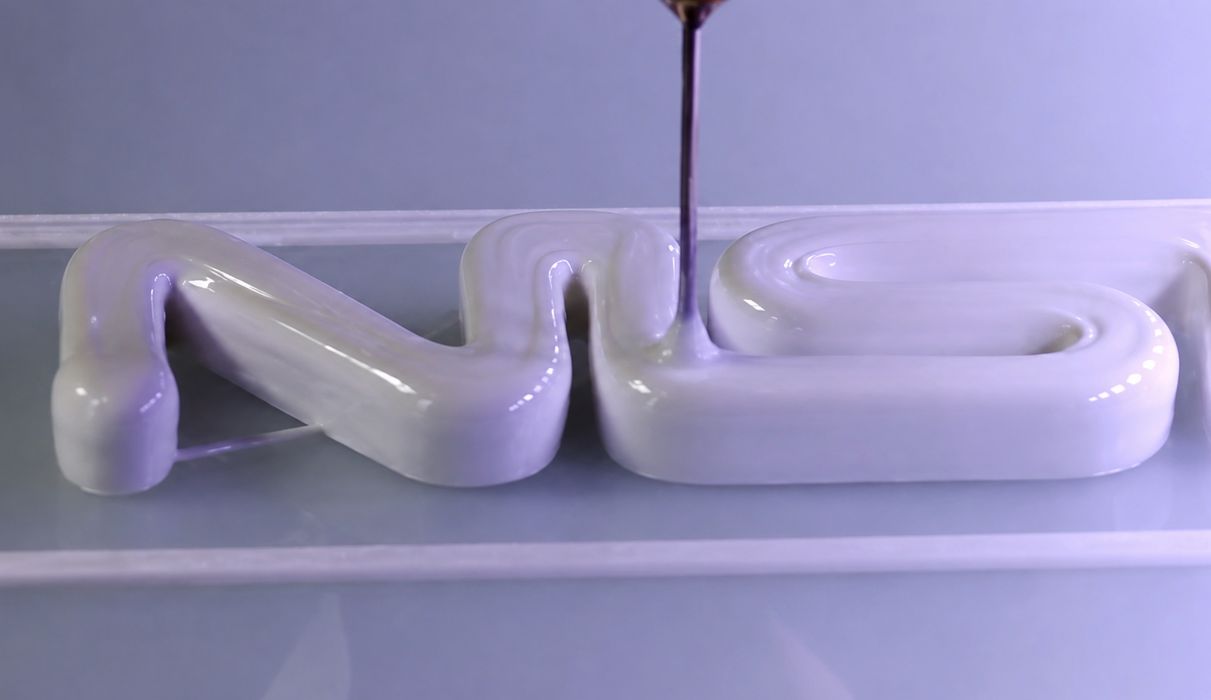
A better understanding of why ketchup suddenly pours could improve the consistency of ceramic 3D printing.
Most people believe 3D printing is for plastics or metals, but ceramics have increasingly become one of the technology’s most promising materials. Technical ceramics such as alumina and zirconia have outstanding wear resistance, electrical insulation, and high-temperature performance, making them very desirable for aerospace, electronics, medical implants, and dental applications.
Printing those materials, however, is not at all straightforward. A frequent method of ceramic 3D printing involves extruding a ceramic slurry through a nozzle, layer by layer. Another approach is to infuse a photopolymer resin with ceramic particles and print using either the MSLA or DLP processes.
Researchers at the U.S. National Institute of Standards and Technology (NIST) are investigating the way ketchup flows. The idea here is to improve ceramic additive manufacturing by controlling the flow behavior of ceramic slurries and pastes.
Unlike water or honey, ketchup is a non-Newtonian fluid. It resists movement until sufficient force is applied, then suddenly becomes much easier to flow. That’s why it always bursts out of the bottle when you need some.
Ceramic materials used in extrusion systems and resin methods behave in much the same way. During printing, they must flow smoothly through a nozzle or spread evenly across a build surface.
NIST materials scientist Russell Maier is measuring these complicated flow properties with greater accuracy. It turns out to be surprisingly difficult.
Ceramic slurries are very sensitive materials. Water-based formulations gradually dry during testing, altering their viscosity. They also exhibit a form of material “memory”, taking time to recover after being disturbed. Even loading a sample into a test instrument can change its behavior enough to affect the results. Some slurries also slip against the measuring plates rather than deforming normally, introducing additional errors.
You can imagine how these minute-by-minute material property changes can mess up a precision 3D printing process.
To characterize these materials, researchers use rheometers, instruments that measure how much force is required to make a material flow. Reliable rheology data is important because manufacturers depend on it to verify incoming material quality and tune print parameters before production begins. If those measurements vary from lab to lab, the resulting printed parts may vary as well.
NIST’s role is to establish measurement techniques and reference materials that everyone can trust.
Many ceramic printing processes already produce impressive parts, particularly for dental restorations and specialized medical implants. However, consistency is a big concern, especially as manufacturers move toward larger production volumes where repeatability is critical.
As ceramic 3D printing expands into more industrial and medical applications, standardized measurements could become as important as improvements in hardware. After all, manufacturers cannot consistently produce identical parts unless they can first consistently measure the materials used to make them.
NIST developed a “reference” ceramic material that can be used by a lab to calibrate another ceramic material for accuracy and develop print parameters that are more likely to succeed. They’ve sent samples of the new ceramic reference material to several labs across the US for initial testing.
If this approach works, we could see it being used by any manufacturer that’s using ceramic 3D printing to increase the quality and consistency of the parts they produce.
Via NIST
