
Squeezing 3D printed parts could be the way of the future.
Researchers at Old Dominion University have been developing a process called Hot Powder Bed Compaction (HPBC), which might provide a way to dramatically improve the strength of 3D printed thermoplastic components.
The university recently received a US$400,000 National Science Foundation grant to advance the technology, developed by Oleksandr Kravchenko and former doctoral student Jimesh Bhagatji.
The concept is pretty straightforward.
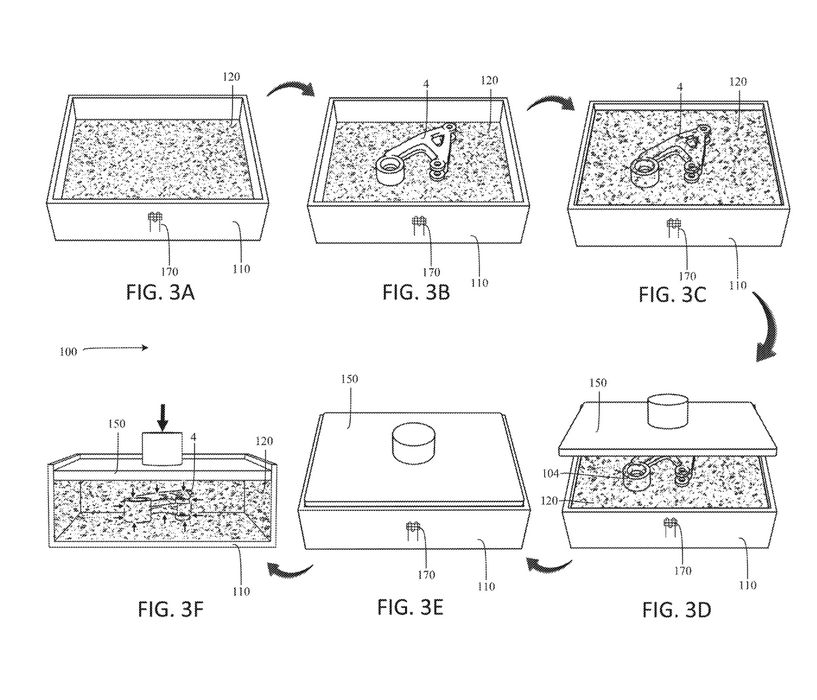
A printed FFF part is placed inside a sturdy container and completely surrounded by fine powder, such as talc or ceramic particles.
The container is heated until the thermoplastic begins to soften, and a mechanical press applies strong pressure to the powder in the container.
The powder distributes that pressure around the FFF part. This pressure collapses microscopic voids between extrusion lines and create better layer adhesion. Reinforcing fibers can help the softened polymer retain its shape.
The researchers’ patent, US12583150B2, granted in March 2026, shows several setups for achieving this result. One uses a hydraulic press pushing downward, or another uses wedges that translate some of the force sideways, making compression come from multiple directions.
The powder effectively becomes a temporary, highly adaptable mold that uses the object’s original shape.
In a 2024 SAMPE paper, the researchers reported a 27.77% increase in flexural strength for treated carbon fiber-reinforced PA test objects. A topology-optimized rocker component showed approximately 30% greater strength.
Bhagatji’s later doctoral research reported reducing internal voids from 16.8% to 2.3%, along with tensile strength improvements reaching 61.9% in the tested composites. That’s quite impressive for something done after printing.
A Strengthening Machine?
I am thinking this technology could be commercialized as a special type of post processing machine that would literally make your parts stronger.
Imagine taking completed parts from an FFF, SLS, or MJF printer, placing them into a powder-filled compaction chamber, and running an automated heating, pressing, and cooling cycle.
One system like that could potentially provide service for the output from several 3D printers, without requiring modifications to any of the printers.
However, the benefits for powder bed parts remain unproven using HPBC. Interestingly, a separate 2026 study of warm isostatic pressing found tensile strength improvements of only 3.1–5.5% for PA12 powder bed fusion parts, although much larger improvements occurred with porous binder-jetted polymer components.
A commercial strengthening system would have to handle dimensional shrinkage, distortion, consistency, and the what happens with different materials in order to be acceptable to buyers. However, it turns out that these specific questions are in fact the major objectives of newly funded research.
For now, HPBC looks pretty promising for fiber-reinforced FFF, where insufficient interlayer bonding happens all too often.
At some point, however, it could very well be that an entrepreneur picks up this idea and transforms it into a simple device that any 3D printing operation would love to have: a box that makes your parts stronger.
Via Old Dominion University and Espacenet