
Researchers have shown that one common FFF material may be a much better foundation for rapidly deployable biosensors.
Most discussions about 3D printed biosensors focus on the biological layer that detects pathogens, chemicals, or disease markers. However, that layer is only one part of the system. The printed structure underneath must also provide accurate geometry, controlled fluid flow, and stable electrical performance before any biofunctionalization can take place.
Researchers at the University of Derby took exactly that approach, evaluating three commercially available FFF filaments as the basis for electrochemical biosensors intended for defence testing, disaster response, and other environments where laboratory equipment is unavailable. Rather than building a complete sensor, they focused on identifying which material offers the best platform for future development.
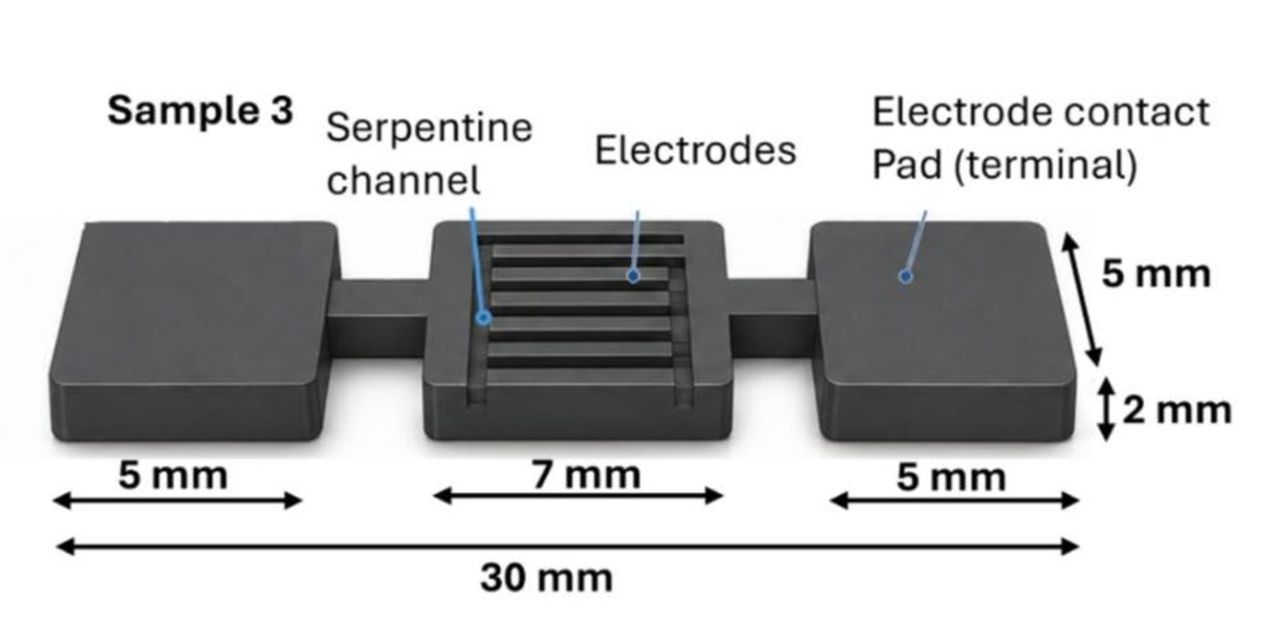
The team compared conductive PLA (CPLA), graphene enhanced PLA (GPLA), and conventional PLA (PPLA). Each material was used to print identical serpentine sensor geometries on an Ultimaker S5, followed by dimensional inspection, computational fluid dynamics analysis, and electrical testing.
Graphene Provides More Than Conductivity
The most interesting result was that graphene improved far more than electrical conductivity.
GPLA consistently produced the most accurate printed features, smoother surfaces, and the lowest manufacturing variability. The authors attribute this to graphene’s influence on heat transfer and material flow during extrusion, allowing printed roads to maintain their intended geometry with less shrinkage and more consistent deposition.
That matters because electrochemical sensors rely on precisely controlled geometries. Even small dimensional changes alter conductive path lengths, electrical resistance, and fluid movement across the sensing surface.
The CFD simulations also showed that the serpentine channel design maintained predictable laminar flow while extending the interaction time between incoming fluid and the sensing region. That could eventually improve sensitivity once biological recognition layers such as antibodies or aptamers are added.
Electrical testing reinforced that conclusion. Conventional PLA proved to be an excellent insulator, making it unsuitable as an electrode despite its stable behaviour. Conductive PLA provided reliable electrical performance, but GPLA combined lower resistance with good print quality and dimensional consistency, giving it the strongest overall balance for future biosensor development.
The researchers have not yet produced an actual working biosensor, so this work merely sets the stage for later work to build sensors using this discovery.
The researchers are already planning that next phase. Future work will add graphene based surface treatments, hydrogels, antibodies, and aptamers before evaluating electrochemical impedance performance under more realistic operating conditions.
If those experiments are successful, this work could become more significant than it first appears. Instead of merely demonstrating another 3D printed biosensor, it establishes a systematic engineering process for selecting printable materials before the expensive biological components are ever introduced. That could shorten development cycles for applications where replacement sensors may need to be printed within hours instead of weeks.
Via The International Journal of Advanced Manufacturing Technology
