

Charles R. Goulding and Preeti Sulibhavi investigate how the Army’s push to source legacy components is creating new opportunities for digital inventories, additive manufacturing and on-demand production.
The U.S. Army is taking a closer look at an old problem with a distinctly modern solution: how to keep legacy military equipment operating when the companies that once made its parts no longer do so.
A recent Army market survey illustrates the challenge. U.S. Army Contracting Command–Detroit Arsenal is seeking companies capable of sourcing rare, obsolete and highly specialized components for M2A2 ODS-SA Bradley infantry fighting vehicles supporting Ukraine. The Army specifically cited supplier obsolescence and severe supply chain bottlenecks, and said contractors may need to source or reproduce components including turret drive control units, transmission control modules, ammunition chutes, specialized targeting hardware, military-grade lights and vehicle fasteners.
The effort is not simply about finding a warehouse somewhere with an old part on a shelf. The Army is looking for companies that can establish viable ways to source, reproduce, test and deliver components quickly enough to restore vehicles to mission-capable status.
That creates an important opportunity for additive manufacturing (AM).
From Obsolete Parts to Digital Parts
The fundamental advantage of 3D printing in this situation is that the physical supply chain can potentially be replaced, at least in part, by a digital one.
Instead of maintaining inventories of thousands of low-volume components for decades, an organization can maintain qualified digital design files, material specifications, manufacturing parameters and inspection procedures. When a part is needed, it can potentially be produced at an appropriate manufacturing facility closer to the point of need.
The concept is already moving beyond theory. In August 2026, DefenseScoop reported on the U.S. military’s Digital Manufacturing Exchange (DMX), which transferred authorized Oshkosh Defense intellectual property so Marines could produce replacement parts in Japan.
Oshkosh Defense develops mission-critical technology and mobility solutions for military and delivery fleet operations. Oshkosh Defense’s family of vehicles and mobility technology solutions sets the industry standard for excellence. It is a global leader in defense technologies and the design, production, and sustainment of advanced military vehicles and mobility systems. Oshkosh is an emerging leader in the delivery and electric fleet vehicle market.
Over the past hundred plus years, it has delivered and sustained more than 190,000 combat-ready vehicles in more than 20 countries. During the Valiant Shield exercise, the system produced 19 components representing 11 unique parts using data from the Navy, Marine Corps, Army and industry.
The significance is larger than the individual parts. DMX is intended to create a network connecting military services, defense companies, allied manufacturers and secure digital technical data. In a contested logistics environment, the goal is to send the digital information rather than ship the physical component across vulnerable supply routes.
That is precisely the kind of infrastructure needed to address military obsolescence.
A legacy vehicle might require only a few dozen examples of a particular bracket, cover, duct, housing or other low-volume component over the remainder of its service life. Conventional manufacturing may not be economical for such small quantities, particularly when the original tooling has been discarded and the original supplier has exited the market.
AM changes that equation. There is no requirement for conventional tooling in many additive processes, and production can begin from a digital model. This makes the technology particularly attractive for low-volume, high-mix spare parts.
The Army has understood this potential for years. A 2018 Army partnership with Sarai Services Group was established specifically to locate combat vehicle and weapons parts that were difficult to find or no longer produced.
Today, the technology available to address that problem is considerably more mature.
The Opportunity for Additive Manufacturing
The most immediate opportunity is reverse engineering and digital inventory creation.
An obsolete component can be inspected, measured or scanned and converted into a digital representation. Engineers can then determine whether it can be reproduced directly, modified for additive manufacturing, or redesigned using modern materials and processes.
Qualification remains critical. A 3D printed replacement cannot simply be assumed to be equivalent to an original part, particularly when the component affects vehicle safety, weapons systems, aircraft operation or other mission-critical functions.
That means the opportunity extends beyond printers. It encompasses 3D scanning, metrology, materials science, simulation, process qualification, nondestructive inspection, digital rights management and secure manufacturing networks.
The Army is already building this ecosystem.
In March 2025, the Army reported that its Battle Damage Repair and Fabrication (BDRF) effort had assessed more than 40,000 vehicle parts and developed more than 600 3D CAD models for potential manufacturing at Rock Island Arsenal. The program uses AM to produce temporary replacements for parts with long procurement lead times or parts that have become obsolete.
That is an important distinction. The objective isn’t necessarily to 3D print everything. Instead, AM becomes another tool in the sustainment toolbox, used where conventional procurement is too slow, expensive or impractical. The model could also evolve toward permanent qualified replacement parts as manufacturing processes and qualification systems mature.
The Army Has Already Been Printing Parts
Fabbaloo has followed this development closely.
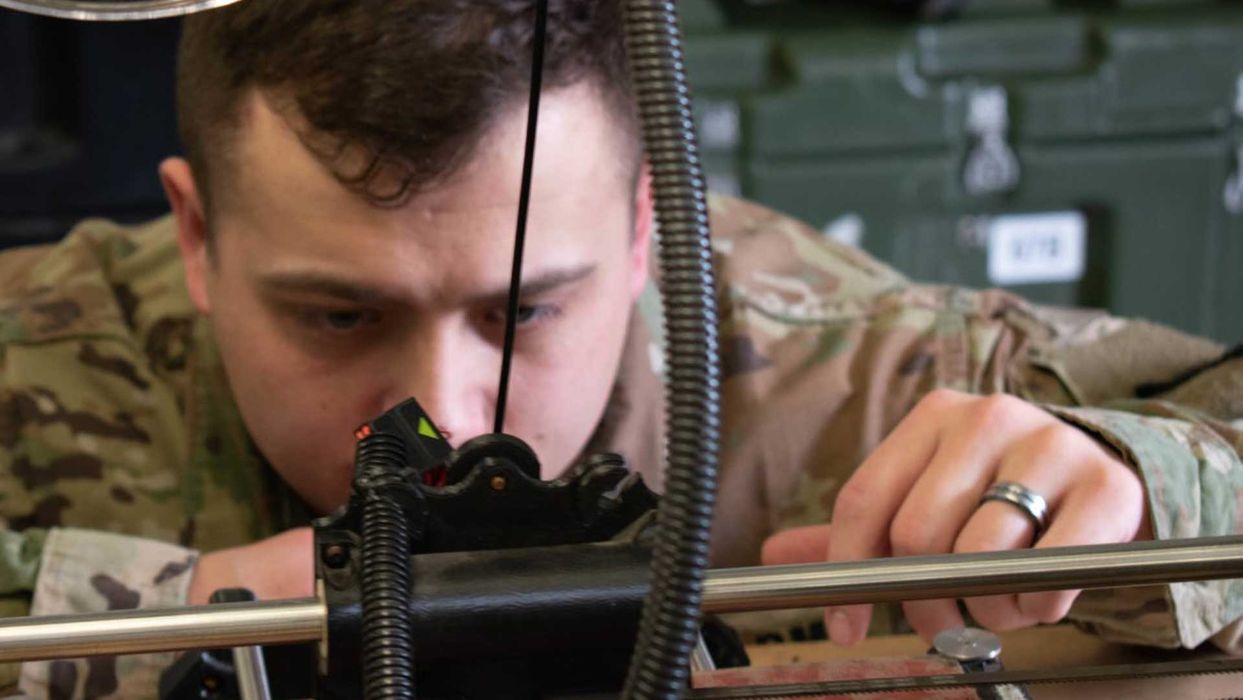
In our 2025 article, “Inside the Arsenal: The Army’s 3D Printing Revolution at Rock Island,” we reported that the Army had already printed more than 1,500 unique parts for in-service platforms through its Rock Island Arsenal activities. The article also examined the arsenal’s ambitions to move from limited repair production toward much larger-scale manufacturing, including high-volume production of drone bodies.
Rock Island is becoming particularly important because it combines advanced manufacturing equipment with the engineering and sustainment expertise required to turn digital designs into usable military hardware. Its capabilities include large-scale metal additive manufacturing, including the Jointless Hull system.
The Army’s experience goes well beyond ground vehicles. Our 2024 article, “Future Flight: Bell’s 3D Printing Advances and the Army’s Tiltrotor Transformation,” looked at how Bell uses additive manufacturing for prototyping, tooling and production in support of the V-280 Valor and the Army’s Future Long-Range Assault Aircraft program. Bell Textron Inc. is an American aerospace manufacturer headquartered in Fort Worth, Texas. A subsidiary of Textron, Bell manufactures military rotorcraft at facilities in Fort Worth, and Amarillo, Texas, United States. It was founded by pilot Lawrence Dale Bell in 1935.
We have also documented the broader evolution in “The U.S. Army and 3D Printing,” including portable manufacturing concepts and the Army’s efforts to use AM to improve supply chain resilience. More recently, our article “How Florida SkillBridge Is Helping Veterans Bring Additive Manufacturing Skills Into Civilian Industry,” we examined another piece of the puzzle: workforce development. Veterans who have encountered digital inventories, 3D printing and distributed manufacturing during military service can carry those skills into the civilian aerospace and manufacturing sectors.
The Research and Development (R&D) Tax Credit
We describe several 3D printing and additive manufacturing developments that may create strong opportunities for companies to identify federal R&D tax credit activities. For example, companies are increasingly replacing parts of the physical supply chain with digital ones by developing digital design files, material specifications, manufacturing parameters, and inspection procedures for low-volume or hard-to-source parts. That type of work may support the development of a new or improved “business component” under IRC § 41 when it is aimed at improving a product, part, or manufacturing process.
The article also describes reverse engineering obsolete parts by inspecting, measuring, or scanning them, then deciding whether to reproduce, modify, or redesign them using modern materials and processes. These activities often involve real technical questions: Which material will perform? What tolerances are achievable? Will the printed part meet strength, fit, or reliability requirements? Resolving those questions through engineering analysis, simulation, test builds, and evaluation can help satisfy the “technological uncertainty” and “process of experimentation” requirements.
The prototyping, tooling, production, process qualification, simulation, nondestructive inspection, and scaled manufacturing developments further reinforce the R&D connection. Manufacturing process development can qualify when the process itself meets the IRC § 41 tests. In addition, materials consumed in qualified prototype work may be eligible supply costs, although companies should separate research prototypes from routine production items.
In short, additive manufacturing projects can generate creditable R&D when companies document the technical uncertainties, alternatives tested, engineering results, and prototype costs behind the printed parts and related production processes. R&D Tax Savers has been helping companies claim R&D credits since it was introduced into tax law in 1981.
A New Kind of Defense Supply Chain
The Army’s current search for obsolete Bradley components shows why these capabilities matter.
Traditional supply chains are optimized for moving physical goods from established manufacturers through distribution networks. Military sustainment often has a different problem: a platform may remain operational for decades after its original supply chain has disappeared.
AM offers a way to decouple equipment longevity from the longevity of its original suppliers.
The emerging model is not simply “put a 3D printer in the field.” It is a much broader digital manufacturing system in which qualified designs, manufacturing knowledge, materials, machines and inspection capabilities can be connected across a distributed network.
The Army has described advanced manufacturing as a way to reduce logistics burdens and improve readiness, while its BDRF program demonstrates how AM can already fill gaps created by obsolete and long-lead-time components.
That makes supply chain innovation a defense and security issue, not merely a manufacturing efficiency issue.
In a future conflict, factories, ports, warehouses, ships, roads and aircraft may all be constrained or targeted. A military that depends entirely on long physical supply chains can find itself waiting for a relatively small component to restore an otherwise valuable system.
A distributed manufacturing network provides another option.
The Army’s search for obsolete parts is therefore a revealing indicator of where military logistics may be heading. The goal is not to replace every conventional supplier or manufacture every component additively. It is to ensure that when an important part disappears from the commercial supply chain, the mission does not necessarily disappear with it.
For additive manufacturing, that represents one of its most consequential opportunities: turning the defense supply chain from a system based primarily on where parts are stored into one increasingly based on where qualified parts can be made.