
A new research paper shows how additive manufacturing is enabling increasingly sophisticated auxetic structures with unusual mechanical behavior.
Auxetic materials are unusual because they become wider when stretched and narrower when compressed. Conventional materials generally do the opposite.
The trick is usually not the material chemistry itself. Instead, carefully designed cells rotate, bend, fold or buckle in ways that create a negative Poisson’s ratio at the larger structural scale.
A review by Zhiyin Luo of Beijing University of Technology examines how these architectures have evolved, and where additive manufacturing fits into their fabrication. The paper covers familiar re entrant honeycombs, chiral structures and origami inspired designs, but gives particular attention to newer three dimensional petal like architectures.
From Honeycombs To Petals
Classic re entrant auxetic cells use inward angled ribs that rotate under load. They are relatively straightforward to model and manufacture, but slender struts can buckle or fracture under substantial loads.
Chiral structures instead use rotating nodes connected by flexible ligaments. Origami and kirigami approaches rely on programmed folds or cuts. Each strategy can produce the same broad auxetic effect through a different deformation mechanism.
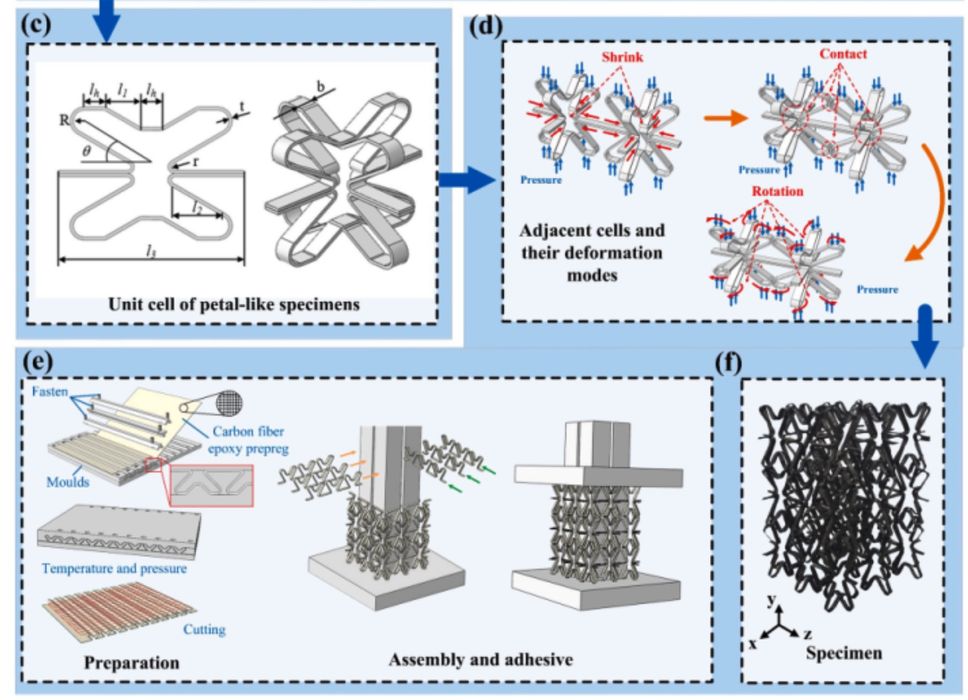
The newer petal like structures add another level of complexity. Two dimensional petal shapes are extended into spatial cells using rotation, connections between layers and multicell assemblies.
Rounded transitions replace sharp corners to reduce stress concentrations. Connection platforms can also provide larger bonding regions, particularly important when continuous carbon fiber composites are involved.
Under compression, these structures do not just bend until something breaks. They pass through several stages including elastic deformation, contact between adjacent petals, rotation and progressive crushing, followed eventually by densification.
That progression is important for energy absorption. Instead of a sudden collapse after local failure, loads can potentially migrate through alternate paths while the structure maintains a relatively stable stress plateau. The review notes previous work showing carbon fiber reinforced petal structures retaining auxetic behavior during substantial deformation and low velocity impact.
Additive Manufacturing Makes The Geometry Possible
This is where 3D printing becomes especially relevant.
FFF offers an inexpensive method for relatively large open cell structures using materials such as PLA, ABS, PETG and TPU. However, interlayer bonding, dimensional accuracy and anisotropy can significantly change the intended mechanical behavior.
SLA and DLP provide much finer features and smoother curved geometries, making them attractive for small auxetic cells. Resin toughness, heat resistance and post curing effects continue to be constraints.
SLS and MJF are particularly interesting because complex three dimensional lattices can be produced without conventional support structures. Unfortunately, trapped powder inside tiny internal passages can become a serious problem as geometries shrink.
DIW expands the concept into elastomers, hydrogels and ceramic or composite inks, while metal additive manufacturing could enable strong auxetic structures for aerospace or harsh environments.
Continuous fiber reinforcement presents another approach, potentially combining unusual deformation with meaningful structural strength. But fiber turning radius, deposition path continuity, interlaminar bonding and joints must all be designed around the manufacturing process.
That last point may be the most important thing here: a theoretically perfect auxetic cell might perform quite differently once actually printed.
The researchers noted surface roughness, dimensional errors, orientation, defects and cell size as major variables. These effects become increasingly significant as structural features get smaller.
There is also plenty left to prove. Much existing research focuses on quasi static compression, while fatigue, repeated impact, environmental aging and long term reliability remain less understood.
Future development may therefore involve machine learning and topology optimization alongside finite element simulation, with designs optimized simultaneously for stiffness, mass, energy absorption and manufacturability.
3D printing has made bizarre auxetic geometry relatively easy to produce. The harder challenge now is ensuring the printed object behaves like the geometry promised.
