
HeyGears has filed a patent describing what looks like a highly automated resin 3D printing production system, including automatic part removal, resin drainage, recycling and job sorting.
The patent is US20260233462A1, assigned to Guangzhou HeyGears IMC.INC. It combines several ideas that together suggest the company is thinking way beyond the printer itself.
HeyGears is already deeply involved in resin 3D printing, particularly dental applications, where large numbers of relatively small parts or models can be produced every day.
That kind of environment has a problem: the printing part can be fast, but post processing all the parts still involves a huge amount of manual effort.
Getting The Resin Off
One of the more interesting concepts in the new patent handles uncured resin left on a freshly printed object.
Normally a printed part or build platform might be set up to drip for a while before washing. That allows for recovery of at least some of that expensive resin. However, it never gets all of the stray resin off the print, and washing is always required.
Complex geometries can trap resin in depressions or cup shaped features. Leaving the object in one orientation may simply leave some of that resin sitting there.
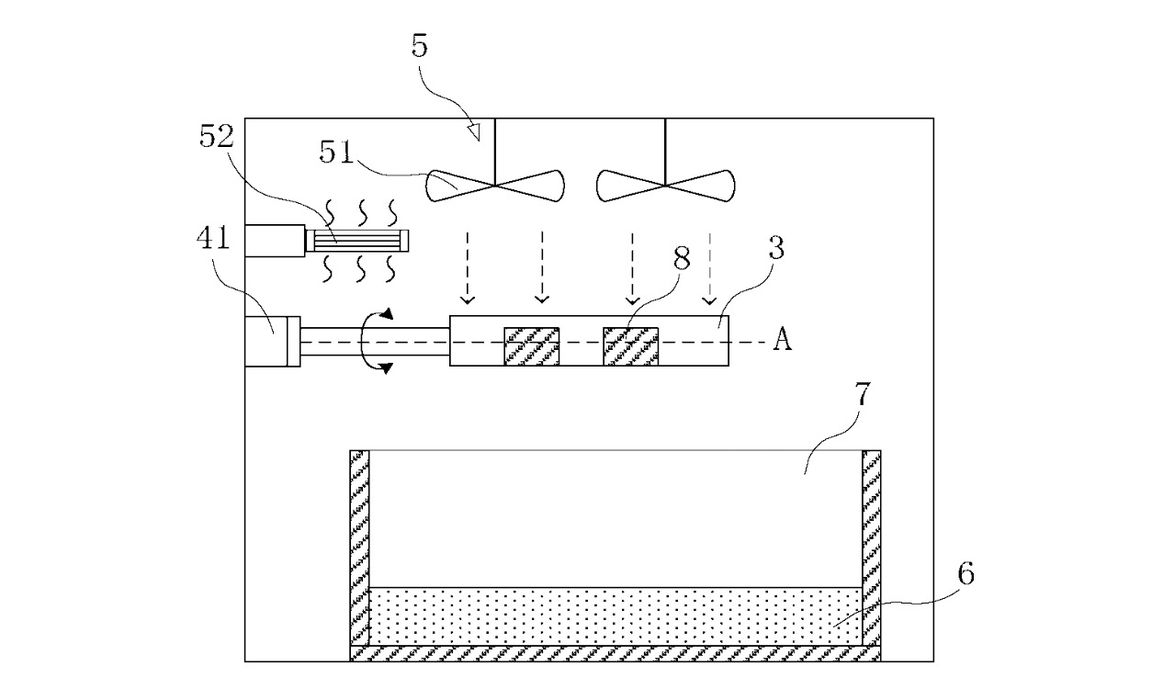
HeyGears proposes placing the printed object in a receiving mechanism that can automatically rotate it through multiple tilt angles. The object can pause at one angle, move to another, and continue through several positions to hopefully persuade the resin to flow away.
The patent goes considerably further.
The system could also use heated air to reduce resin viscosity, forced air to accelerate drainage, vibration, or slow rotation. Collected resin could then be filtered and returned for reuse.
HeyGears even describes automatically selecting the best drainage angle from the geometry of the 3D model. One implementation could use historical data or machine learning to determine which orientation should drain a particular shape most effectively.
A dental model with a cavity might receive an entirely different drainage sequence from a relatively flat component. In other words, post processing could become part specific rather than just using the same timer and orientation to everything.
The patent claims that in some scenarios more than 70% of resin printing material could be saved compared with a non recycling setup. Resin recovery at a production scale could be a big deal, if this works.
An Automated Production Cell
HeyGears also describes cloud software that can receive 3D models, classify them according to customer or production case, group jobs together and distribute them across one or more 3D printers.
After printing, automated mechanisms could separate parts from the build surface, move them into the drainage equipment and eventually place them into storage containers.
This bit is really interesting: parts belonging to the same customer or job can remain grouped together.
That strongly resembles the workflow required in a dental production center, where hundreds of models might be produced daily but must still land at the next process for the specific patient.
This automation could change the current resin operation scenario in the industry. Today if a resin 3D printer finishes quickly but requires an operator to remove every build, drain it, sort the parts, recover resin and prepare the next job, throughput is actually limited by the amount of manual labor available. And that labor is expensive.
A system like the one described in this patent could create a much more continuous manufacturing process that incorporates significant automation.
HeyGears appears to be thinking about resin 3D printing as an integrated production process rather than a collection of separate machines. If they can make that approach reliable with these techniques, the bigger competitive advantage may come from simplifying all the steps that happen after the printer job ends.
Via Espacenet
