
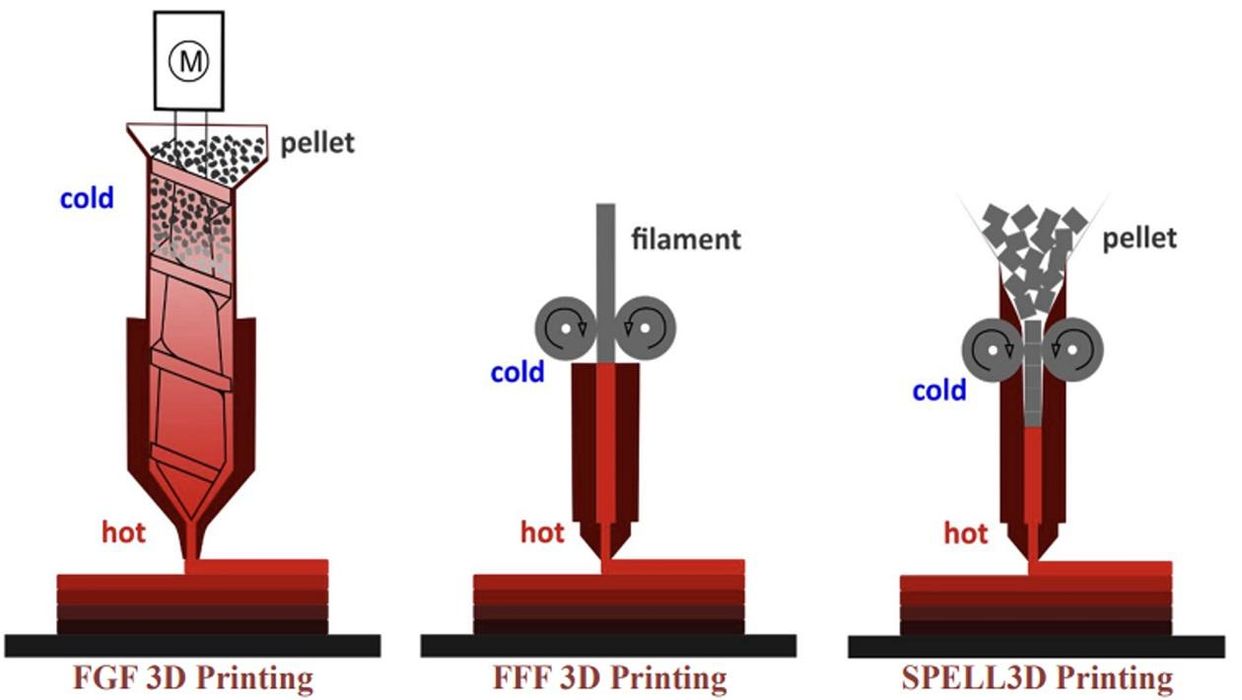
A project is underway to develop an effective desktop FGF 3D printer.
Most 3D printer operators are familiar with FFF, the technology that prints a thermoplastic filament. FGF is quite different. FGF (Fused Granular Fabrication) prints with pellets instead of filament.
FGF is actually quite difficult to perform, so that’s why it isn’t widespread today. If it’s so difficult, why bother at all?
It’s all about costs. Pellets are typically 10X less expensive than filament. That’s because filament is literally made from filament: raw pellets are softened in an industrial extruder and extruded as filament. That’s an extra step to create a spool of filament that adds costs.
The FGF approach is to skip that step completely, making the cost of materials far lower.
The main issue is that pellets are of inconsistent size and geometry. This means that as they approach a hot end, there could be more or less material flowing at any moment. Unpredictable flow means you have a bad-quality print with gaps or blobs.
The usual approach to solving that problem with industrial FGF systems is to have a very large and long extrusion system. This extra size allows the pellet motion and geometry to “average out”, creating predictable flow. Those large extrusion systems are too big for desktop equipment, and that’s why you don’t see desktop FGF systems.
SPELL3D, based in Malta, is working on solving this issue. It’s a collaboration between the University of Malta and local company Invent 3D.
In the image at the top, SPELL3D hopes to simplify the pellet extrusion system, bringing it down to the same size as a typical FFF system. That would enable use on desktop equipment, and therefore save operators massive amounts of money on materials.
How do they do this? A report in the Malta Times explains:
“SPELL3D takes a simpler approach. Rather than using a screw to compress and melt pellets, the system delivers them into a compact heating chamber in a controlled way. This screwless design results in a smaller, lighter extruder, well suited for desktop and modular applications. However, simplifying the mechanics introduces new challenges. Pellets vary in size and do not feed as predictably as filament. To address this, the team developed a modular feed system and thermal control system to maintain even flow, balanced heat distribution, and consistent quality.”
This is a very intriguing approach, and one that would certainly be welcomed by everyone in the community — except the filament manufacturers, of course.
But it remains to be seen if this is truly workable. I see that the project has been underway for at least several years, and in all that time, we have not seen a commercialization of a product using this technology.
Via SPELL3D and Times of Malta
