
3D printed medicine has been “almost here” for quite a while.
The goal seems quite attractive. Instead of producing millions of identical tablets, a pharmaceutical manufacturer could potentially print a dose for one particular patient, adjusting the drug amount, release rate, shape, flavor or even combining several medications into a single pill.
And this isn’t entirely theoretical. The US FDA approved Aprecia’s 3D printed levetiracetam product more than a decade ago.
So where are all the other printed medicines?
That gap between what 3D printing can apparently do and what pharmaceutical manufacturing is actually doing is at the heart of a recent review of additive manufacturing for dosage form development.
More Than Personalized Pills
Personalization tends to get most of the attention, but there’s another useful role for 3D printing here: developing drugs in the first place.
A pharmaceutical team could change a tablet’s internal geometry, infill, drug concentration or material arrangement and then study how those changes affect dissolution and drug release.
That makes the printer less of a manufacturing machine and more of a formulation tool.
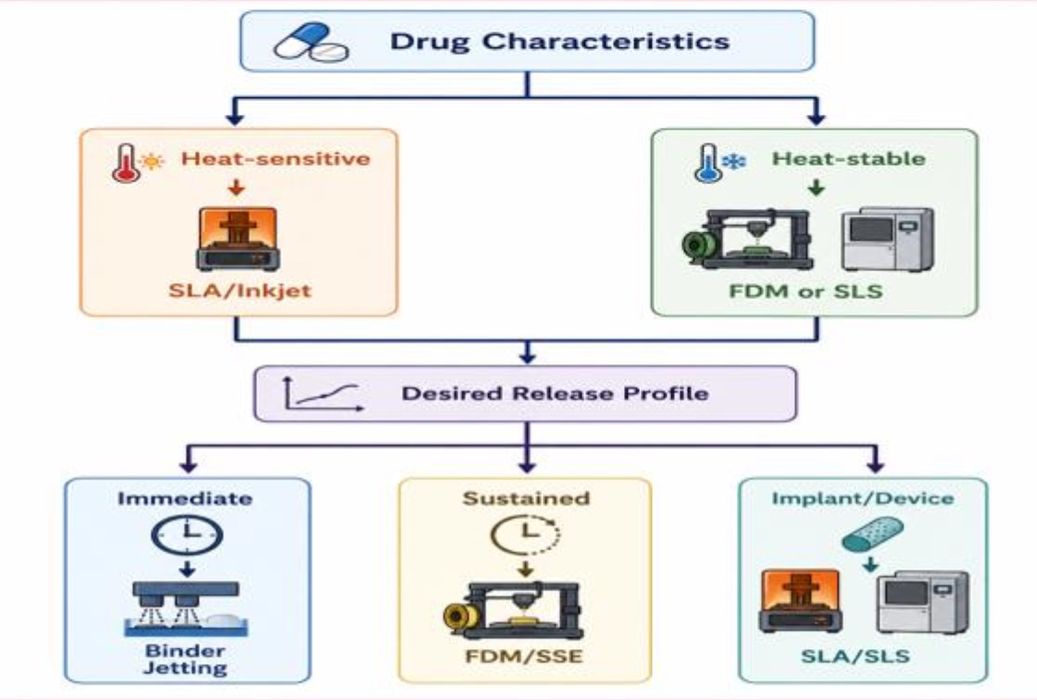
Several AM processes have been explored for this purpose.
FFF can print drug-loaded thermoplastic filaments, often prepared through hot melt extrusion. Semi-solid extrusion can deposit pastes and gels without exposing the active ingredient to quite as much heat. Binder jet systems can produce highly porous tablets, while vat photopolymerization offers another route where compatible chemistries are available.
Each solves one problem while creating another.
For example, FFF is relatively easy, but heating the material can damage temperature-sensitive drugs. Binder jetting can make tablets that break apart quickly, but powder handling and mechanical strength become important. Other processes bring their own material, curing and post-processing constraints.
This is where pharmaceutical 3D printing starts looking a lot less like ordinary 3D printing.
Producing something tablet-shaped is the easy part.
Producing a tablet containing exactly the intended dose, releasing it at exactly the intended rate, remaining stable over time and doing so repeatedly is a completely different challenge.
You Can’t Just Tweak the Slicer
Imagine a pharmacy printing customized tablets.
Then someone changes a print speed.
Or replaces a nozzle.
Or switches to a new batch of excipient.
Those would be fairly straightforward activities in a normal 3D printing operation. In pharmaceutical production, however, any one of them could potentially change the dose or release behaviour of the finished medicine.
That means the printer has to sit inside a much larger validated system involving formulation, feedstock preparation, calibration, process monitoring, cleaning, traceability, packaging and stability testing.
And unlike a misprinted bracket, a questionable tablet isn’t something you simply print again and hope for better results.
There’s also a fairly brutal economic reality.
Conventional tablet manufacturing is extraordinarily good at making enormous quantities of identical pills cheaply. 3D printing is unlikely to beat that model simply by printing the same pills more slowly.
A much stronger opportunity is where mass production performs badly.
That could include pediatric doses, rare-disease medications, clinical trial batches, unusual release profiles or polypills combining several drugs for one patient.
Those are situations where making thousands or millions of identical tablets may not make much sense in the first place.
There’s still a regulatory problem, however. If every customized dose is slightly different, regulators eventually have to decide which variations are simply allowed manufacturing adjustments and which effectively create a new pharmaceutical product.
That may be more difficult than building the printer.
For now, the most realistic home for pharmaceutical AM may therefore be controlled environments such as hospitals, specialist pharmacies and drug-development laboratories rather than a medicine printer sitting behind every retail pharmacy counter.
