
PCTG is a wonderful 3D print material, and it just might be ready to explode in popularity.
I first encountered PCTG many years ago when given a spool by Fiberlogy. It was a curious material that is somewhat similar to PETG. I had no issue printing PCTG, although there really weren’t any print profiles for it at the time.
What is PCTG? PETG and PCTG come from the same chemical family, but they have their glycol ratios flipped. PETG has more ethylene glycol than CHDM, whereas PCTG has more CHDM than ethylene glycol. CHDM is a bulkier glycol that disrupts crystallization.
The result is a material that is equivalently easy to print, but has better toughness, impact resistance, clarity, and chemical resistance.
It’s basically a better PETG.
I’ve long thought that the industry should eventually switch to PCTG as the default material over PLA, but it hasn’t happened.
At least not yet.
There have been a couple of issues.
One is that PCTG tends to cost more than PLA, and that’s because of the volume of production. There are far fewer companies producing PCTG filament. Less volume means less economy of scale and thus somewhat higher pricing.
That leads into the second problem: availability. There are plenty of places to buy PLA filament, but far fewer selling PCTG products. The main producers seem to be Fiberlogy in Europe and North Dakota-based 3D-Fuel in North America.
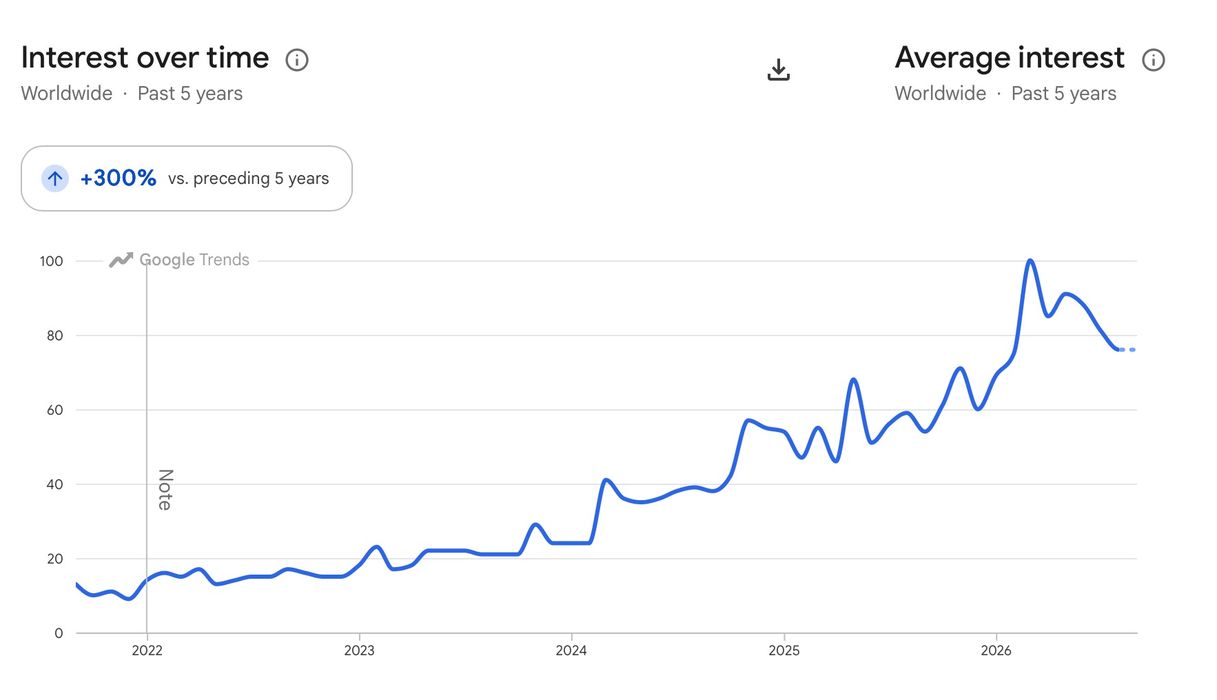
Recently I’ve been seeing a slowly increasing rate of mentions of PCTG online. I wondered whether this could indicate the start of a trend.
I consulted with Google Trends to find out. Trends allows you to see the frequency of search terms over time, which is a proxy for interest.
I found that indeed, there has been quite an uptick in PCTG searches over the past year. See image at top.
Another clue is from 3D-Fuel itself, which now offers their Pro PCTG in no less than 73 different colours, plus reinforced and specialty variants. You don’t manufacture filament in 73 colours unless there are significant numbers of buyers. This is quite different from only a couple of years ago when the number of colours could be counted on one hand.
It seems clear that the use of PCTG is expanding, with searches, appearances in print profiles, colour availability, and specialty filaments.
While this is obviously good news for PCTG providers, it’s also good news for 3D printer operators: you get better prints.
I’m hoping that this expansion of interest continues, and that at some point pricing for PCTG will close the gap between it and PLA.
