
HDPE ought to be a very useful 3D printing material.
It’s cheap. It’s tough. It’s chemically resistant. It’s lightweight. It’s already everywhere in the manufacturing world, showing up in bottles, pipes, containers, fixtures and plenty of industrial parts.
And yet, for FFF 3D printing, HDPE has always been one of those materials that looks much better on a spec sheet than it does on the build plate.
The problem is not mystery. It’s shrinkage.
As HDPE cools, it crystallizes strongly. That contraction can yank corners off the print surface, bend long walls, or pull layers apart. You can fight this with a heated enclosure, careful orientation, serious bed adhesion and probably a few unprintable words, but none of that really makes HDPE easy.
It warps. A lot.
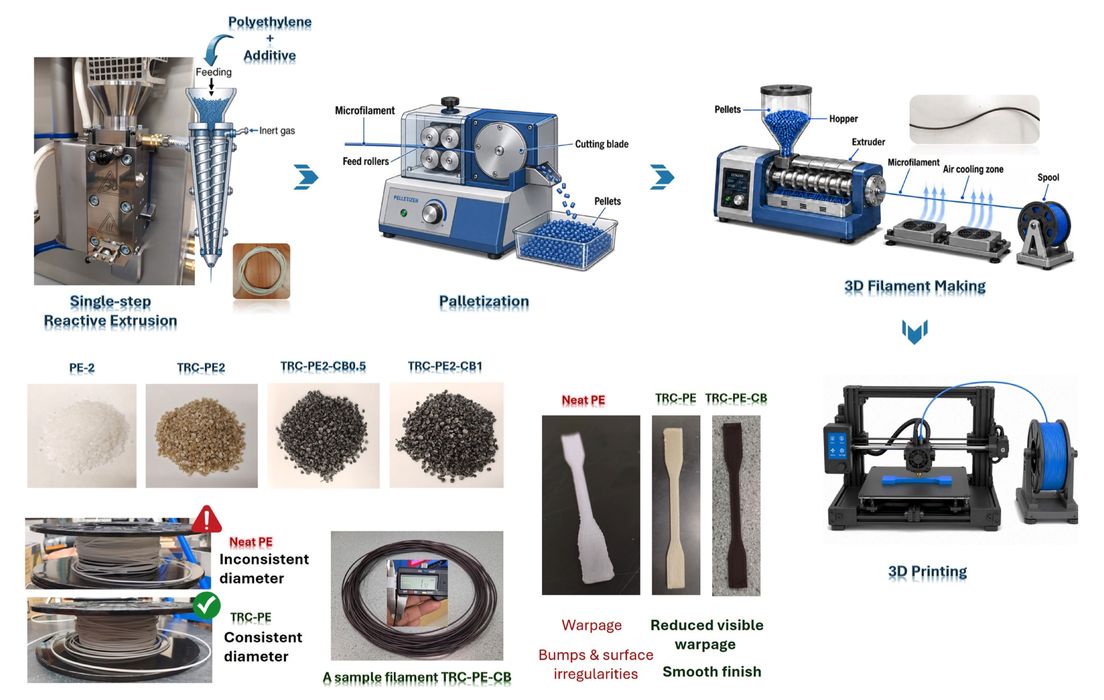
A new paper, Thermo-Reactively Coupled (TRC) HDPE for Melt-Processable Warp-Resistant FDM 3D Printing, looks at a more fundamental approach: change the polymer during melt processing so it becomes less prone to warping.
The researchers are asking whether it can be modified enough to print better, while still remaining melt processable. A version of HDPE that resists warping but turns into a gummy, gelled, nozzle-clogging mess would not be much of a win.
Changing The Polymer Without Killing Printability
Thermo-reactive coupling is essentially chemistry performed during melt processing. Under heat, the polymer chains can be joined or altered, producing branching, chain coupling or limited network formation.
Basically, the researchers are trying to make the HDPE molecules a bit less independent of one another.
That can change how the material behaves when it is softened, how it flows through an extruder, and how it cools after being deposited. The material has to leave the nozzle cleanly, hold its shape, bond to the previous layer and then cool without building up so much internal stress that the part tries to peel itself into a new geometry.
Why do this? Because HDPE’s basic properties are attractive enough to justify the effort.
If it could be made into a more reliable FFF material, it could be useful for chemical-resistant fixtures, durable containers, industrial components and possibly larger printed structures. HDPE is also plentiful and widely recycled, which adds an obvious commercial angle for both filament and pellet extrusion.
The difficult trick is improving the print behavior without turning HDPE into something that no longer behaves like a practical extrusion material.
The Narrow Window
There’s a catch, of course.
Reactive modification can be touchy. Too little coupling, and the original warping problem may still be there. Too much, and the material could become too viscous, form gels, extrude inconsistently, or become harder to reprocess through another heat cycle.
FFF makes that even messier.
A material may be compounded, pelletized, dried, extruded into filament, pushed through a nozzle, paused, restarted, and then cooled across a part with uneven thermal conditions. A formulation that behaves well in a small test print may still become troublesome on a large, open build plate.
That is why the “melt-processable” part of the paper’s title is doing a lot of work.
The goal is a printable process window: enough molecular modification to tame shrinkage, but not so much that the material becomes impractical for ordinary extrusion equipment.
That could be an important development. HDPE has never lacked useful properties. What it has lacked is good behavior during printing.
If thermo-reactive coupling can make HDPE less prone to warp while preserving normal melt processing, it could change the material from “possible but annoying” into something a lot more usable.
Via Polymers
