
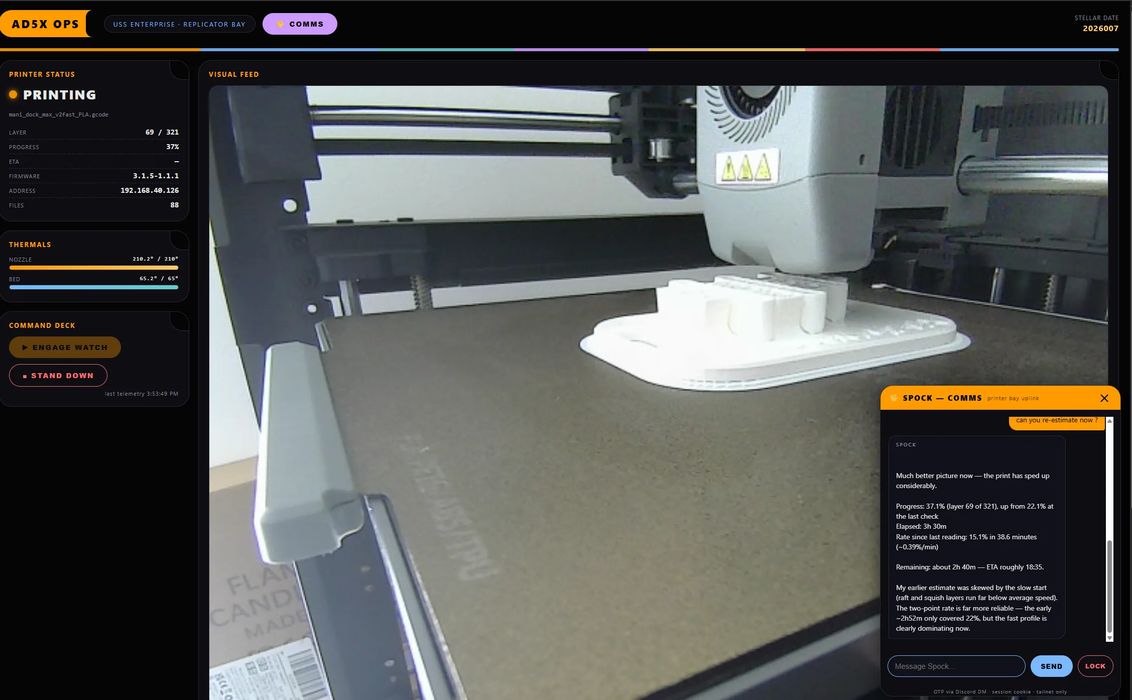
I ran into a fascinating open-source project that attempts to automate some of the work to perform 3D print jobs.
João Silva published a series of open-source tools related to 3D printing, specifically skills for Hermes.
Hold on, what’s a “Hermes”? It’s an agent harness for AI. Essentially, it is a controller that, based on your requirements, will perform tasks, schedule activities, monitor websites, answer emails, etc., all automatically once set up. Hermes is one of several tools that can do this sort of thing, such as OpenClaw. ChatGPT and Claude Code can also do this type of activity.
The catch is that the harness has to have a “skill” for specific tool access. How, exactly, do you make a restaurant reservation? There’s a skill for that, which might specify the online website to use, time of day preferences, names to use for booking, whether to invite other people, etc. A skill is simply all the details one might need to perform a specific activity.
Silva made one for 3D printing.
Well, not for “all” 3D printing. His Hermes skill is focused on the Flashforge Adventurer AD5X 3D printer. The skill has several functions:
- Slice a 3D model using a headless OrcaSlicer instance in the background, using print profiles and user preferences for the specific job.
- Fixes up known issues in Flashforge GCODE
- Uploads and launches the print on the AD5X using its network interface
- Tracks currently mounted filament spools (the AD5X can have up to 4 spools per job)
That’s a basic list, but having it as a skill means that Hermes can actually do those functions when requested. For example, when you’re out and about, you might message your Hermes agent and ask it to print another three copies of that Bunny sculpture. And Hermes would do it.
Silva also has another related skill to transform a sketch into an OpenSCAD 3D model.
This is all quite interesting, but it’s only of use to those using an AD5X 3D printer and Hermes, of which there will be a rather small number.
My thought is that this approach might be something of interest to the big 3D printer manufacturers. AI agents are going to be a huge thing in the near future, so having an ability to use them with 3D printers might be attractive.
Could we see printer manufacturers publish official “skills” for using their equipment?
Or maybe we won’t, because the manufacturers would rather keep users inside their walled gardens?
Or maybe other manufacturers would see that as an opening to tie their equipment to the AI agent train and ride it to future success?
It’s not clear where this is going, but at least Silva has shown that this approach can technically work.
