
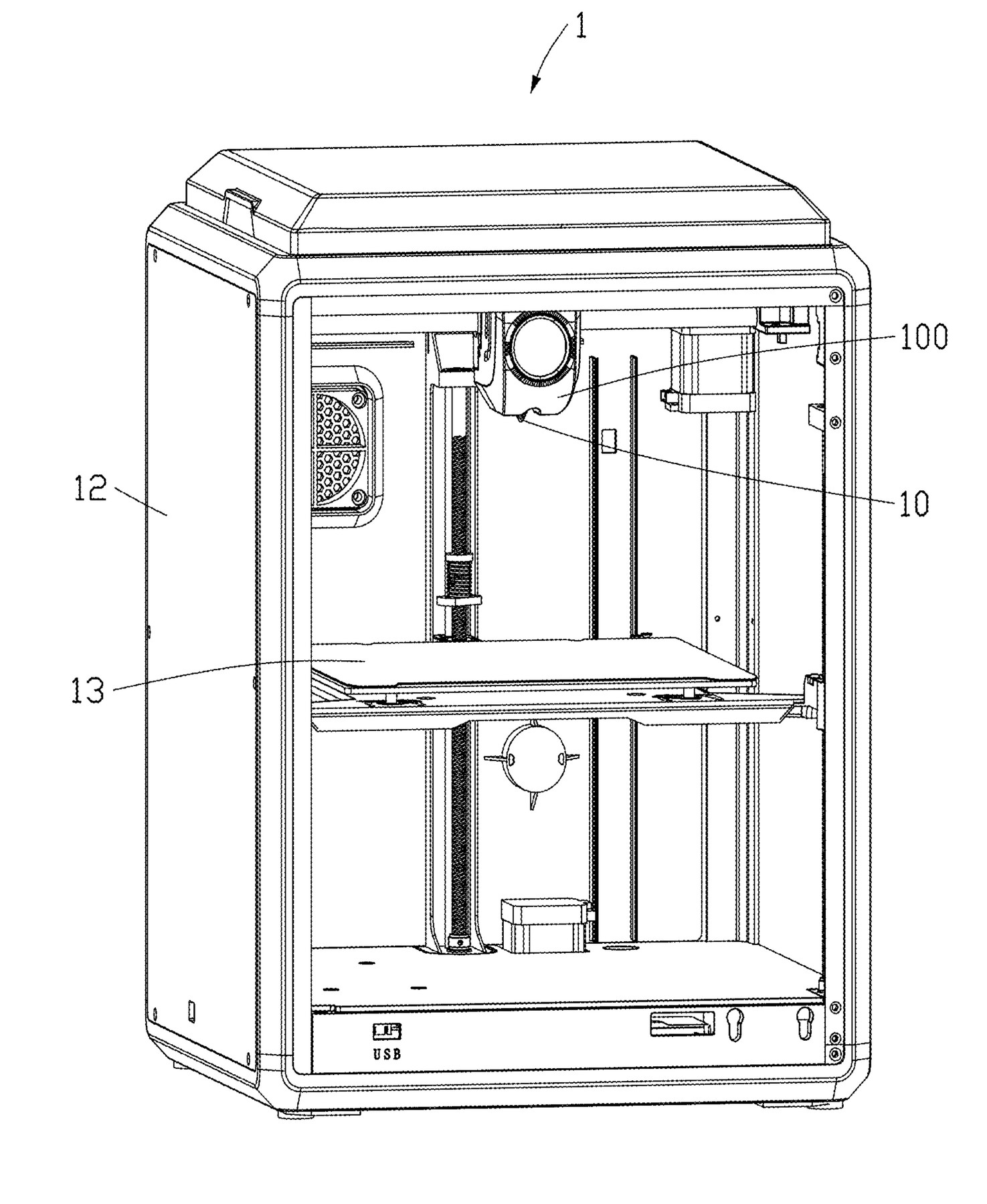
Creality wants to heat the middle of the filament instead of waiting for heat to work its way inward from the walls.
That is the interesting idea in a patent application from Shenzhen Creality 3D Technology Co., Ltd. The filing, US20260273845A1, describes a hot end with small internal projections reaching into the filament channel.
In high-speed FFF, the difficulty is not simply getting the nozzle hot. The incoming filament has to absorb enough heat, quickly enough, while the extruder is pushing a much greater volume of material through the melt zone. High speed printing depends on this capability.
Ordinarily, the filament contacts the heated inner wall of the hot end. The outer portion of the filament softens first, while the colder core softens more slowly. Push too hard and the machine sees greater pressure, higher viscosity and, eventually, the possibility of under-extrusion or a blockage.
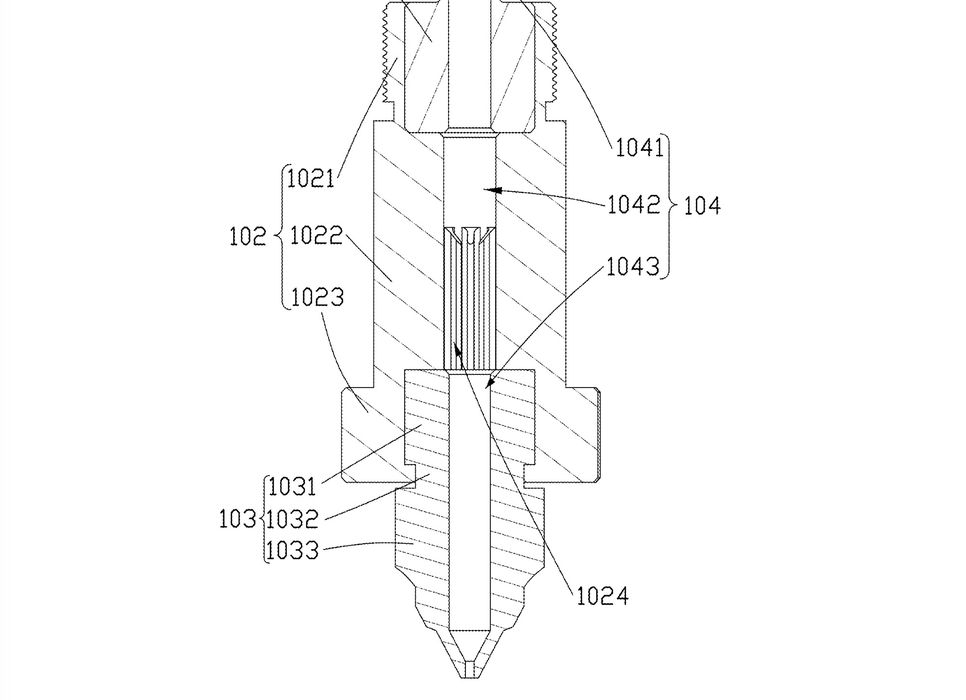
Creality’s proposed solution is a heat conduction part inside the filament path. One end connects thermally to the heated body. The other end extends toward the channel’s central axis, forming several separated projections around the filament path.
These projections do not close off the passage. Concave spaces remain between them, leaving an open flow path for softened polymer. The patent shows versions with two, four, six and eight projections. The number can apparently be selected according to the desired flow rate and printing requirements.
That shape is doing two jobs at once. The projections conduct heat directly into material farther from the wall, while the gaps avoid turning the melt zone into a restrictive filter. As the filament moves through, it should melt more uniformly and leave the hot end with lower viscosity.
I like this because it addresses a real high-speed extrusion problem without pretending that merely increasing heater power is enough. More heater power can warm the surrounding metal while the filament core remains solid. Internal fins should fix this issue where it actually occurs.
The filing also describes a staged thermal arrangement. A preheating section sits before the main heating area, and a narrower transition section separates it from a radiating section that can connect to a heat sink. The intent is to soften the incoming filament gradually, while preventing heat from creeping too far upward into the cold side.
There is even a temperature-sensor mounting point in one embodiment, placed on a protruding structure near the nozzle. That could provide a reading closer to the material than a sensor mounted only in the heater block, although the patent does not establish how much better the measurement would be in practice.
A performance table in the patent document suggests the fins can keep reasonable flow rates at high print speeds.
This is all suspiciously similar to the CHT hot ends we’ve seen for the past few years. Those involve a divider in the filament path that performs a similar heating role. However, Creality’s approach here seems more sophisticated.
Creality is treating the hot end as a heat exchanger with a carefully shaped flow path, not merely as a heated tube. If the company can manufacture and maintain that geometry reliably, this patent could point toward a more credible route to high-speed extrusion.
Via Espacenet
