
A two layer PLA and carbon fiber PLA print delivered the strongest result in a multi material filament extrusion study.
That’s one of the findings from research by Muhammet Mevlüt Karaca and Tuğçe Yıldız at Karabük University in Türkiye. They investigated whether combining ordinary PLA with carbon fiber reinforced PLA in different arrangements could produce parts with better mechanical properties.
The results suggest that where you put the carbon fiber may be more important than how much you use.
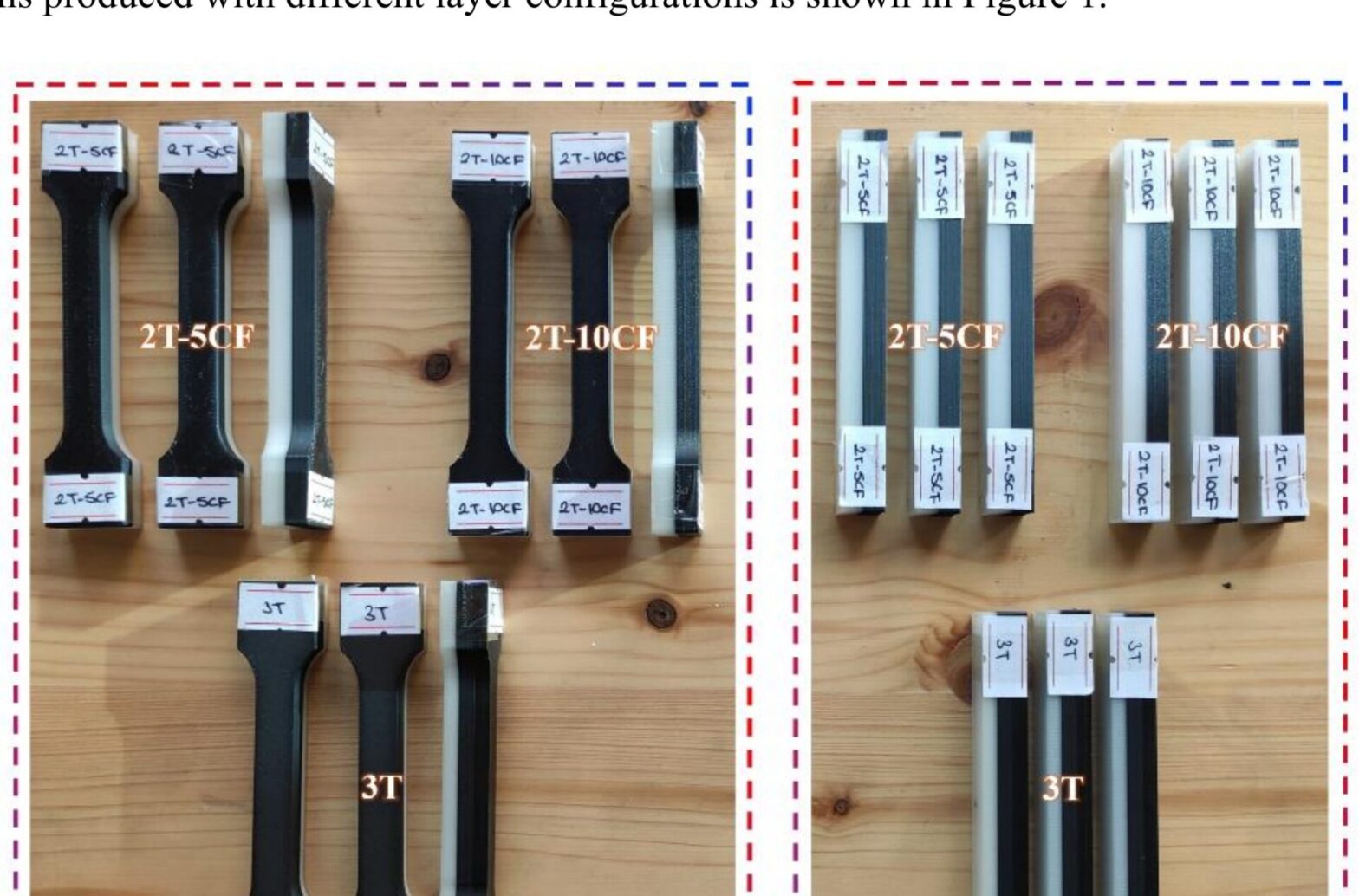
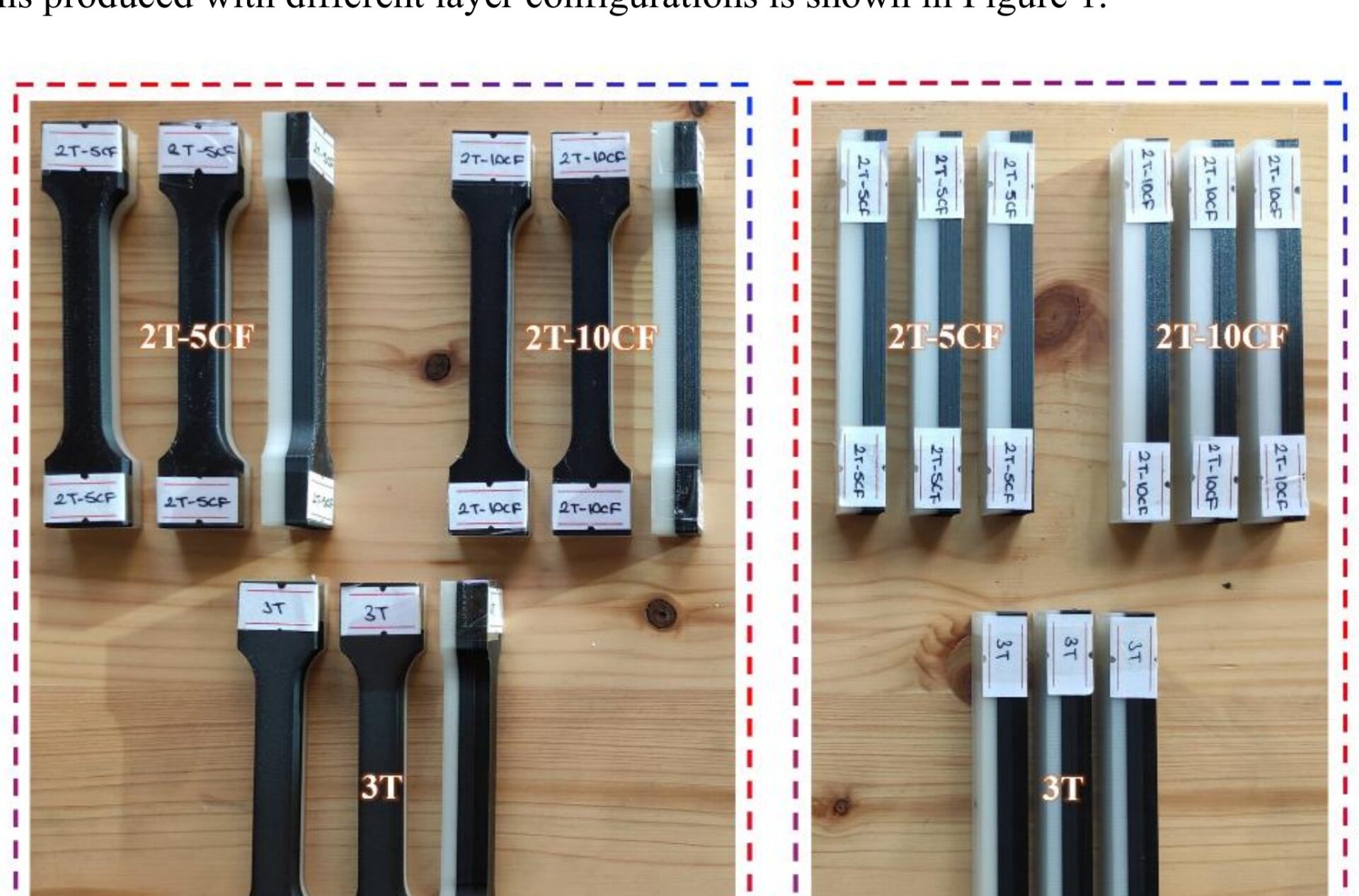
The researchers worked with three filaments: ordinary PLA, PLA containing 5% short carbon fibers, and PLA containing 10% carbon fibers. Using an Anycubic Kobra S1 equipped with its Color Filament System (CFS), they produced six different specimen configurations.
Three consisted entirely of one material. The others combined materials in stacked sections: two versions with equal thicknesses of PLA and reinforced PLA, and a three-section arrangement progressing from ordinary PLA through 5% to 10% reinforcement.
The CFS automatically switched filaments during printing, using 210C for ordinary PLA and 230C for the reinforced materials. This is particularly interesting because the experiment used a relatively ordinary desktop FFF system rather than specialized composite manufacturing equipment. That suggests their results are something you might see on your own equipment.
The specimens were subjected to tensile and bending tests, with three specimens tested for each configuration.
The winner was the two-section combination of ordinary PLA and 5% carbon fiber PLA.
This arrangement achieved a tensile strength of 47.58 MPa, approximately 19% higher than ordinary PLA. Its elastic modulus increased by 74%, while bending strength increased by 24%, reaching 82.31 MPa.
It even exceeded specimens made entirely from 5% carbon fiber PLA, which achieved 44.76 MPa tensile strength and 78.08 MPa bending strength.
That’s kinda surprising. Half the cross-section of the winning specimen contained no carbon fiber reinforcement at all, yet the combination outperformed the fully reinforced version.
The researchers suggest that the stiffer reinforced section carries more of the applied load, while the ordinary PLA accommodates deformation. During bending, the location of the reinforced material also influences how stresses are distributed through the specimen.
But what happened when they added more carbon fiber?
Performance declined.
Specimens made entirely from 10% carbon fiber PLA achieved only 39.06 MPa tensile strength. The three-section arrangement, incorporating all three materials, also reached just 39.06 MPa. Its bending strength was 69.17 MPa, considerably below the simpler two-section design.
The researchers investigated the fractured specimens using scanning electron microscopy, which helps explain these results.
The successful two-section specimens showed relatively well-bonded material boundaries and evidence that carbon fibers had participated in carrying loads. The 10% reinforced sections, however, exhibited fiber clusters, small voids and signs of separation from the surrounding polymer.
The three-section specimens also showed delamination at material boundaries.
There’s another interesting measurement in the study. The successful two-section specimens had an estimated void content of only 3.5%, compared with 11.5% for the three-section specimens. Those additional voids provide potential locations for cracks to begin.
The printing process itself may have contributed to this outcome. The researchers reported some nozzle wear and occasional clogging while printing the abrasive reinforced filaments at relatively high speeds.
Multi-material FFF equipment now makes it increasingly straightforward to place reinforced filament only where it contributes to a part’s performance. Perhaps operators could worry less about the filament strength and more about where it is deposited during printing.
Via Firat University Journal of Experimental and Computational Engineering