
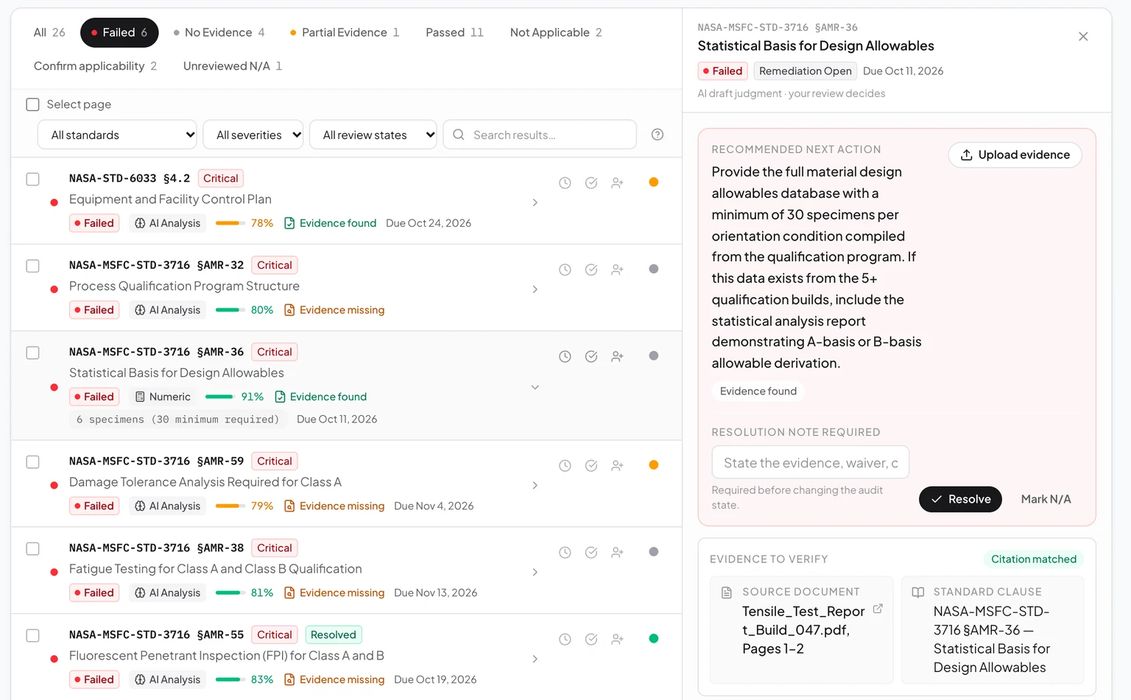
A new company should enable manufacturers to more quickly qualify 3D printed parts.
The new company is StandardFlow, launched this year by Simon Lee and Fabbaloo friend Michael Molitch-Hou, who is now the CEO of StandardFlow, based in Chicagoland.
What do they provide, exactly? It’s essentially a massive automation system for standards documents analysis.
Here’s the problem they’re solving: in many industrial printing scenarios, parts are produced for demanding, highly regulated customers. In order to pass qualification, the parts must meet a number of standards, which are publicly listed sets of requirements. Even if the part is printed correctly, it still must cover all the requirements in the documents.
The issue here is that there are now an enormous number of these standards documents, particularly for military and aerospace parts.
And, if you haven’t noticed, those are the very two areas where much of today’s push in 3D printing has headed. That’s where the money is these days, and so we see many companies in those spaces. So there is a sharply increasing number of manufacturers who need to deal with standards for their parts.
Molitch-Hou explains how StandardsFlow fits in:
“Industrial AM cannot scale on manual evidence-to-standard mapping. We are building the missing qualification layer that sits between engineering evidence and standards authority. Our mission is to automate the most labor-intensive aspects of qualification, transforming complex engineering data into traceable compliance assessments and actionable roadmaps that allow production to move at the speed of innovation.”
Basically, the tool looks at the documentation associated with the manufactured part and vets it against the required standards documents. This process, if done manually, could take considerable effort. Here it is mostly automated.
According to StandardsFlow, it can:
- Identify missing documentation
- Conflicting specifications
- Outdated revisions
- and other qualification risks
And this is done for over 100 public standards totalling 11,000+ requirements in 14 domains! That gives you some perspective on how large this problem can be.
It even provides recommendations on how to rectify any detected issues. StandardsFlow claims they can save up to 90% of the effort with their system, bringing analysis down from weeks to literally minutes.
For many large operations, this could be a massive time-saver. Manual processing usually takes teams of specialists and engineers to provide a clean report, which could not only be used for qualifications but also for audits or other procedures.
The amount of effort spent on this activity would vary by manufacturer and part, but it’s very likely that in some cases there could be a significant business case to use an automated tool for this work.
That appears to be the niche StandardsFlow will occupy.
Via StandardsFlow