
How much resin do you really need to test a new 3D printing material?
That’s the question behind an interesting patent application from Stratasys, WO2025165971A1, entitled “A System For Printing Reduced Volumes Of Test Resin In An Additive Manufacturing Process.”
When developing new photopolymer resins, material researchers typically produce small test objects to measure mechanical, optical and other properties. These specimens, often called coupons, don’t require much material.
But the 3D printer might require considerably more, particularly large production systems.
Consider a large Digital Light Processing (DLP) 3D printer. You might need to pour an enormous (and expensive) amount of resin into the machine’s vat just to get to the minimum resin depth to run the print job. That’s the case even if you’re printing only a small test coupon in the center of the build platform.
While the unused resin can theoretically be recovered, you still have to manufacture that quantity of experimental resin in the first place. If you’re developing dozens of formulations, that could be very expensive.
The obvious solution would be to use a smaller 3D printer for material development. However, there’s a big problem with that approach: the small machine might have different operating characteristics than the larger production machine.
The exposure system, layer separation forces and other operating parameters might be different, even slightly. You could end up developing a terrific material that works perfectly on the small machine, only to discover that more work is required when moving to production. So you really want to test the material on the machine that will be used for production.
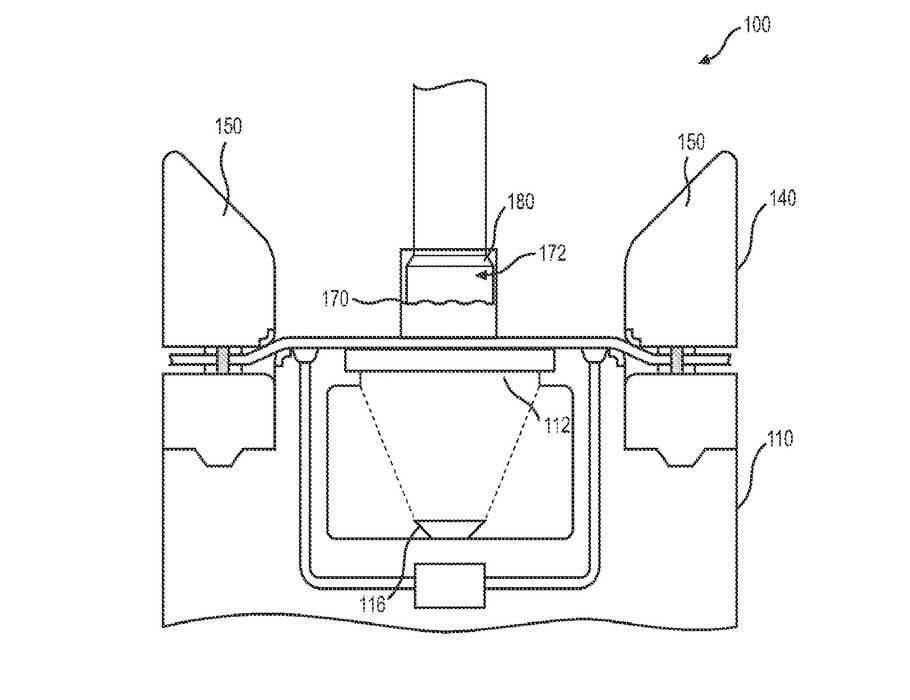
Stratasys proposes a very simple alternative: temporarily shrink the resin vat on the production machine.
Their approach involves a small, flexible structure resembling a rectangular ring with an adhesive surface on the bottom. This is placed directly onto the flexible membrane at the bottom of the existing resin vat, creating a much smaller reservoir within the larger vat.
A correspondingly smaller build platform is installed, either replacing or attaching to the standard build platform. The operator can then pour a much smaller (and cheaper) amount of experimental resin into the reservoir and proceed with printing.
There’s an interesting complication here.
The Stratasys machine described in the patent application uses a somewhat sophisticated method of separating each freshly printed layer from the bottom of the resin vat. Fluid is introduced between the flexible separation membrane and the rigid transparent window beneath it. This allows the membrane to lift away from the window and assists in separating it from the printed layer.
The little resin reservoir must therefore flex along with the membrane during every layer cycle. Otherwise, it might interfere with the separation process, damage the membrane or simply leak resin into the surrounding vat.
Stratasys proposes using a rubber material with sufficient flexibility to accommodate this motion, while remaining rigid enough to maintain the integrity of the reservoir.
Another interesting possibility described in the patent application is the installation of multiple reservoirs within the same vat. This would allow researchers to print coupons from several different resin formulations during a single build.
Imagine preparing several slightly different resin formulations and producing test specimens from each simultaneously. You’d use the same machine under the same general operating conditions, which could make comparisons between formulations more straightforward.
Once material development is complete, the inserts are removed and the standard build platform reinstalled. Production can then take place on the same machine using a full vat of the newly developed resin.
I suspect there’s another benefit here. Companies developing specialized resins for relatively small markets might be able to experiment with a greater number of formulations if each experiment requires less material.
Somehow I am not surprised by this patent from Stratasys. Back in 2019 I saw the NEO800 SLA 3D printer from RPS, which had a massive resin vat of 555L. Imagine the cost of filling that up with US$200/L resin, just to print a test object. At that time they had a small temporary vat to solve the problem, very similar to this patent.
Then, Stratasys acquired RPS, and voila, we have this patent.
Via Espacenet