
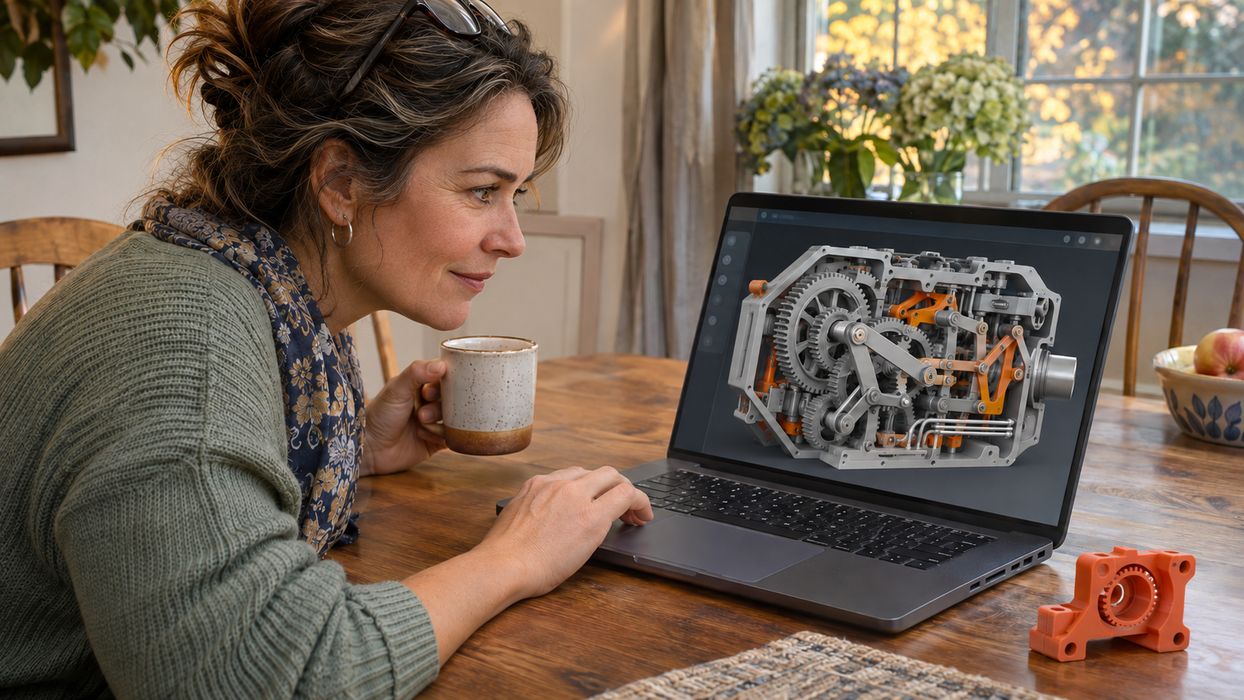
BenchCAD’s latest results are spectacular, and this has some implications.
Anthropic’s latest Claude Fable 5.2 LLM scored 0.835 with tools on BenchCAD 2.1, nearly double the 0.444 achieved by Claude Fable 5.1 in the same configuration. On BenchCAD’s standard 2.1 harness, Fable 5.2 scored 0.754. Either way, the improvement is so large that the trajectory is impossible to miss.
BenchCAD is a benchmark for AI CAD: code-based 3D modeling combined with professional hardware tasks. Its Core test includes 100 cases covering six tasks, including rebuilding parts and assemblies from engineering drawings or rendered views and wiring circuit boards. The model has to produce geometry and other design data that can be checked by human scorers.
That puts BenchCAD at the front end of a 3D printing workflow. CAD defines the object; a slicer turns that model into layers and then GCODE; the printer then builds those layers in filament, resin, or powder. If the CAD model is wrong, the printer will faithfully produce a bad object.
The latest result is really interesting because Anthropic’s Fable 5.2 is creating relatively complex designs. In work with Diode Computers, the model designed a speakerphone, a voice-assistant hub and a handheld virtual pet. It selected components, routed circuit boards, modeled 3D printable enclosures, wrote firmware and kept track of many constraints including clearances, antenna placement and the fit between the PCB and the case.
The 0.835 result came from Claude Code, Anthropic’s own tool harness, while the standard 2.1 result was 0.754. BenchCAD says scores from different harnesses aren’t comparable, and its 2.1 release is not directly comparable with 2.0.
Fable 5.2’s score rose to 0.835 when the system gained better geometric reasoning and the ability to inspect, revise and rerun its work. The model could recognize that a layout was failing, toss it and then try again. That is actually close to what humans do when engineering a design, a more sophisticated process than just generating a shape as many text to 3D systems do today.
If this trajectory of improvement continues, basic CAD designs will soon become routine: brackets, adapters, enclosures, replacement parts and fixtures generated from a description or a sketch. The hard part of the development process might just change from learning the complex CAD software to instead the skill of explaining exactly what you want and checking whether the result is fit for purpose.
These high benchmark scores does not prove that whole machines or complex assemblies being automatically created are only months away. But the improvement is so rapid that using AI-generated CAD for complicated systems within months or a year no longer sounds totally ridiculous. It sounds a lot more plausible.
Remember, this isn’t a binary thing: we will see improvement gradually, step by step. At some point we will look back and say, wow, we’re there.
For 3D printing, that could trigger a huge expansion of usage. Almost anyone could be able to create a functional physical object, and eventually a machine, without mastering a CAD software tool.
There is only one problem: you still need a 3D printer. Sales will go up.