
A research team has shown an FFF printable plastic composite that moves heat so well it starts encroaching on “metal only” performance — while still staying electrically insulating.
Why Thermal Dielectrics Matter In AM
In electronics, heat is usually handled with aluminum or copper, and increasingly with metal additive when engineers want complex heat sink shapes. That works, but metals come with two common drawbacks: they conduct electricity (not always welcome around crowded circuits), and they strongly interact with radio frequency (RF) signals (bad news near antennas, radar, and RF sources).
That has pushed interest in thermally conductive polymer composites: plastics loaded with ceramic particles that conduct heat but still act as dielectrics. These materials can be lighter, avoid shorts, and remain RF friendly, and they can potentially be shaped with relatively accessible processes like FFF.
The catch is that most FFF friendly versions have been stuck at modest thermal conductivity. You can add more filler, but at some point the filament becomes difficult to extrude, prints become unreliable, and parts end up with internal voids that hurt heat flow.
Different Fillers Produce Different Results
The work, from Northeastern University and the US Army Research Laboratory (DEVCOM ARL), focused on hexagonal boron nitride (hBN) as the filler. hBN is attractive because it can conduct heat very well while remaining electrically insulating. However, it tends to work best when its plate like particles are aligned and connected into a continuous pathway.
The team iterated through 23 formulations and landed on a composite they call G7c: a PLA based matrix loaded with 45 vol% hBN. They did not rely on a single particle size, but instead used a blend of larger platelets (tens of microns) and very small ones (sub micron). The idea is quite intuitive: the big particles help form longer heat pathways, while the small ones help “fill in” around them.
They also treated the surface of the larger hBN particles and added a small amount of plasticizer (epoxidized soybean oil) plus an antioxidant. Those tweaks were not just for handling; they enable the process step that seems to make the big difference.
After printing, they annealed the parts at a temperature range that lets the polymer reorganize without melting. This post processing reduces internal defects and increases crystallinity in the PLA, but more importantly it appears to grow polymer crystals from the treated hBN surfaces. Those crystals can form bridges between nearby platelets, effectively creating extra thermal connections that you do not get straight out of the nozzle.
The Results And The Practical Friction
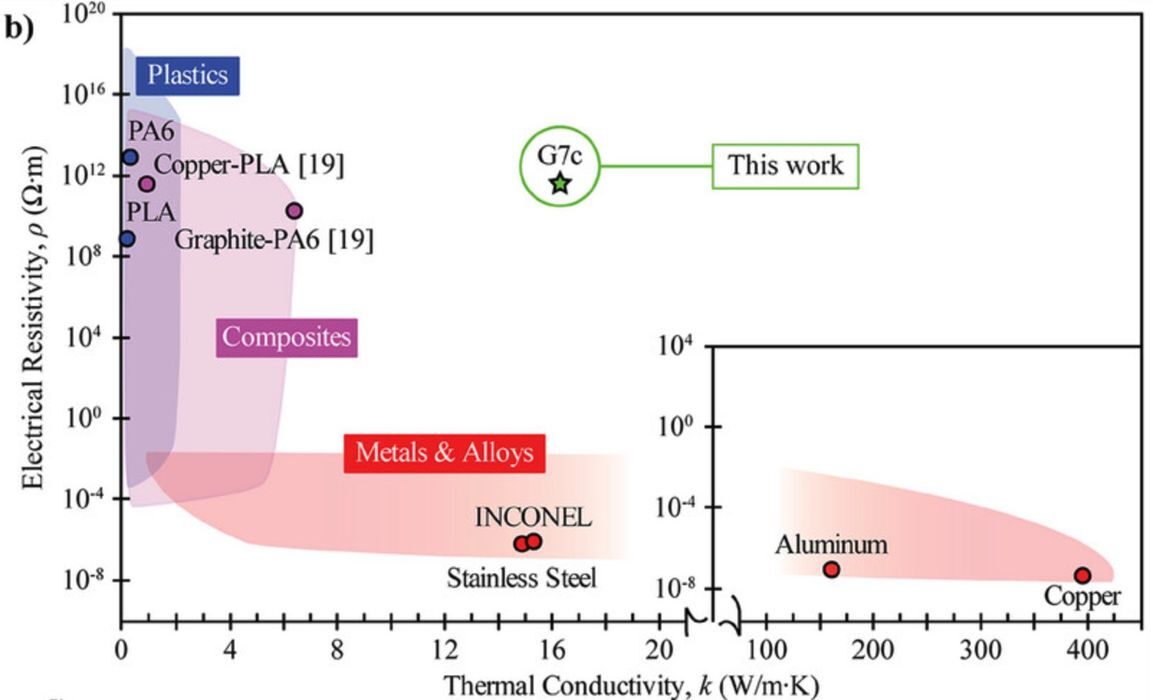
With the right print orientation and the anneal step, they reported a “strong axis” thermal conductivity of 16.3 W/mK. The paper’s authors say that is far beyond typical commercial FFF composite filaments, and near some metals’ thermal performance ranges.
They also measured RF relevant dielectric behavior. At 10.8 GHz, they report a dielectric constant around 3.48 and a low loss tangent of 0.0016 for the printed composite. That matters because a metal heat sink placed near RF structures can behave like an unwanted reflector or detune nearby elements.
Printing this material was not plug and play. The filament’s high thermal conductivity increased heat creep risk in the hot end, so extra cooling was required at the heat break.
The abrasive, high filler load also caused feeding wear issues under standard drive gears, forcing changes to the feed mechanism.
Their example print used a large 1.2 mm nozzle at 250C with a 65C bed and 250 micron layers, emphasizing that high solids composites may demand “industrial mindset” printing even on familiar machines.
Next Steps
Two limitations stand out. First, the matrix is PLA, so the part’s safe operating envelope will be bounded well below true high temperature electronics environments; the paper suggests use below about 150C. Second, the impressive conductivity is anisotropic, meaning designers will have to think about print direction, toolpath planning, and post processing as part of the thermal design, not as optional finishing steps.
If those workflow pieces can be packaged into a repeatable recipe, this could become a useful niche: printable, RF friendly, electrically insulating thermal spreaders for electronics where metal is inconvenient.
