
Infinity Flow produces a series of automation solutions for desktop 3D printers.
The company is quite new, appearing only in 2024. Their origin story is classic:
“Infinity Flow 3D Printing started as a senior project at Purdue University, driven by our passion for 3D printing innovation. We developed an automated printer that revolutionized the process, earning the Malott Innovation Award and second place in the Manufacturing and Validation Awards.
Inspired by this success, we recognized the potential of our filament switcher to transform how enthusiasts and professionals manage their printing tasks. This led us to establish Infinity Flow Printing, with a mission to create user-friendly automation devices that simplify and enhance the 3D printing experience.”
Today they provide a number of different hardware and software products to aid production using 3D printers that weren’t necessarily designed for production use.
S1 Plus Automatic Filament Loader
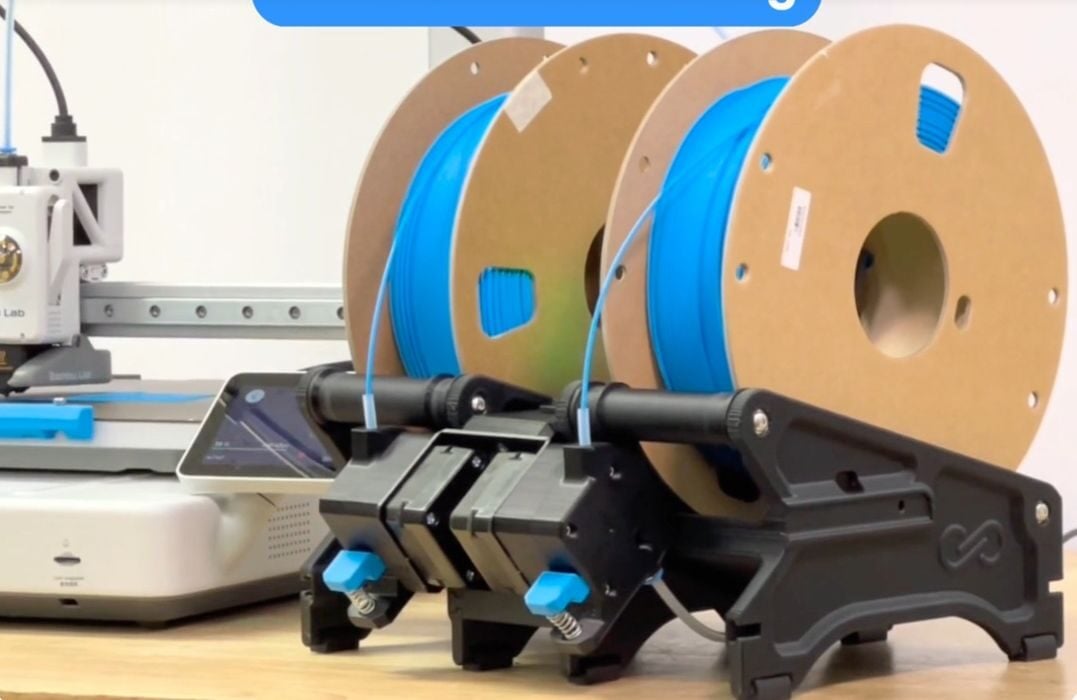
Their key product is the S1, a system to continuously provide filament to a desktop FFF 3D printer. As you can see in the image at top, it’s a dual spool affair. The idea is that the printer is fed from one spool, and when the spool runs out, it automatically switches to the second spool. This happens without pausing the print job, and all filament switching occurs in the S1 Plus.
Once a switch occurs, an operator can swap in a new spool for the empty one, guaranteeing a continuous supply of filament to the printer.
This is identical to features I’ve seen on far more expensive production FDM systems from Stratasys, where there are two spool canisters that act in the same way. However, here the S1 Plus works on any desktop FFF 3D printer. It’s just filament being fed to the printer.
Now there’s a question I’m sure you’re thinking about: why would you need this? Any desktop 3D printer would complete even a large job before needing a second spool. Aside from switching near-empty spools, there is another very important function here.
That’s where the second interesting product from Infinity Flow comes in: FlowQ.
FlowQ Cloud Service
FlowQ is a cloud-based software system that is used to operate a network of 3D printers. They use secure, end-to-end encrypted network tunnels to connect a printer to their cloud, so there are lowered security concerns.
The service provides the ability to dispatch jobs remotely, monitor operations, store files, queue jobs, and even track filament usage.
The key is that it is able to use 3D printers that have “any” bed clearing mechanism. These would be approaches like the “tilt and strike” approach shown here, or plate changing systems, such as the PlateCycler, which we reviewed last week.
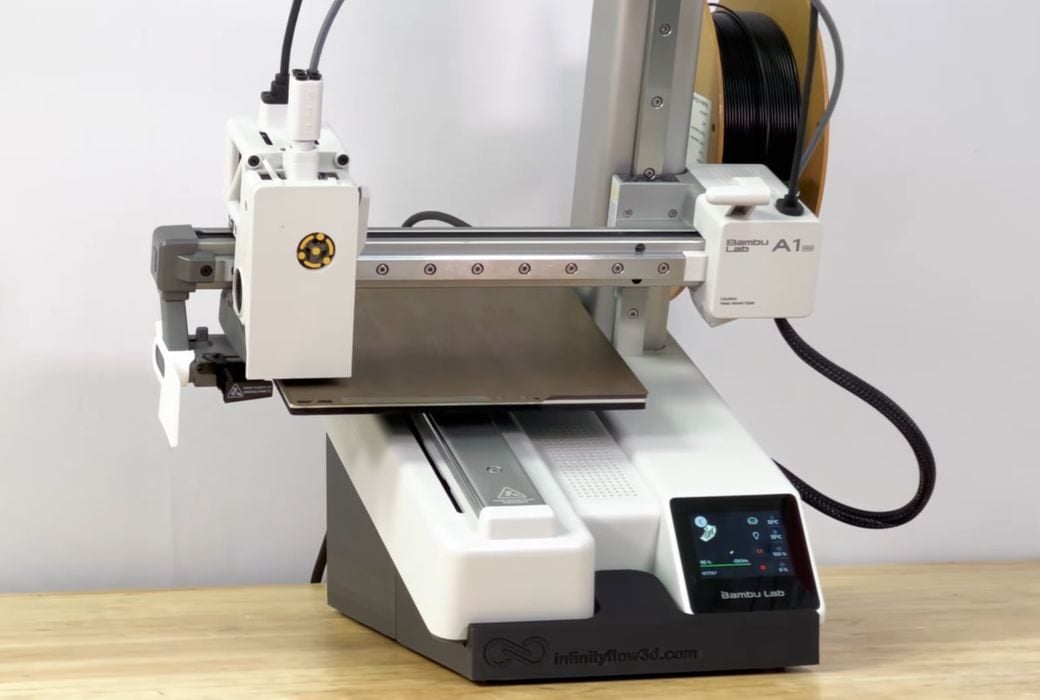
These systems allow the 3D printers to operator more or less continuously. When one job finishes, FlowQ can then automatically dispatch a second job.
However, this works only if the machine also has filament ready to go. That’s where the S1 Plus comes in — it provides that filament, at least for two spools worth of material. Note that the S1 Plus comes in a couple of variants, one of which can handle 5kg spools.
In other words, you could potentially have a single 3D printer produce ten kilograms of parts without any human intervention. Impressive!
FlowQ is a subscription service, and they currently charge US$6 per month per printer. That should be substantially less than the cost of hiring operators to run around manually managing the equipment, if you have many machines.
If you’re looking into continuous 3D printing, Infinity Flow seems to have some of the systems and services you might need.
Via Infinity Flow
