
Here’s an interestingly simple idea: don’t blend TPU and PLA together. Just stack them.
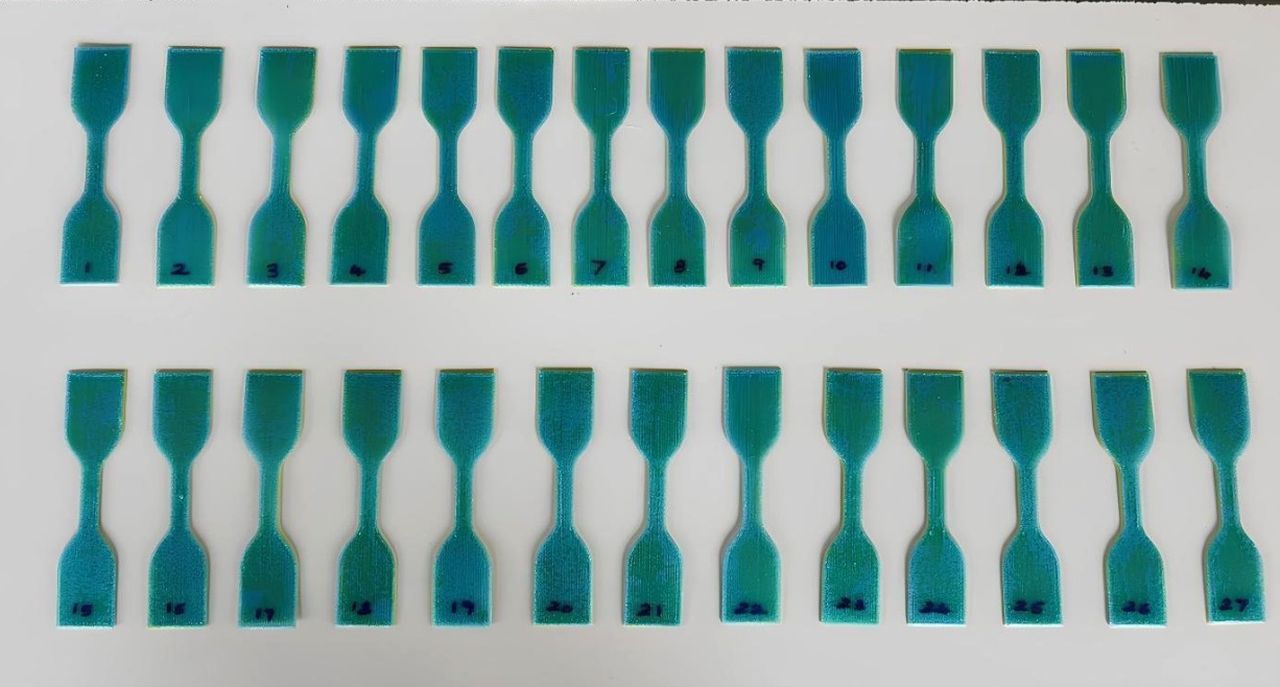
Researchers at Chaitanya Bharathi Institute of Technology in Hyderabad tried exactly that, using an AKAR 600 PRO dual-extruder FFF machine to print tensile test coupons from alternating layers of TPU and PLA. Each specimen used an equal ratio of the two materials, but not as a mixed filament. Instead, the part became a kind of polymer sandwich, with rigid PLA and flexible TPU taking turns through the build.
Blending polymers can get messy very quickly. The materials have to be compatible, evenly dispersed and predictable after extrusion. “Just blend them” often turns into a long troubleshooting session.
Layering is a more straightforward approach. Any conventional dual-extrusion machine can do it, provided it can switch nozzles cleanly and handle purge routines without making a mess. No special compounded filament is required.
Why Layer TPU And PLA?
PLA brings stiffness, but it tends to fail in a brittle manner. TPU brings flexibility, toughness and abrasion resistance, but it’s not the material you’d normally choose when a part must stay rigid.
Put them together in layers and you get another design knob to turn. Instead of choosing “rigid” or “flexible,” the designer can begin to place those behaviors through the thickness of the part.
That could be useful for things like protective housings, energy-absorbing inserts, grips or custom wearable parts. Alternating whole layers is a fairly blunt way to do it, but it’s easy to see where this could go. A future slicer might vary the material sequence by region, load path or expected flex point.
The researchers tested quite a few print settings using a Taguchi L27 design. They varied layer thickness, print speed, TPU nozzle temperature, PLA nozzle temperature, shell count and bed temperature. For each of the 27 parameter sets, they printed three ASTM D638 tensile specimens, giving them 81 tensile-test data points.
The best result came from a 0.18 mm layer height, 45 mm/s print speed, TPU/PLA nozzle temperatures of 240/230C, four shell layers and a 55C bed. That specimen reached 40.795 MPa tensile strength and a Young’s modulus of 1.188 GPa.
That’s a respectable result, although the winning recipe won’t shock many experienced FFF operators. Finer layers usually mean more bonded interfaces and fewer voids. Slower print speeds give the material more time to fuse. Higher nozzle temperatures can also help bonding, although they bring the usual tradeoffs: ooze, stringing, dimensional trouble and possible PLA degradation if pushed too far.
The Machine Learning Catch
The researchers also trained several machine learning models to predict tensile strength and modulus, including Linear Regression, Random Forest, Support Vector Machine, AdaBoost and XGBoost.
XGBoost came out on top, with reported R2 values of 0.9988 for tensile strength and 0.9971 for modulus. On paper, that looks almost too good.
And that’s where the catch appears.
The dataset included only 27 unique print parameter combinations, with three repeated samples for each. The train-test split was 80/20. If repeated samples from the same print condition landed on both sides of that split, the model may have been tested on recipes that were very close to ones it had already seen.
This doesn’t make the work useless. Far from it. It suggests that machine learning can help navigate dual-material FFF settings, especially when the relationships between temperature, speed, shell count and layer height don’t behave in a simple linear way.
But it does mean the near-perfect prediction scores should be treated carefully.
There are other missing pieces, too. The study did not cover elongation at break, impact behavior, fatigue, interfacial fracture behavior, moisture conditioning or print orientations beyond those tested. For a TPU/PLA laminate, those could be important. If the whole point is combining stiffness with flexibility, then repeated flexing at the material boundaries may be one of the first things an operator would want to understand.
FFF users already think constantly about infill, walls, layer height and print orientation. This work suggests that, for dual-extrusion systems, material layering could become another powerful design parameter.
