
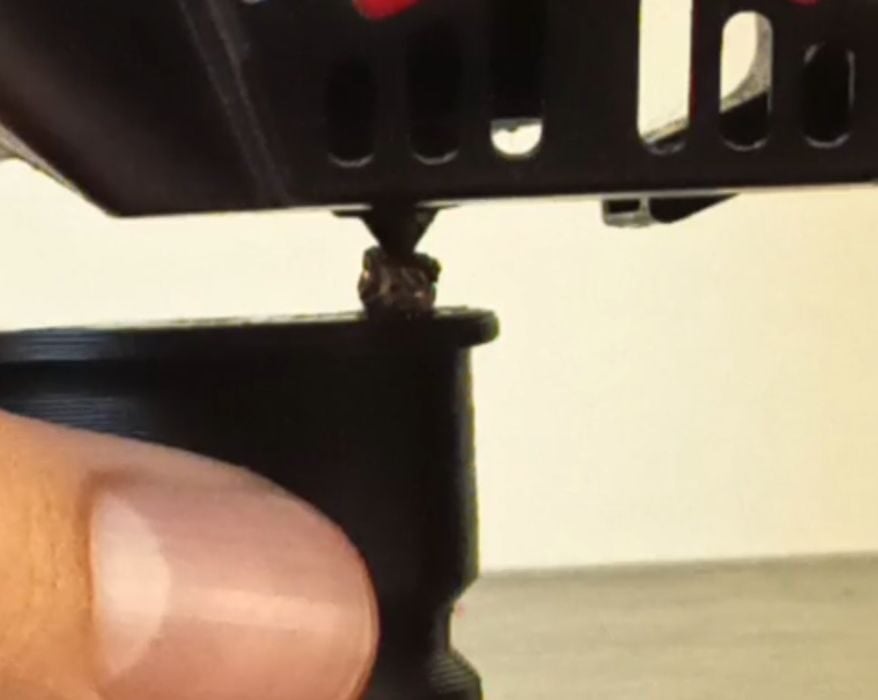
I’m looking at an unusual method of placing threaded inserts into 3D prints.
Threaded inserts are quite popular in some 3D printed projects. The idea is to insert a threaded nut into the plastic structure, where later it will accept a bolt, typically to attach components together.
Placement of the threaded insert is done in a couple of ways. One easy way is to design a hexagonal void, and pause the print job when the void is fully formed. Then drop in a hex nut, and continue to job to cover over the top.
Another method is to use heat. The part would have a small hole where the insert is to be placed. The insert is heated so that it will soften the plastic and be pressed into the hole. The plastic will cool down and tightly grip the insert.
Usually the heat is provided by a handy soldering iron. The iron heats up the insert, which is then grabbed by pliers and placed as above.
Recently I saw someone attempting to do the insertion with their FFF 3D printer directly. At top you can see an image of what they attempted to do. If you watch the video it’s quite awkward, with the insert tipping over. Commenters asked why they didn’t just use a soldering iron, which would probably be easier to do.
Very likely the poster didn’t have a soldering iron, leaving the 3D printer’s hot end as a substitute.
Would this approach work? After thinking about it, I think this could be quite useful, if some extra functionality were created.
In the video you can see the part wobble due to the entirely handheld operation. That’s not accurate and could very likely damage the part.
But what if this process were automated a bit? What if the following were done automatically:
- The hole would be printed in a way to hold the insert perfectly oriented before heat was applied
- A jig was printed to position the part precisely on the print plate so that the hot end would hit the center of the insert
- GCODE was written to heat up the nozzle, lower down to the insert and apply heat for a specific interval
- GCODE would then press the insert down the exact distance required to flush mount the insert
I think this is all possible to do. While it might seem less speedy than using a soldering iron, it could be more scalable — and accurate.
Imagine if you had a dozen parts on the print plate held in place with a jig. If you dropped inserts into holes on all twelve parts you could then launch the GCODE to precisely insert all of them. That could indeed save time and provide near perfect, uniform results.
Unfortunately, I don’t believe there is any system to do this. But it is something that could be considered by a 3D printer manufacturer as a new feature for their equipment. Is any manufacturer listening?
Via Reddit
