
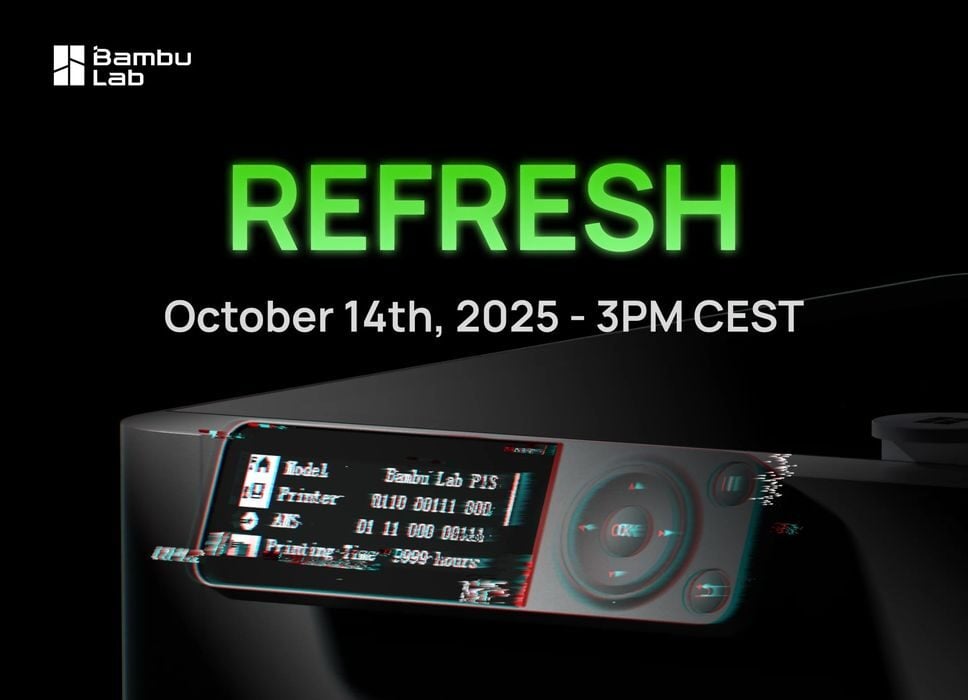
Bambu Lab just set a date of October 14th to announce the new P2S.
After rumours emerged of the company about to announce a new machine, they issued a cryptic announcement saying only:
“Powerful, yet simple.
Proven, yet innovative.
Familiar, yet full of potential.
The P1S legacy continues — stronger than ever.
A new chapter for the ultimate workhorse.
The classic evolves.
P2S arrives October 14th.
Mark your calendars.”
This follows a week or so of hints, such as the P1S being out of stock, resellers suggesting a replacement machine was about to be announced, and more. In a way, this is not that big a surprise, since the P1S is one of the company’s older models.
The P1S also faces very strong competition from other brands, such as the Centauri Carbon, Kobra S1 Pro, and others. It was clearly time for Bambu Lab to push that platform higher.
But what exactly will the P2S include?
We can’t see much at all from the cryptic image they posted because it’s a shot of a P1S. The image does have some shaky noise, suggesting that Bambu Lab realizes the days of the P1S are closing.
Let’s do some speculation.
The P2S will clearly attempt to fit into the P1S’s market niche. That would be for a CoreXY, enclosed system that is not specifically designed for abrasive engineering materials. In other words, similar to competing machines in that class.
The P2S name includes a “2”, which seems to be Bambu Lab’s method of indicating the generation of machine. Their initial machines in all categories carried a “1”: A1, P1x, X1x, etc. The company moved to the H2D and H2S this year, which are second generation machines.
The first letter seems to indicate the platform style:
- A: desktop open gantry for consumers
- P: desktop enclosed machine with moderately sized build volume
- X: professional machine with moderately sized build volume
- H: professional machine with large build volume
Therefore we can expect the P2S to be an enclosed desktop device with moderate build volume. I would not be surprised if it’s identical to the P1S so that build trays can be reused.
Then there’s that last letter, the “S”. Comparing the H2D and H2S, the “D” means “dual extrusion” and the “S” means single extrusion. Therefore the P2S will sport a single nozzle, similar to the P1S.
As for the remaining machine characteristics, we’ll have to wait for Bambu Lab to deliver the details next week. However, I expect that some of the technology in the H series might make its way into the P2S.
In particular, I suspect the H2S extruder and toolhead could be a key part of the P2S. It’s quite functional and very easy to use.
Some suggest the P2S might be an H2S in a smaller format. I am not sure that will be the case, as the H series is reserved for professional use. The P1S was missing a number of features found on the X1C, and that’s likely going to be the case here too. For example, the H2S has a heated build chamber, but probably the P2S will not.
Nevertheless, the visual appearance of the P2S could closely resemble the H2S, except in smaller form.
Of course, we don’t have pricing either for the P2S, but as it’s replacing the P1S in a specific market niche, the price will probably be quite similar to the P1S. That price was US$1148, but recently marked down to US$869 in order to compete with aggressive alternative products. I am expecting a price in the US$800-1000 range.
Enough speculation; let’s wait and see what happens next week.
Via Bambu Lab
