
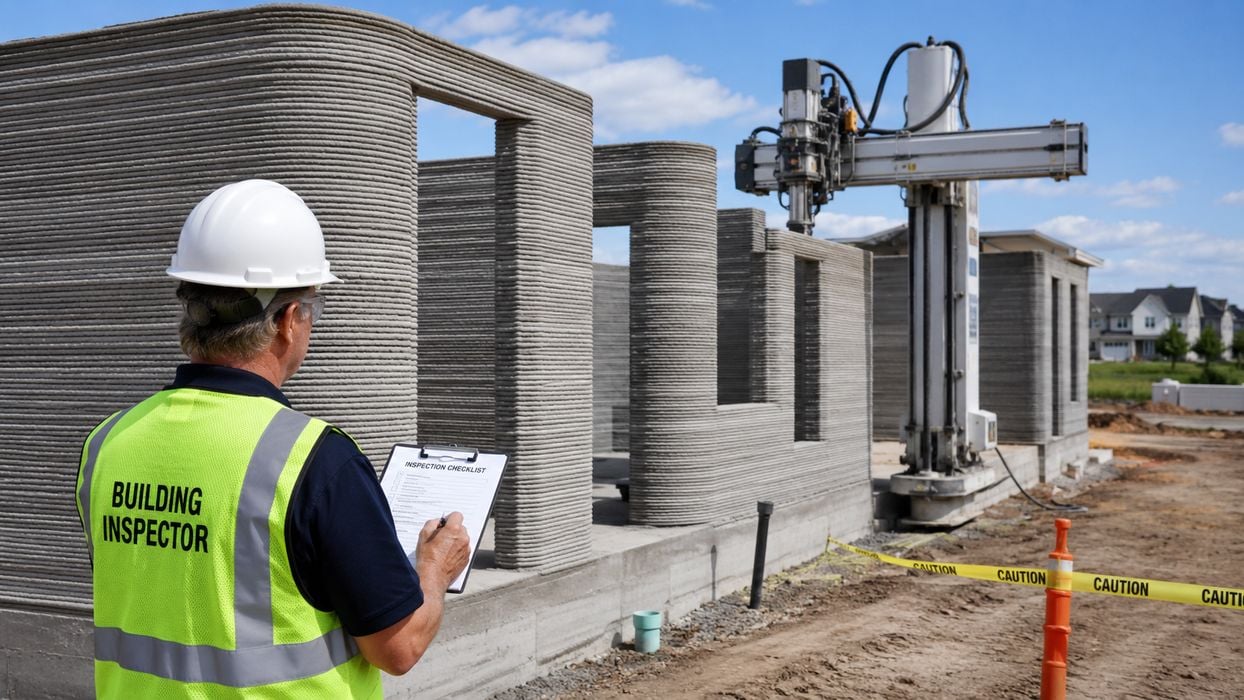
Regulation may be the least fun part of 3D printed construction, but it determines whether 3DCP can move past demonstrations.
3D concrete printing, or 3DCP, has never had much trouble generating attention. The process looks really impressive: a huge gantry or robotic system extrudes cementitious material layer by layer to form walls, often with cavities for insulation, reinforcement, utilities, or later filling.
That visual has helped 3DCP technology firms attract investors, municipalities, housing advocates, and plenty of media coverage.
But the real question has always been this: will the building authorities sign off on it?
For many projects, the answer has been “maybe”, but only after a lot of engineering paperwork.
Most 3DCP projects in North America have been approved through alternative means and methods provisions in building codes. That means the applicant must prove that the unusual method satisfies the intent of the code, even if the code does not directly describe the method.
That works, but it is a lot more work and is not exactly scalable.
A contractor, printer company, engineer, and local authority may be able to approve a specific house in a specific city. That does not automatically mean the same wall design, material, printer, or workflow will be accepted in another jurisdiction.
The basic regulatory challenge is that 3DCP is not simply “concrete, but printed”.
Conventional building codes understand cast concrete, masonry block, wood framing, steel, and other established systems. They assume known methods for reinforcement, inspection, curing, fire resistance, durability, and structural performance.
3DCP changes several of those assumptions.
Printed walls are built in layers. That raises questions about interlayer bonding, anisotropic behaviour, dimensional consistency, moisture movement, cracking, and long-term durability. The material itself is usually not your standard ready-mix concrete. It must be pumpable, extrudable, and stable enough to hold shape immediately after deposition.
Then there is reinforcement.
Traditional reinforced concrete has familiar rules: place the rebar, inspect it, pour the concrete, and verify the result. 3DCP systems may use inserted rebar, printed cavities with grout, post-tensioning, fibres, mesh, hybrid block-like assemblies, or other approaches. Some of these are quite sensible, but they must still be proven to regulators, who often have never seen anything like it.
This is where standards become really important.
The latest important development is the emergence of formal definitions such as ICC-ES AC509 and ICC 1150-2026, the latter being the International Code Council standard for 3D automated construction technology for 3D concrete walls. These documents give engineers and code officials a more consistent basis for judging printed wall systems.
But that does not mean 3D printed buildings are suddenly automatically legal everywhere.
It means the industry is moving from “please trust our test house” closer to “here is the standard we designed and tested against.” That is a lot better for builders.
In 2022, Montana approved a 3D printed wall system as a replacement for concrete masonry unit wall construction. Then, regulators were willing to evaluate the wall as a functional equivalent to a known construction method.
That is probably a practical approach for 3DCP adoption: not asking regulators to accept strange architecture, but showing them wall systems that behave like familiar assemblies. The answer could be code equivalency.
For contractors and developers, regulatory predictability is a lot more important than a flashy building design. A developer needs repeatable and predictable approvals, known inspection routines, accepted engineering methods, and standards.
For 3DCP vendors, therefore, need to provide a complete construction system: material, printer, wall geometry, reinforcement method, structural testing, fire testing, quality control, operator training, and documentation.
That is a lot more than just the machine itself.
But this could be a big advantage for some 3DCP companies. Companies that get evaluation reports and code-recognized system approvals could have a major advantage over others focusing on flashy designs.
For now, 3DCP is not being held back only by printers or materials. Regulation, certification, and inspection are just as important. It is the stage every serious construction technology eventually has to pass through: it’s not done until the paperwork is complete, as they say.
The good news is that the regulatory path is slowly becoming clearer. The bad news is that it still will take a long time to get there.
Via International Code Council and ASTM
