
Canon Production Printing has filed a European patent application for a different way to remove support material from UV inkjet 3D printed structures.
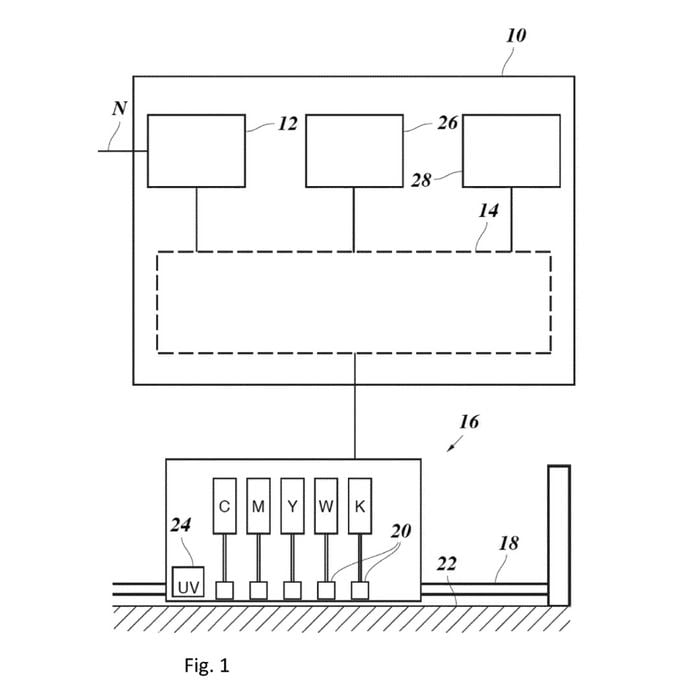
The patent describes a printing method, an ink set, an object, and an apparatus configuration for making 2.5D relief structures or 3D objects using two different ink compositions.
The interesting part is not the geometry. It is the chemistry at the interface between the model material and the support material.
Support Removal by Chemistry
Inkjet additive manufacturing can produce very fine, full-colour or textured structures, but it has the same old problem as many other 3D printing processes: overhangs need support.
In UV inkjet systems, support material can adhere firmly to the printed structure above it. That can make removal slow, messy, or risky. If the operator has to scrape, peel, bend, soak, or otherwise work at the support, post-processing time rises, and the part can be damaged.
Canon’s idea is to use different gellants in the support and structure inks. The patent specifies that the first ink composition, used for support, contains sunflower wax as its gellant. The second ink composition, used for the actual structure, contains a different gellant, preferably a fatty acid ester.
Both inks may be radiation curable, and the patent says curing can occur within two seconds after printing. That fits the general UV gel inkjet workflow: jet material, control droplet spread through gelling, then cure with UV radiation.
In other words, Canon is trying to make the support material behave differently enough from the build material that it can still hold the print during fabrication but detach more easily later.
Support removal is one of those tedious steps that determines whether a process is truly productive.
The example structures were small: 22 mm x 22 mm x 4 mm. The support was removed manually. In one experiment, the object was squeezed in the length direction to detach the support. In another, it was bent in the width direction.
The catch is that support behaviour is a balancing act. If the material detaches too easily, it may fail during printing.
The patent’s publication does not mean Canon will commercialize this exact method. Patent applications often reveal engineering directions more than product plans.
Many AM advances are sold around speed, resolution, or materials. But in production, the difficult steps often happen after printing. If Canon can reduce support removal from a careful manual operation to a quick mechanical release, that could make UV inkjet-based 3D and relief printing much more practical.
Via Espacenet
