

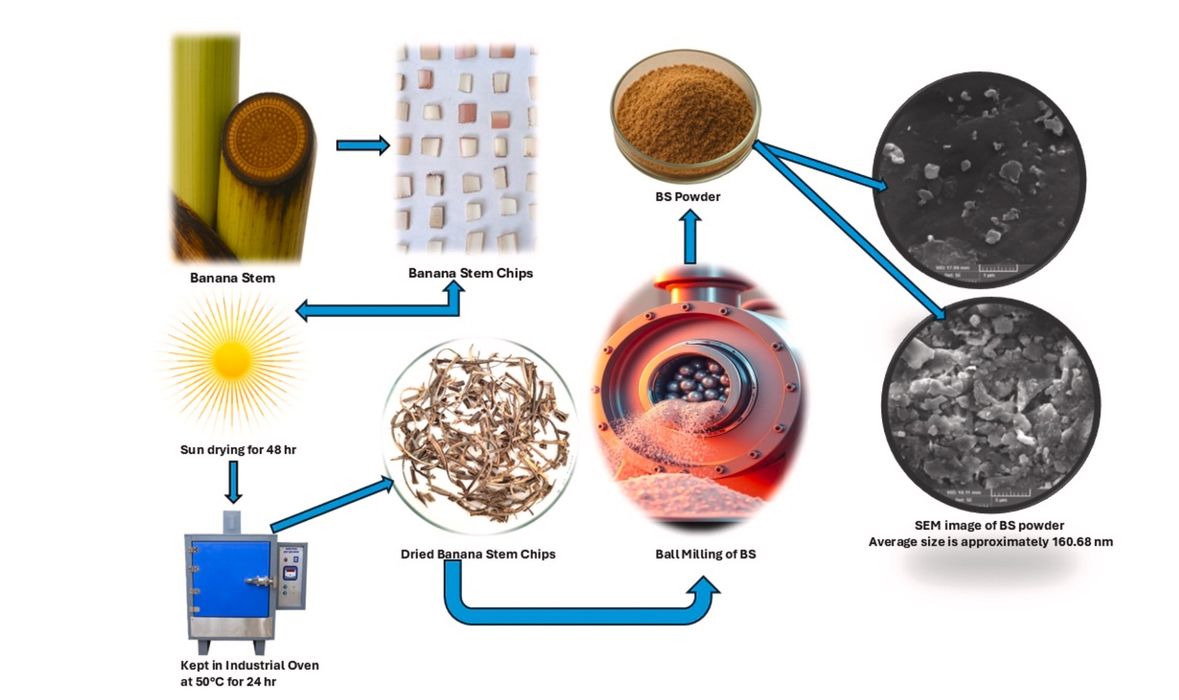
Banana plants become agricultural waste, and a new experiment checks whether it can be fed into polypropylene.
Banana pseudo-stem is one of the latest slightly nutty fillers researchers have tried in 3D printing materials. The field keeps testing whether common industrial and agricultural waste streams can incorporated into usable 3D print materials.
This experiment didn’t fail outright. The material printed. But it did not make the polymer any stronger.
Harsh Satiya and colleagues dried and ball-milled banana pseudo-stem, blended it with PP and 10 wt% polypropylene-grafted maleic anhydride (PPgMA) compatibiliser, and compounded the mixture twice in a twin-screw extruder. They made formulations containing 0, 1, 3 and 5 wt% banana powder, then extruded filament and used it to print tensile and impact specimens. The printer ran at 200C with a 0.4 mm nozzle, while PP tape on the glass bed was used to stop warping, which PP is notorious for.
A new filament is good only if it survives the printing process. In this experiment, above 5 wt% filler the filament maker nozzle choked. The paper therefore tests a pretty narrow test window for the plant waste.
At 1 wt%, banana powder did alter the polymer in an interesting way. It acted as a heterogeneous nucleating agent: small, well-dispersed particles gave polypropylene chains places to start forming crystals. The PBS1 composite reached 27.8% crystallinity, compared with 20.1% for plain PP, and its crystallisation temperature rose from 110C to 117C. Thermal degradation still occurred mainly between 350C and 500C, well above the printing temperature.
But it turned out that better crystallisation did not translate into better printed parts. Tensile strength dropped from 26.0 MPa for plain PP to 17.4 MPa for the 1 wt% composite, then to about 15 MPa at 3 wt% and 12.0 MPa at 5 wt%. Impact strength followed the same trajectory, falling from 27.0 J/m to 18.1, about 15 and 10.3 J/m.
A microscopic investigation showed why this happened. At 1 wt%, the banana particles were relatively well dispersed. At 3 and 5 wt%, they re-agglomerated into clusters measuring roughly 5–30 micrometres. Voids, pull-out cavities and weak interfaces then gave cracks easy starting points. Then the FFF process added its usual problems: layer adhesion and porosity.
Injection-moulded specimens far outperformed the FFF versions at every composition, and that’s a reminder that the material and the process cannot be separated. High-pressure moulding consolidated the polymer into a denser, more isotropic structure. The printed version preserved the weaknesses of both the composite and the layer-by-layer build.
So where does this leave bananas in the 3D printing industry? Probably not with a stronger general-purpose PP filament. The paper suggests a very narrow market: lightly filled material for parts where agricultural-waste content is more important than maximum strength. At 1 wt%, however, only a small fraction of the PP material has been displaced, so it would be minimal savings at best.
This experiment didn’t result in a practical outcome that could be used. However, this is how science is done: try something and see if it works. Here, banana stems did not do the trick.
Via Science Direct