

A pair of MIT graduates have developed a fun and clever way to minimize the amount of food waste sent to the landfill.
Biru Cao and Yiqing Wang’s FOODres.AI solution is an AI-powered desktop 3D printer that is designed to turn food scraps into functional household objects.
With a whopping 30-40% of the United States’ food supply thrown out, the 3D printer is not a systemic solution to food waste, but could offer individuals a creative way to minimize and reuse their own organic scraps and establish greater circularity in the household.
The FOODres.AI project was started through the framework of the MIT IDEAS program, a social innovation challenge that invites students to develop creative solutions to social and environmental challenges. Cao and Wang were interested in developing a technology that could effectively transform food scraps from the kitchen into functional products, like coasters, pen holders or other small-scale decorations.
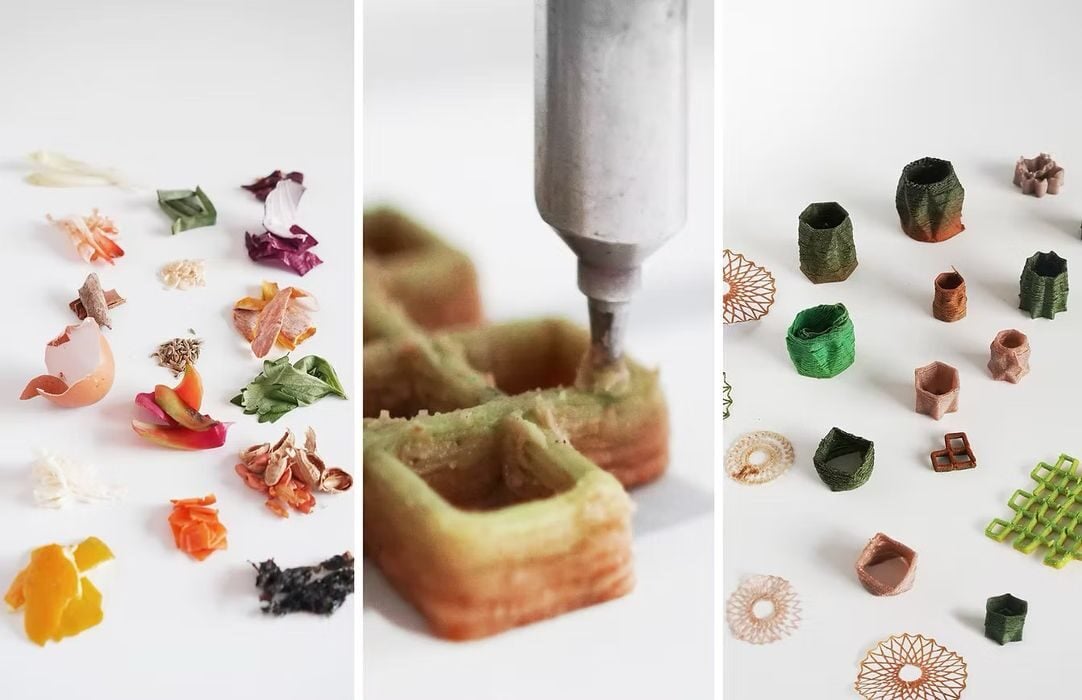
The FOODres.AI solution consists not only of a desktop extrusion 3D printing system, but also a mobile app powered by AI tools and a material mixing module. According to the makers of the 3D printer, “The machine and mobile app use AI to sort materials through the phone camera based on printable recipes. Users simply drop in food waste and select the desired form and size to print objects.”
Items like onion skins and egg shells are detected using a self-trained AI model through the user’s mobile app. This tool establishes the printability of the scraps and tells the user what organic materials to put in the built-in material processing module.
This module is key to the FOODres.AI solution, as it combines the food scraps with natural additives to create a printable bioplastic slurry. This material is then fed into the 3D printer, which deposits it onto a build platform using an extruder with automated heating and material refill functions.
Read the rest of this story at VoxelMatters
