
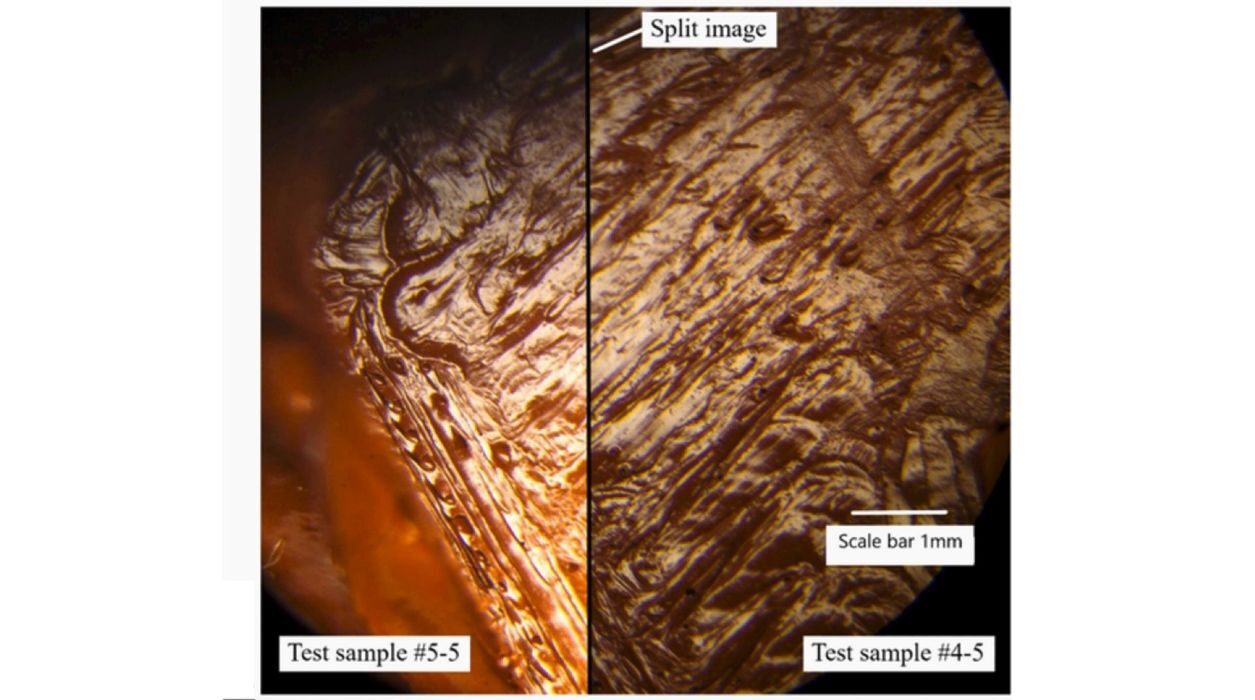
A research paper investigated the possibility of identifying the specific 3D printer that was used to produce a given part.
The research was triggered by Kirk Garrison, a criminalist in the San Bernardino County Sheriff’s Department. Garrison was concerned about the increasing frequency of “ghost guns” being used in local crimes. These are weapons made with certain 3D-printed parts, rendering them untraceable.
The question was whether it was possible to identify the source of the 3D-printed parts. This is commonly done with firearms, where the barrels produce a unique “signature” on bullets. Could something similar be done with ghost gun parts?
Evidently, Garrison undertook a significant amount of personal experimentation to see if this was at all possible. Ultimately, this resulted in the research paper, ”An exploratory study of topographical signatures within 3D fused deposition modelling using Polylactic Acid (PLA) filament”.
The method of analysis focused on marks in the extrusions generated by manufacturing differences in the nozzles of FFF 3D printers. This is very similar to the use of firearm barrels in identification processes.
The result of the study showed that there is some likelihood of identifying the source 3D printer, given a number of constraints. The study was able to identify a particular 3D printer in more than half the samples tested.
That shows some promise, but this seems to be far off from a practical capability. The detection ratio seems far too low to be considered as evidence, which I presume is the ultimate goal of the project.
There are other challenges. If the technique is based on nozzles, then it can be bypassed by switching nozzles. Nozzles are very inexpensive and are often changed anyway.
There’s another problem: wear. Use of carbon fibre or other reinforced filaments tends to wear out nozzles through abrasion. That abrasion, by definition, would change the inner surfaces of the nozzle, defeating detection. It could be as simple as running a CF print after each gun part is produced.
That said, most inexpensive desktop FFF 3D printers use brass nozzles, which are notoriously soft. They will wear out even if you don’t use reinforced filaments.
This work was a necessary investigation, but it seems pretty clear that it is not likely to yield a practical tool for authorities.
Via Science Direct and 404Media
