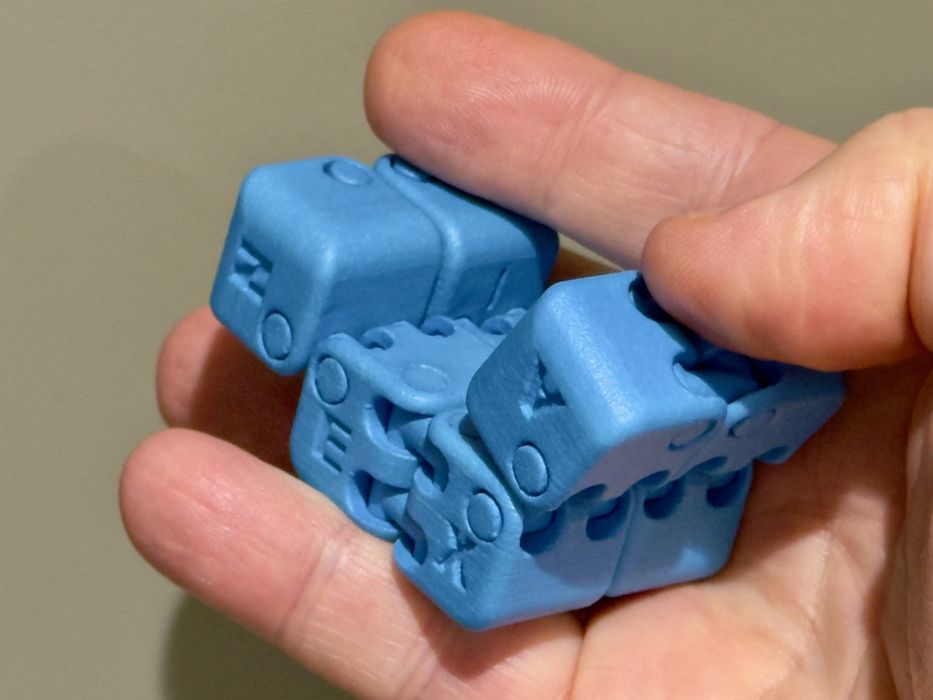
Charles R. Goulding and Preeti Sulibhavi describe why 3D printing proved to be the perfect manufacturing solution for customizable fidget toys that are making a meaningful difference for neurodivergent users.
At first glance, a fidget clicker seems almost too simple to attract much attention. Usually small enough to fit in the palm of your hand, these handheld devices produce a satisfying tactile “click” every time they are pressed. While they have become popular with collectors and hobbyists, their greatest value lies elsewhere. For many people with autism, ADHD, anxiety, or sensory processing disorders, fidget toys provide a safe, repetitive sensory experience that can improve concentration, reduce stress, and help regulate emotions.
Their popularity continues to grow as educators, therapists, and parents recognize their benefits. According to the U.S. Centers for Disease Control and Prevention (CDC), approximately 1 in 31 eight-year-old children in the United States has been identified with autism spectrum disorder. Autism prevalence has increased significantly over the past two decades, creating growing demand for affordable sensory tools that can support children and adults in classrooms, workplaces, and everyday life.
That growing market recently received mainstream attention after CNBC profiled North Carolina entrepreneur Victoria Baumann, who left her teaching career to build a successful business producing colorful 3D printed fidget clickers with her father. According to the report, the company generated over US$428,000 in revenue during 2025 after going viral on social media. While the business story is compelling, perhaps the more interesting aspect for the additive manufacturing industry is how desktop 3D printing made the entire venture possible.
Built Around Desktop 3D Printing
The business began with only a pair of desktop 3D printers before expanding into a small production operation capable of fulfilling thousands of monthly orders. Rather than investing hundreds of thousands of dollars in injection molding equipment, Baumann and her father were able to manufacture products directly from digital files.
Their production relies primarily on material extrusion, more commonly known as Fused Deposition Modeling (FDM) or Fused Filament Fabrication (FFF). These printers melt thermoplastic filament and deposit it layer by layer to create finished parts.
This manufacturing process has become the workhorse of consumer and small business 3D printing because it combines relatively low equipment costs with excellent flexibility. A quality desktop FDM printer can produce accurate, durable plastic components continuously with minimal operator intervention, making it ideal for entrepreneurs producing products in modest volumes.
Unlike industrial powder-bed fusion technologies such as Selective Laser Sintering (SLS), which fuse nylon powder using high-powered lasers, FDM systems require far less capital investment and are easier to operate from a home workshop or small studio. While SLS offers superior mechanical properties and eliminates the need for support structures, it is difficult to justify for a startup producing colorful novelty products in relatively low production volumes.
Instead, desktop extrusion systems provide exactly the right balance of affordability, scalability, and reliability.
Choosing the Right Plastic
Most fidget clickers are produced using common thermoplastics such as PLA, PETG, or occasionally ABS.
PLA remains especially popular because it prints easily, offers excellent dimensional accuracy, and is available in hundreds of vibrant colors and specialty finishes. Since many fidget toys emphasize playful aesthetics, manufacturers can select pastel shades, glitter-filled materials, translucent filaments, silk finishes, or even color-changing plastics to create visually distinctive products.
PETG offers increased toughness and impact resistance, making it attractive for products expected to survive years of constant clicking and handling. ABS provides additional durability but generally requires enclosed printers and more controlled printing conditions due to warping.
Because every product begins as a digital model, switching materials requires little more than loading a different spool of filament and adjusting print settings. That flexibility would be impossible using traditional manufacturing methods without substantial tooling costs.
Why Injection Molding Would Have Been Difficult
At first glance, injection molding might appear to be the logical manufacturing choice for a product selling in large quantities. After all, it dominates the toy industry.
However, injection molding depends upon expensive metal molds that can cost anywhere from several thousand dollars to tens of thousands of dollars for each design. Every variation in shape, size, or decorative detail generally requires new tooling.
That becomes problematic when a business thrives on creativity.
Many successful fidget toy companies regularly introduce new themes inspired by food, animals, seasonal holidays, internet trends, or popular aesthetics. A strawberry clicker may be followed by waffles, mushrooms, flowers, ghosts, pumpkins, or entirely new concepts only weeks later.
With desktop 3D printing, releasing a new product often involves nothing more than finishing a CAD design and sending it to a printer.
There are no tooling delays.
There are no mold revisions.
There is virtually no financial risk associated with testing new ideas.
If a design proves unpopular, production simply stops.
If demand suddenly explodes, additional printers can be added to the print farm.
That level of manufacturing agility represents one of additive manufacturing’s greatest competitive advantages.
Scaling with a Print Farm
As order volumes increase, businesses often transition from owning one or two machines to operating dozens simultaneously.
This distributed manufacturing model, commonly called a print farm, allows production to expand gradually instead of requiring massive capital investments.
Each printer becomes one production cell. If one machine requires maintenance, the remaining printers continue operating.
Modern desktop printers also feature automatic bed leveling, filament runout detection, power-loss recovery, and increasingly sophisticated monitoring software. Combined with remote camera systems and print management software, a relatively small team can oversee dozens of machines running nearly around the clock.
For products as compact as fidget clickers, multiple parts can be arranged on each print bed, maximizing machine utilization and reducing labor costs.
This incremental scaling strategy has become increasingly common among small manufacturers producing customized consumer goods.
Customization is the Real Competitive Advantage
Perhaps the greatest reason 3D printing was the correct manufacturing choice lies in customization.
Consumers increasingly seek products that feel personal rather than mass-produced.
A digital workflow makes customization almost effortless.
Designers can introduce new color combinations, engraved names, seasonal editions, limited releases, or experimental mechanical features without redesigning expensive production tooling.
The business also benefits from rapid design iteration.
If customers report that a click feels too soft, too loud, or requires less finger pressure, engineers can modify internal geometries, print a revised prototype within hours, and immediately begin testing.
Traditional manufacturing often requires weeks or months to implement comparable design changes.
For products centered around tactile experience, that rapid feedback loop becomes incredibly valuable.
A Perfect Example of Distributed Manufacturing
Stories like Baumann’s illustrate a larger shift taking place across manufacturing.
Rather than concentrating production inside massive centralized factories, desktop additive manufacturing allows entrepreneurs to manufacture locally using affordable equipment. Inventory becomes digital rather than physical. New products can be launched almost immediately, and production grows alongside customer demand.
This approach reduces financial risk while encouraging experimentation and creativity.
For niche products serving specialized communities, these advantages can outweigh the economies of scale offered by conventional manufacturing.
Research and Development (R&D) Tax Credit
Enacted in 1981, the now permanent Federal Research and Development (R&D) Tax Credit allows a credit that typically ranges from 4%-7% of eligible spending for new and improved products and processes.
Qualified research must meet the following four criteria:
- Must be technological in nature
- Must be a component of the taxpayer’s business
- Must represent R&D in the experimental sense and generally includes all such costs related to the development or improvement of a product or process
- Must eliminate uncertainty through a process of experimentation that considers one or more alternatives
Eligible costs include U.S. employee wages, cost of supplies consumed in the R&D process, cost of pre-production testing, U.S. contract research expenses, and certain costs associated with developing a patent.
On December 18, 2015, President Obama signed the PATH Act, making the R&D Tax Credit permanent. Since 2016, the R&D credit has been used to offset Alternative Minimum Tax for companies with revenue below US$50 million. And, pre-profitable, pre-revenue startup businesses can also obtain up to US$500,000 per year in payroll tax offsets and cash rebates for up to five years.
Baumann may have a credible IRC § 41 position for documented engineering-based development of new or improved fidget clickers. The credit case is strongest for material, geometry, print-parameter, prototype, and testing activities directed at functional performance.
More Than Business Success
It is easy to focus on the impressive revenue figures or the viral social media videos, but the broader impact is arguably more meaningful.
One former teacher recognized that small, thoughtfully designed objects could help people concentrate, self-regulate, and feel more comfortable during stressful situations. By combining artistic creativity with accessible desktop 3D printing technology, she transformed that idea into a sustainable business.
Along the way, she also demonstrated something the additive manufacturing industry has been saying for years: 3D printing is not merely a prototyping tool. In the right hands, it becomes a practical manufacturing platform capable of launching entirely new businesses.
Perhaps even more importantly, every colorful clicker produced on those desktop printers has the potential to make a classroom less overwhelming, a dental appointment less stressful, or a child with autism feel just a little more comfortable navigating the world.
That is a powerful reminder that sometimes the greatest impact of additive manufacturing is measured not in production volumes or machine specifications, but in the lives improved by the products it makes possible.